
Article — "Orders Flow Back to China and Automakers Bet Big on US: The Two Reshoring Stories in Conflict": Article — "Orders Flow Back to China and Automakers Bet Big on US: The Two Reshoring Stories in Conflict": Two headlines ran within days of each other in August 2026, and if you read them fast they look like they're from different planets.
Ford announced it would kill its China-built Lincoln — the Nautilus, made in Hangzhou — and shift luxury production home, expanding assembly in Louisville and Chicago. American car brands, the story goes, are fleeing China.
Same window: QIMA, which audits supply chains for a living, reported that North American clients' China share snapped back to 35% in the second quarter, reversing a Q1 rush into Southeast Asia. Companies, the other story goes, are fleeing back to China.
Reporters keep filing these as opposite trends — reshoring versus re-Chinaization, decoupling versus the failure of decoupling. That framing is wrong. They're the same decision, run through the same variable, and the map is just sorting itself along the seam.
Last week this column tracked the QIMA number in isolation — orders flowing back to Chinese suppliers as the "China plus one" math stopped penciling out. This week the interesting move is to hold that rebound up against the auto industry sprinting the other way, and ask what single logic produces both.
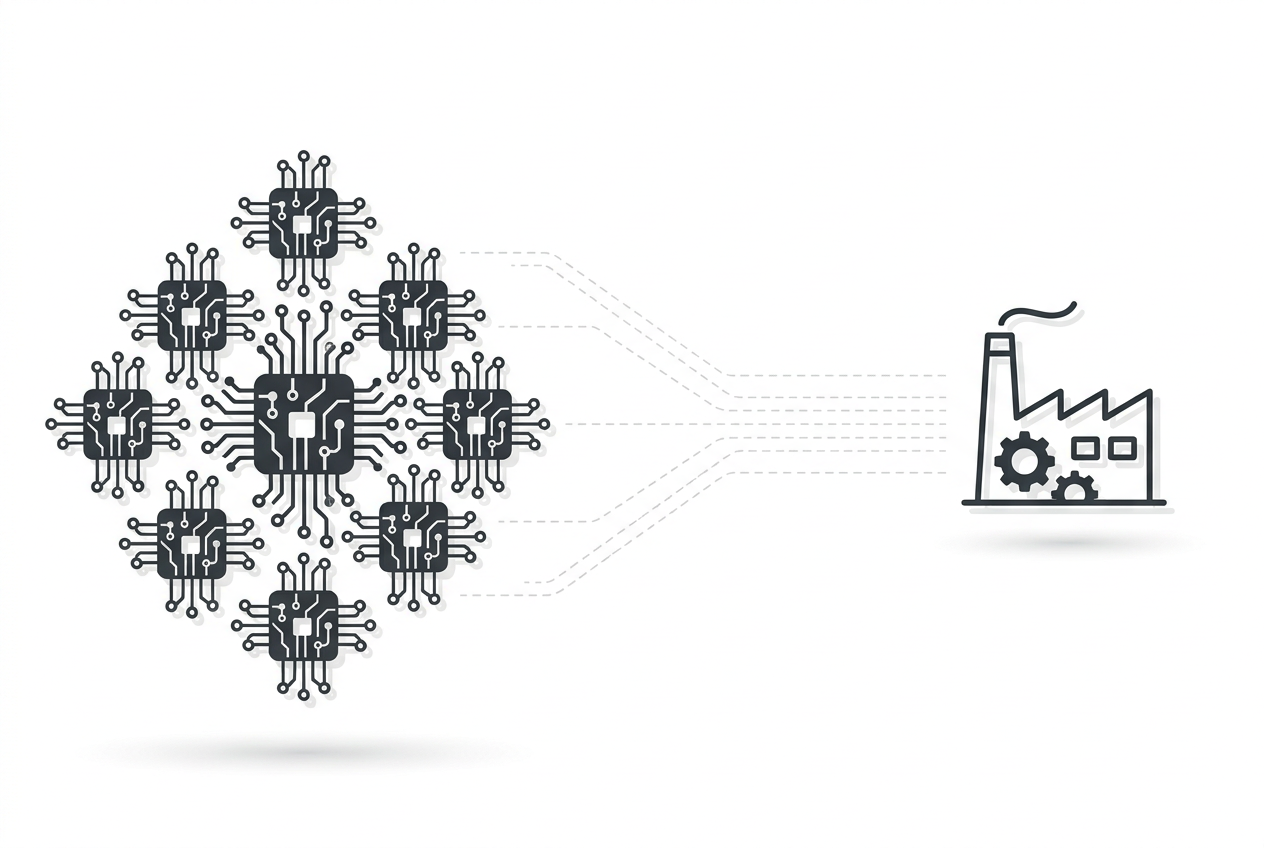
Here it is: you can move a factory, but you can't move the ecosystem around it. So the question every firm is actually answering is whether the thing it's relocating is one portable node or an entire web. Assembly reshores to America because it's cheap to move. Volume production returns to China because the cluster underneath it won't come with you.
You can move a factory, but you can't move the ecosystem around it. Assembly reshores because it's cheap to move; volume returns to China because the cluster won't come with you.
Start with the mechanism, because it's the whole argument.
Ding Yunchao runs Yilade Electronics in Dongguan. His firm opened a plant in Mexico, and in year three the local GM called with good news: they'd finally hit 60% of the efficiency the Chinese operation had shown three years earlier.
Sit with that. Three years of effort to reach a fraction of a benchmark that was already three years stale. And in those same three years, the Chinese plant kept improving — so the gap didn't close, it widened.
That's not a labor-cost story. Wages in Mexico and Vietnam aren't dramatically below China's once you account for everything. Ding's point is that when you set up in Mexico, you ship the materials from China and fly the technicians in from China, and those costs eat the arbitrage alive.
The thing you're paying for in China isn't cheap hands. It's density. Ninety percent of the world's printed circuit boards are made in Asia, more than half of those in China. Move your assembly to Vietnam and you're now waiting on Chinese components to arrive — and that wait is inventory risk, freight cost, and missed orders.
Then there's power. Vietnam's northern industrial belt — Bac Ninh, Bac Giang, Hai Duong — runs a chronic electricity shortfall around 30%, per the country's own grid operator. Textiles, furniture, appliances, consumer electronics, hardware: all showing orders drift back.
This is what "ecosystem gravity" means concretely. The suppliers, the skilled labor, the reliable grid, the sub-day responsiveness — that's the web. You can pick up one strand and carry it somewhere. You cannot carry the web.
SHEIN is the cleanest illustration of a firm reading its own math correctly. It reportedly cut its Vietnam warehouse footprint from 15 hectares to 6 and trimmed local staff — while committing over 10 billion yuan to a smart supply chain in Guangzhou.
Fast fashion lives on ultra-small batches at ultra-high speed. That model dies the moment you introduce a component wait, because trend cycles are shorter than the lead time. Panyu district's garment cluster in Guangzhou isn't a cost center for SHEIN; it's the product.
So volume production with a dense component cluster — electronics, apparel — snaps back. Not out of loyalty. Because the alternative is a factory sitting idle waiting for parts.
Now flip to the auto side, and watch the same variable produce the opposite answer.
Toyota is pouring billions into US truck production — $3.6 billion to move half of Tacoma output from Mexico to San Antonio, another billion into Camry and RAV4 in Kentucky and the Grand Highlander in Indiana, inside a plan to deploy up to $10 billion domestically through 2030. Ford, per Axios, is pulling Lincoln assembly out of Hangzhou and back to Louisville and Chicago.
Why does assembly move so freely when SHEIN's warehouse can't? Because final vehicle assembly is precisely the one node cheap enough to relocate.
A car's ecosystem lives upstream — in stamping, powertrain, and above all batteries. Bolting the finished thing together is the last, most portable step, and it happens to be the step with the highest political visibility. A ribbon-cutting in Texas is a photo op; a stamping supplier in Guangdong is invisible.
That's the trade every automaker is making: relocate the one movable, politically-exposed node, and quietly leave the immovable web where it is. These are high-margin, politically-loud goods — luxury sedans, flagship pickups — so the "Made in America" label carries a price premium and a policy win at once. President Trump called the Tacoma shift "a really big deal" and "Tariffs at work."
And here's the tell that proves it's one logic, not two: the same companies are re-coupling to China exactly where the ecosystem is unmovable.
The Big Three — Ford, GM, Stellantis — are deepening their dependence on CATL's lithium iron phosphate battery tech for the very US and European plants they're building to escape China. GM is reportedly relocating China-made vehicles to the US; Ford is diversifying its supply chain into Thailand, Vietnam, and Canada. Meanwhile Ford has been cancelling battery contracts with Korea's SK On and LG Energy Solution.
Read that carefully. The same firm, in the same strategy document, is decoupling assembly and re-coupling batteries — because assembly is a movable node and cost-competitive LFP cells are a web they can't reproduce at home yet.
That's not hypocrisy. That's the variable working exactly as described: relocate what's portable and visible, retain what's rooted and cheap.
CNN's read a month earlier was that automakers remained "resistant" to moving production home after a year of tariffs. That's the surface. Underneath, they're moving the one thing that's easy to move and holding onto everything that isn't.
Which reframes the whole "decoupling versus reshoring" argument. Adam Tooze's line — that years of US tariffs have "largely failed" to reduce dependence on Chinese suppliers — and the Fortune story about tariffs pushing companies back to China are describing the ecosystem layer. The Ford and Toyota headlines are describing the assembly layer. Both are true simultaneously.
Tariffs are not the deciding variable here. They're the accelerant that forced firms to finally do the math — and the math kept returning the same answer, sorted by portability. When de minimis went and the tariff gap between China and Southeast Asia narrowed, "China plus one" stopped covering the ecosystem penalty, so ecosystem-dependent orders came home to China. Where the ecosystem was portable and the politics loud, assembly went to America.
There's a coda worth watching. Chinese automakers like BYD and Geely, blocked from exporting into the US, will likely enter by building plants on North American soil — probably in the US directly, since Washington is already assailing Mexico as a "shadow transshipment" hub. Which means the next wave of US auto assembly may be Chinese-owned, running on Chinese battery chemistry, framed by Trump as a domestic win while members of Congress fume.
That's the bifurcation carried to its logical end. The assembly node keeps migrating toward political cover. The ecosystem keeps sitting where it always was.
The map isn't splitting into "reshoring" and "re-Chinaization." It's splitting along one seam: whether the web comes with you. It never does.