Article — "Tariff Wall Proves Both Inflationary and Porous as Import Prices Hit 18-Year High and Evasion Spreads": The effective tariff rate on US imports fell from a peak of 11 percent in late 2025 to just below 7 percent by May 2026. Four points of relief. And yet in July, import prices from China rose 0.9 percent in a single month — the biggest monthly jump since 2008 — while overall US import prices climbed 5.9 percent year over year.
The wall got shorter. The toll got higher.
That is not supposed to happen. Lower a tax, and the thing it's levied on gets cheaper, not more expensive. When the arithmetic runs backward, the number isn't wrong — the model is. The tariff wall is failing on its own terms, and it's failing in two directions at once.
The wall got shorter. The toll got higher. When the arithmetic runs backward, the number isn't wrong — the model is.
Last week we made the case that decoupling never actually happened: the schedule reportedly reshaped which segments of value chains serve the US market, though the evidence does not speak to the Chinese value-added inside them. This week the same architecture reportedly produces a second failure — it can't stop the goods from coming, and it can't stop them from getting more expensive. One design, two broken promises.
Start with the price paradox, because it's the load-bearing clue.
An effective rate is an average — total duties collected divided by total import value. It can fall for two very different reasons. Tariffs can come down. Or the mix of what gets counted can shift, as high-tariff goods vanish from the official ledger and reappear as something else.
If the second is happening, the effective rate drops precisely because evasion is working. The number arguably falls not because the wall got cheaper to cross, but because more traffic is going around it and never registering as dutiable at the full rate.
Meanwhile the goods that do come through — measured honestly at the border by the BLS import price index — cost more. The report indicated a decline was expected in July but import prices rose 0.3 percent instead, led by China. Strip out fuel and overall import prices still rose 4.5 percent year over year, per the St. Louis Fed, so this isn't an oil story.
So you get the signature of a leaky, expensive wall: the average toll falls as evasion drains the numerator, while the price of honestly-declared Chinese goods hits an 18-year high. Both readings are real. They describe the same broken structure from two angles.
Now the mechanism behind the leak.
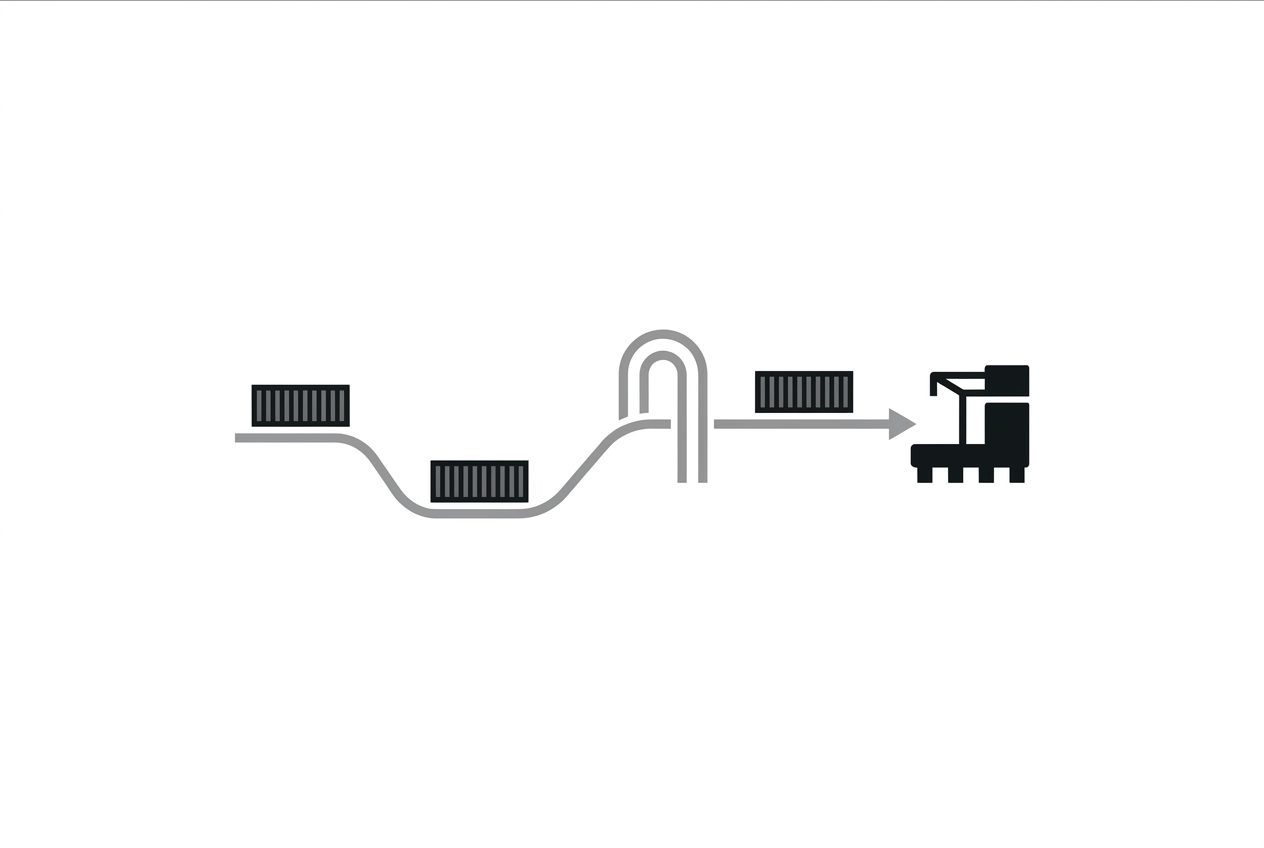
The White House's own Office of Trade and Manufacturing Policy, under Peter Navarro, published a report this month naming more than 40 countries as participants in what it branded the "Great Transshipment Scam" — a shadow logistics network relabeling, repackaging, and re-invoicing Chinese goods to launder their country of origin before they reach a US port.
The named enablers aren't fringe actors. They're the EU, Mexico, Canada, India, Japan, South Korea, plus Indonesia, Thailand, Malaysia, and Cambodia. The hardest-hit US sectors, per the report: electrical equipment, integrated circuits, aluminum products, motor components.
The administration puts the revenue loss at $19 billion to $26 billion a year. But the real hole is bigger. Last year, China's customs data and the US Census Bureau diverged by $112 billion — the gap between what China said it shipped to America and what America said it received.
That $112 billion gap is, arguably, the wall's porousness rendered as a single number. It is, on these figures, reportedly four to six times the government's own estimate of the leak. The goods left China. They just didn't arrive as Chinese.
And here is the part the administration won't say out loud: it built the incentive. Flexport CEO Ryan Peterson put it plainly to Fortune — "If your tariff was 0%, there's no need to commit fraud." Fraud is a function of the arbitrage gap. The bigger the gap between the China rate and the alternative, the bigger the payoff for making Chinese goods look like something else.
Which brings us to why the gaps exist in the first place — and why they're not accidents.
The Peterson Institute has been picking apart the schedule's internal logic, and it doesn't survive contact. Consider the stated rationale for tariffing brass instruments: goods containing copper get taxed to stimulate demand for domestic copper.
Fine. Follow that logic and commercial aircraft and aircraft engines are obvious candidates — they're stuffed with copper, and Commerce has already found that foreign aircraft producers threaten national security. Both the copper rationale and the national-security rationale point the same way.
Aircraft are not on the list. Brass instruments are.
PIIE argues, per the institute, that tariffing brass instruments and not commercial aircraft would show the selection has "less to do with copper demand stimulation" and "more with political considerations." Trombones are politically cheap to tax. Boeing's supply chain is not. The schedule tracks the map of who can complain, not the map of copper content or strategic vulnerability.
That's the tell. A schedule optimized for signaling and revenue theater — hit the visible, spare the powerful — will be riddled with contradictions, because coherence was never the objective. And every contradiction is a gradient. Every gradient is a route.
When the tariff on a "nonsensitive" product from a third country sits higher than the tariff on the same product from China, PIIE notes, companies have a reason to switch back and source from China again. When it sits lower, they route through that third country. Goods flow down the gradient. That's not evasion as moral failure; it's evasion as the rational response to a price map full of cliffs and valleys.
So the wall fails to redirect sourcing for the same reason it fails to stop evasion. Both failures come from the same incoherent selection. An arbitrarily contoured schedule doesn't build a barrier — it builds a topography, and goods find the low ground.
Which lands us on what Chad Bown has reportedly been describing — that some supply chains that moved out of China could find it advantageous to move back if tariffs on other countries end up too high.
The regime, on this reading, arguably faces three goals in tension: lower import prices, redirect supply chains away from China, and stop evasion — with the structure making it hard to secure all three at once. Cut China's tariffs to relieve the price pressure, and you erase the gradient that pushed supply chains out; they slide back to China, and redirection collapses. Keep China's tariffs high to hold the line on sourcing, and you preserve the arbitrage that feeds the $112 billion transshipment gap, and evasion wins. Try to hold both high and coherent, and prices stay at an 18-year high, which is the failure the data already shows.
There is no setting of the dials that satisfies all three, because the incoherence isn't at the margin — it's the operating principle. A schedule built on political salience rather than economic logic will always leave at least one arbitrage gap wide open, and at least one failure mode running hot.
That's what the impossible arithmetic was telling us. The effective rate fell four points and Chinese import prices hit an 18-year high not despite each other but because of the same thing: a wall too expensive to justify and too leaky to work.
The administration's answer is enforcement — AI at the border, countries "put on notice," the age of untraceable transshipment declared over. But you cannot enforce your way out of a gradient you designed. As long as the price map has cliffs, goods will keep rolling downhill toward the cheapest lie. The scam Navarro is hunting is the scam the schedule underwrites.