Two sources in this pile are looking at the same $265 billion and reading it in opposite directions.
A VC brief calls the Arizona build-out "quietly the most important line in this report," because "geographic diversification into Arizona also de-risks the entire AI supply chain from a Taiwan-contingency scenario." A portfolio-risk analysis, working the same numbers, says the thing being diversified away can be idled in weeks.
Both cannot be right. The reconciliation is the whole story.
One clock runs in weeks-to-idle; the other in single-digit-percent-of-revenue over years. The gap between them is what this piece is about.
Start with the two clocks, because they don't tick in the same unit.
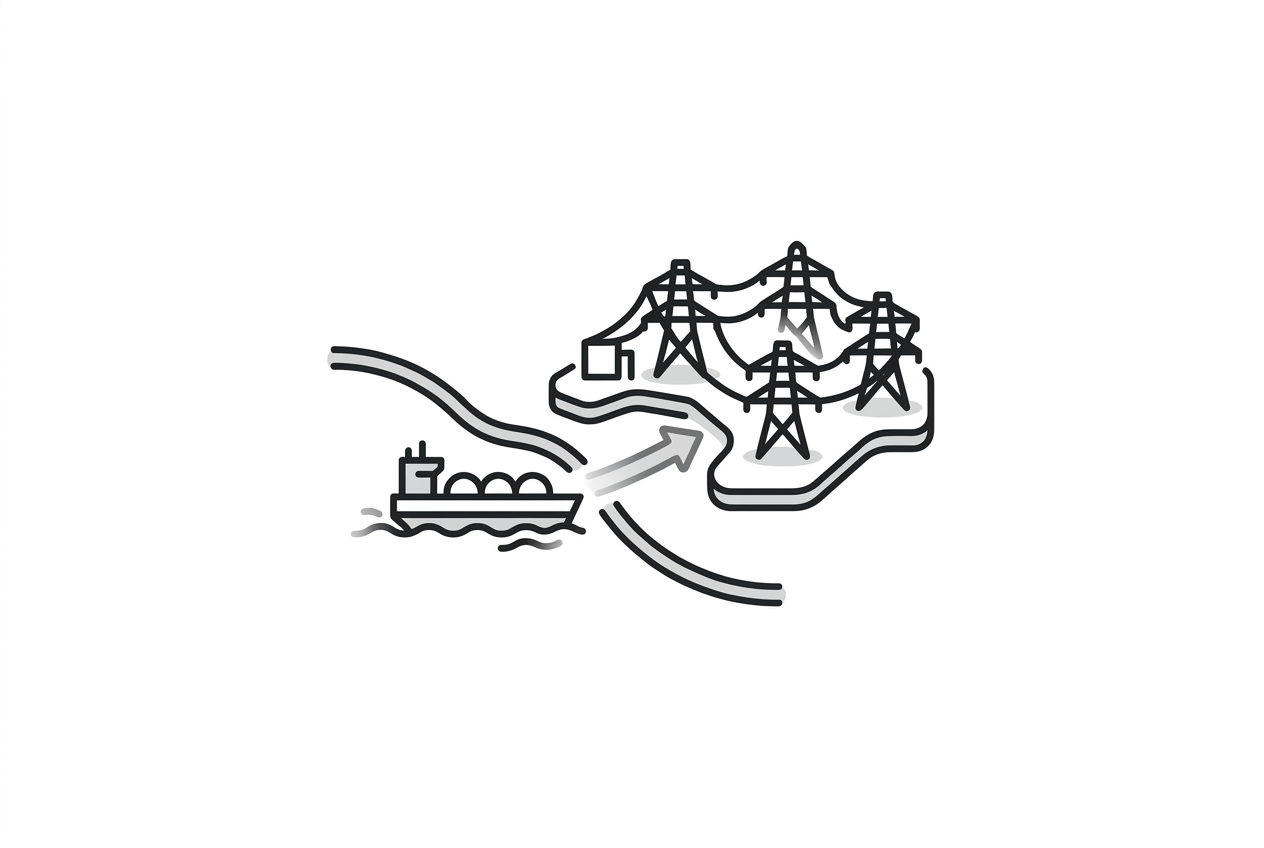
Clock one: a blockade of Taiwan doesn't need to be militarily decisive. It only needs to outlast an 11-day legal LNG reserve — with inventories generally hovering around 12 days, per StockWireX analysis — to starve the grid that runs the fabs producing roughly 90% of the world's leading-edge chips.
Taiwan imports 97-98% of its energy, with over 99% of oil and gas arriving by sea. LNG supplies 40-50% of power generation. The buffer is measured in days.
TSMC alone consumes about 8% of Taiwan's electricity today, a figure projected toward 24% by 2030 as advanced nodes scale. The vulnerability is concentrating into one corporate footprint, and that footprint runs on fuel that has to cross water China can pressure.
Clock two: Arizona. The largest foreign direct investment in US history, $265 billion, reportedly twelve facilities. Fab 21 Phase 1 is in volume production at roughly 92% yield — by one report slightly above comparable Taiwan lines, which is the part skeptics got wrong.
And it will supply, per TSMC's own numbers, about 2% of company revenue in 2025, rising to 4-5% by 2027.
These are not the same measurement. One clock runs in weeks-to-idle; the other in single-digit-percent-of-revenue over years. The gap between them is what this piece is about.
Line them up and the "de-risking" reading collapses on contact. If a blockade can dark 90% of leading-edge output before an LNG tanker misses a delivery, moving 4-5% of that output to Arizona by 2027 does not hedge the risk. It relocates a sliver of it.
The concentration figure that actually matters — the 90% of leading-edge fabrication sitting in Taiwan — barely moves this decade. You cannot replace weeks-to-idle exposure with a revenue slice that takes years to reach mid-single digits.
So if Arizona isn't insurance, what is it? Read TSMC's own margin guidance and the answer stops being about resilience.
US fab construction costs run four to five times Taiwan's. CFO Wendell Huang was explicit that dilution "will widen as the scale of overseas operations grows" — the company guides roughly two to three points of gross-margin dilution in early ramp, widening toward three to four points at scale.
TSMC is choosing, on purpose, to build the most expensive version of its own capacity. A company does not do that to hedge a tail risk it can quantify in days.
It does it for two reasons Huang states plainly. The first is demand: "We're seeing this strong-structure, multi-year demand, and we do not plan to leave any food on the table for anybody else."
That is not the language of risk management. That is a foundry with the clearest 18-24 month order book in the industry declaring it will build wherever the orders are, and eat the margin cost to keep them.
The second reason is sovereignty pricing — the part FourWeekMBA gets right. The $265 billion "is not primarily a capacity announcement. It is a governance action" — one that gives Washington a physical stake in sub-2nm production.
Consider the deal structure. In January the US cut tariffs on Taiwanese goods to 15% "in exchange for hundreds of billions of dollars in investment." Trump has attributed TSMC's US expansion to his tariff threats. Commerce framed the $100 billion as following "our historic deal on trade and investment with Taiwan."
Strip the press-release language and what's left is a transaction: Washington buys physical leading-edge capacity on US soil; TSMC buys tariff relief and political cover; both absorb a margin hit that eventually migrates up the stack into the price of every AI token.
That is demand-chasing plus sovereignty-pricing. It is not insurance against the LNG clock, and TSMC's own dilution math is the tell.
There is exactly one place where Arizona de-risks something real, and it isn't wafers. It's packaging.
The new commitment adds CoWoS capacity — Chip on Wafer on Substrate, the 2.5D packaging that connects a logic die to stacks of high-bandwidth memory. Every NVIDIA H100, B200 and GB200 ships on it. So does every AMD MI300 and MI400.
Without CoWoS, a fabricated accelerator die is not a shippable product. It is the single binding constraint currently controlling how many AI chips can be delivered.
TSMC has reportedly roughly doubled CoWoS capacity every year since 2023 and still can't keep up. The deeper bottleneck — ABF substrate for the redistribution layers — is projected to persist through at least late 2027.
So the Arizona packaging fabs close one genuine chokepoint on US soil, giving hyperscalers with domestic-sourcing requirements a route to accelerators that doesn't run entirely through Taiwan.
But notice what that does and doesn't fix. It relieves a capacity constraint. It does not relieve the geographic one, because the wafers those packages wrap are still overwhelmingly fabricated in Taiwan, still downstream of an 11-day buffer.
You can package a chip in Peoria, Arizona. If the die was fabricated in Hsinchu and Hsinchu goes dark, the CoWoS line in Peoria has nothing to wrap.
Which brings us back to the market, and to the tell in the tape.
On the rebound session, SanDisk jumped 14.27%, Micron 12.17%, AMD 8.11%, the SMH semiconductor ETF up 4.52%. TSMC itself is up around 48% year-to-date, valued near $2 trillion.
That is not a resilience trade. Nothing about the LNG buffer, the 90% concentration, or the years-long onshoring ramp changed on that session. Nvidia reportedly posted $81.6 billion in quarterly revenue, up 85%; TSMC guided full-year growth above 40%. The market is pricing demand.
And it should — the demand is real and structural. But a demand rally dressed up as a de-risking story is a category error, and the VC read that calls Arizona a Taiwan-contingency hedge is making exactly that error at the analytical level.
Whether onshoring can outrun the talent-and-timeline bottleneck before Arizona reaches full ramp is the question we opened last week, and nothing here resolves it in onshoring's favor. The war-risk-premium mechanics driving oil and gold on that same session belong to a different piece; here the point is narrower.
The point is that the number everyone quotes — $265 billion, largest FDI in history — is doing different work than the headlines assume.
It is not buying the world out of the concentration risk. At 4-5% of revenue by 2027, against a chokepoint that idles in weeks, it can't.
It is buying Washington a physical stake in sub-2nm production at a 4-5x cost premium, closing one packaging constraint, and pricing sovereignty into the AI stack — while the systemic risk, the 90% in Taiwan behind a 12-day fuel buffer, stays effectively unhedgeable for a decade.
The fabs move a chokepoint. They don't move the clock.