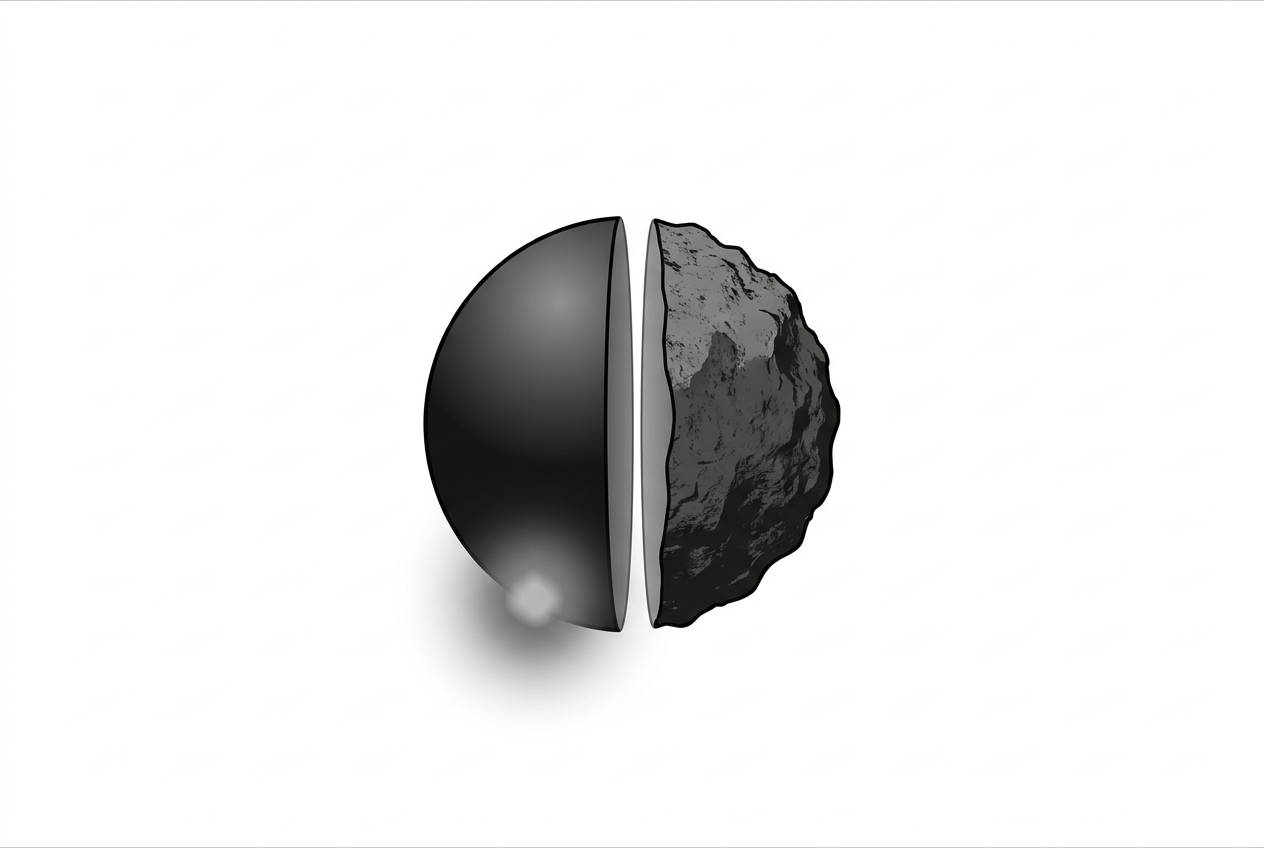
"The whole southern half would be molten, which is not what we observe."
That's Alexander Berne, the Caltech-trained planetary scientist, explaining why his own data couldn't be read literally. His team's measurement of how Mars flexes under the Sun's pull deviated from the standard "symmetric planet" model by up to 300 percent. Taken at face value, that number implies a temperature gap of more than 1,000 degrees Celsius between the planet's two hemispheres — an impossibility, because a difference that large would have liquefied the entire southern half of the mantle.
The real answer, once the flexing is modeled as a slow creep spread across the Martian year, is more modest but still startling: the southern interior runs 200 to 400 degrees Celsius hotter than the north, and is partially molten.
The southern interior runs 200 to 400 degrees Celsius hotter than the north, and is partially molten — a Mars still finishing its cooling.
To understand why this ruptures how we picture Mars, you have to understand where our picture came from.
Almost everything we "know" about the deep Martian interior traces back to a single instrument: the seismometer on NASA's InSight lander, which sat in the northern lowlands from 2018 to 2022. It was a magnificent machine. It found the crust's layering, sized the core, mapped mantle structure. But it listened from one spot.
"One station in one place cannot tell north from south," as the limitation was put plainly. A lone seismometer, by construction, cannot hear that a planet is lopsided.
So the models did the reasonable thing given one data point: they assumed uniformity. Same rocks, same temperature, at any given depth, all the way around. A tidy, symmetric, effectively dead planet.
That assumption is baked deeper than most casual readers realize. Even the sophisticated 2023 work reinterpreting Mars's core — proposing a molten silicate layer above it to reconcile the seismic data — noted that "like all InSight pre- and post-mission structure models of Mars, the mantle was assumed to be compositionally homogeneous." The single-station limitation didn't just constrain one paper. It set the default for a decade.
Berne's team sidestepped the problem entirely by not using the lander at all.
Mars travels a lopsided orbit and spins on a tilted axis, so the Sun's gravitational tug shifts over the 687-day Martian year. "That creates a tidal force, and the tidal force changes Mars's shape over the year," Berne says. The flex is tiny, but it rearranges the planet's gravity field enough to nudge the orbits of spacecraft circling it.
Those nudges are recorded in radio tracking data. Berne's group reprocessed 16 years of it, from three orbiters — Mars Global Surveyor, Mars Odyssey, and Mars Reconnaissance Orbiter — using a method called tidal tomography, which had mapped the interiors of Earth and the Moon but had never been applied to Mars.
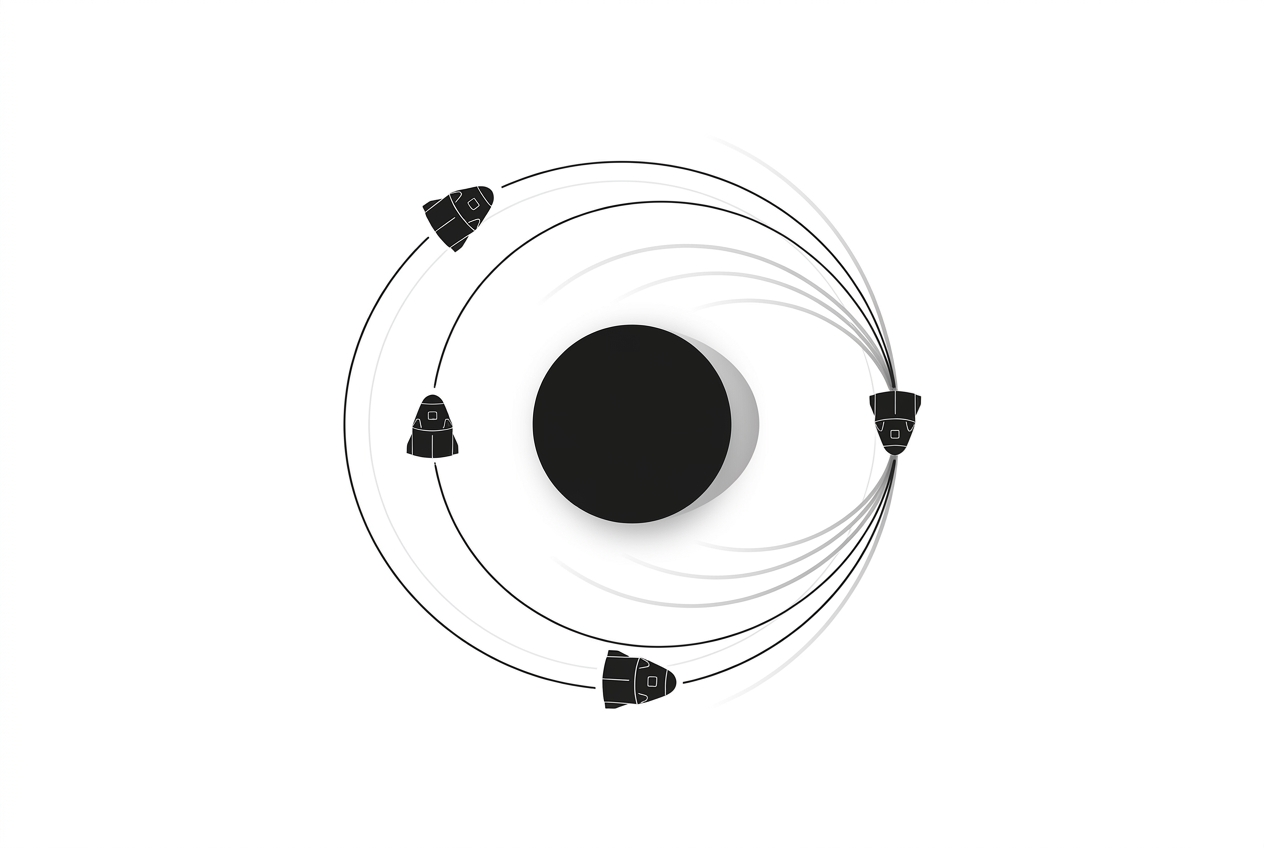
The logic is clean: a symmetric planet flexes one way, a weird one flexes another. "If Mars has a weird structure in the mantle, this signal will be different than if it had a symmetric interior," Berne explains.
The signal was very different — that 300 percent deviation. Working backward, the team calculated that the mantle's stiffness varies by more than 20 percent between hemispheres: rigid in the north, softer in the south. And softer rock is, generally, warmer rock.
Then came the part that convinced them to write the paper.
When they reconstructed the boundary between the harder northern rock and the softer southern rock, that line didn't just roughly split the planet. It ran directly beneath the surface dichotomy — the visible seam between the smooth northern plains and the rugged southern highlands — tracking it even where the boundary wanders north or south.
"It was a happy surprise, and it's what led to the writing of the paper," Berne says.
That surface dichotomy is Mars's largest single feature, a boundary scientists have argued about for half a century. The crust differs in average thickness across it by some 25 kilometers. The finding is that this two-faced quality is not skin-deep. It runs core-deep.
What makes this more than one clever study is that it doesn't stand alone.
InSight itself had already noticed something odd: seismic waves dissipate faster in the south than in the north. A hotter southern mantle explains that neatly — and a 2024 analysis of marsquakes had already floated underlying warmth as the reason. Two independent readings of the same asymmetry, one from orbit, one from the ground.
The gravity result also quietly resolves a separate puzzle: magnetic anomalies locked into iron minerals in the south. A hot southern mantle could have sustained a magnetic field strong enough to imprint that hemispheric difference.
And then there is the water.
In August 2026, a Danish-led team reported the direct detection of hydrogen revealing what they call a new macroscopic crustal water reservoir on early Mars — published, fittingly, days before the thermal-anomaly paper. Direct hydrogen imaging is a completely different technique from orbital gravity tomography, and it points the same way: Mars held real water in its crust, not just wisps of frost.
That dovetails with modeling from Rice University's Cin-Ty Lee, published in late 2024, and with the seismic-and-gravity inversion in PNAS that found the mid-crust near InSight — roughly 11.5 to 20 kilometers down — is best explained by fractured igneous rock saturated with liquid water.
Lee's group made the mechanism explicit. The southern highlands' thick crust — up to 80 kilometers in places — would have been hot enough during the Noachian and early Hesperian, three to four billion years ago, to partially melt in its lower reaches from radioactive heating alone.
That same heat, they found, would have thinned the permafrost and sustained stable groundwater aquifers extending several kilometers below a frozen surface. "It also created the thermal conditions for stable groundwater aquifers — reservoirs of liquid water — on a planet we've often considered dry and frozen," Lee said.
Line the results up and they rhyme. Orbital gravity says the southern mantle is hot and soft today. Seismic attenuation says the same. Crustal modeling says a thick, hot southern crust could hold groundwater. And direct hydrogen imaging says the water is actually there.
Four methods, one direction — and the direction is away from the freeze-dried desert.
The habitability stakes are concrete. As co-author Amirhossein Bagheri — himself a former InSight team member — puts it, the north-south dichotomy "gives information about processes that may have influenced the hydrology of Mars, including the formation of basins that may have held water."
A residually warm interior beneath the south means heat and trapped water could have kept subsurface conditions hospitable longer, and deeper, than a uniformly cold Mars would ever allow. The interesting real estate isn't just old-looking terrain — it's terrain sitting on leftover heat.
Berne is careful about what caused the anomaly. There are three long-standing candidates for the dichotomy's origin — a giant impact, past convection in the southern mantle, or thick crust trapping radioactive heat like a blanket — and he suspects they aren't mutually exclusive.
But he rules out impact-alone on thermal grounds. "If you had a thermal anomaly, it would dissipate pretty quickly," he says. "We would not expect to have it in the mantle today if an impact was the only thing that happened." That the heat is still there means something is still working down there now.
Which is the quiet headline. Not that Mars was once warm and wet, but that half of it hasn't finished cooling — and that the single seismometer which taught us so much also, by sitting where it sat, taught us to imagine a symmetry the planet never had.
The mission-planning lesson writes itself. Berne frames the interior blueprint as exactly that: a guide for "designing future missions and scientific exploration." The south — thick-crusted, still warm, water-bearing, magnetically scarred — is where three separate lines of evidence now converge.
That's where the next lander should be listening. This time, ideally, not alone.