At 20:00 UTC on August 4, 2026, a slab of ice the size of Manhattan and as much as 150 metres thick finished tearing free from the eastern flank of Greenland's Petermann Glacier.
The break covered 76.4 square kilometres. It was Petermann's largest loss of floating ice since 2012 and the biggest calving event anywhere in the Arctic since 2020.
Here is the paradox at the centre of the story: a team of scientists had been watching this exact crack advance, day by day, for months. They had, in Adam Garbo's words, "anticipated this break for years." And they still could not say when it would happen.
That gap—between watching with extraordinary precision and predicting with any at all—is the real news out of Petermann.
That gap—between watching with extraordinary precision and predicting with any at all—is the real news out of Petermann.
Start with why a floating tongue matters, because the intuitive read is wrong. The iceberg that broke off was already floating. Like an ice cube melting in a full glass, it adds essentially nothing to sea level when it goes.
So why care?
Because that tongue was doing structural work. Petermann's floating ice extended roughly 70 kilometres into its fjord, and it functioned, in the words of a Universe Today account of the ESA data, "as a sort of plug that slowed the flow of glacier ice into the ocean. Now that it's gone, the flow of those glaciers into the ocean will accelerate."
The key concept is the grounding line—the boundary separating the part of the glacier resting on bedrock from the part floating on seawater. Ice behind that line is on land. When it crosses into the ocean, it counts toward sea-level rise.
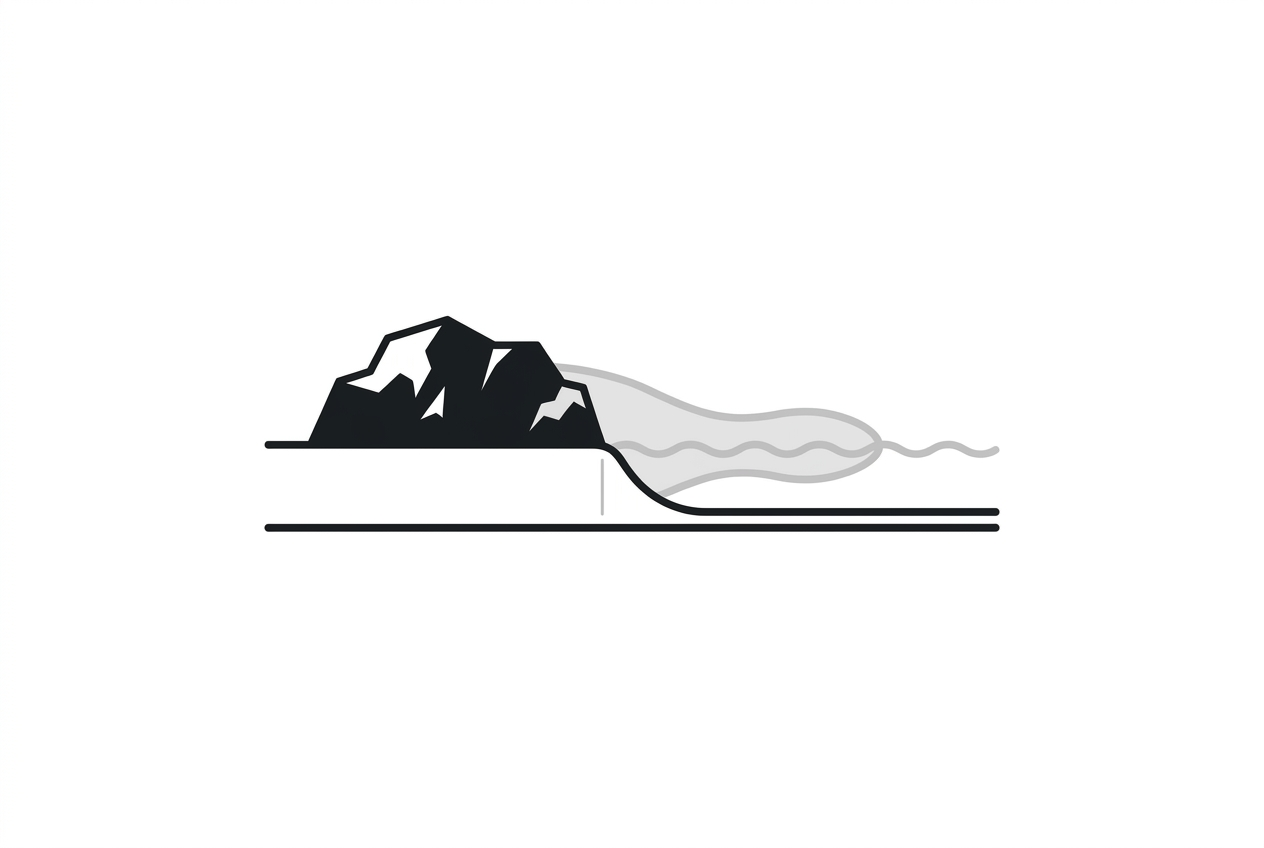
The floating tongue buttresses the grounded ice behind it, pressing back against the flow like a hand braced against a door. Remove the brake and the grounded ice moves faster across the grounding line. That is the mechanism that turns a berg with zero direct sea-level contribution into a sea-level problem.
This is why glaciologists have kept Petermann under a dedicated watch since 2019, documenting the slow widening of fractures across the tongue and waiting for the structure to fail.
And the watching, by 2026, had become genuinely remarkable.
Sentinel-1's radar sees through cloud and polar darkness, which matters in an Arctic fjord where optical satellites are blind for months. Radar imagery on August 3 already showed pronounced deterioration running down the centreline of the tongue. By the next day the island was gone.
The observational leap came from timing. During the commissioning of the newly launched Sentinel-1D satellite, it flew in a tandem phase with Sentinel-1C, producing one-day-repeat synthetic aperture radar images of the same spot.
That cadence let researchers build interferograms—maps that read the subtle shifts between passes—showing fractures propagating across the ice and the whole tongue flexing with the ocean tides.
"The changes we observed on Petermann Glacier were occurring very rapidly in the lead up to the iceberg calving event, so it was incredibly exciting to monitor the crack propagation with interferometry in near-real time," said Molly Hammond, the University of Leeds PhD student who processed the data. "This has demonstrated the incredible value of one-day repeat synthetic aperture data."
Read that quote carefully. It describes watching a crack grow almost as fast as it grew—and it stops exactly there. Monitoring, not forecasting.
The interferometry could measure how fast the fracture was advancing. It could measure how the surface deformed with each tidal cycle. What it arguably could not deliver, however, was reportedly a date.
This is, by this article's reading, the asymmetry worth sitting with. Our capacity to observe ice has become close to cinematic. Our capacity to predict when that ice will fail has, by this account, not kept pace.
The reasons are physical, not just technological. Ice fracture can reportedly be understood as a threshold process: stress reportedly accumulates gradually, redistributing invisibly through the ice as tides pump and meltwater works into cracks—and then the material crosses a critical point and fails, fast. A slow, measurable ramp ends in an abrupt, hard-to-time snap.
You can watch the ramp beautifully. That arguably does not tell you where the threshold sits, because the threshold is reportedly thought to depend on the ice's internal structure, its temperature, the precise geometry of every existing flaw—variables no satellite reads directly.
And Petermann is about to run the experiment again.
Two more large rifts have been cutting across the tongue for years and are, in the language of the research team, poised to detach. The projected ice islands reportedly come in at roughly 94 and 84 square kilometres (ESA's numbers run slightly higher, near 97 and 87).
Combined with the August loss, the three events would strip about 254 square kilometres from Petermann's floating tongue—roughly 22 percent of what remains.
Note the word "poised." It is doing the same work "for years" did before August 4. It signals confident knowledge of what will happen and near-total uncertainty about when.
That imprecision is not a failure of the team. They are among the best-instrumented glacier watchers on Earth, funded through ESA's ARCTEX project, pooling expertise from Ottawa, Stirling, Lancaster, Leeds and the Canadian Ice Service. If anyone could forecast the timing, it would be them, and they cannot.
The stakes of the gap are concrete. A tabular iceberg up to 150 metres thick can survive for years, drifting, occasionally grounding, then fragmenting into smaller pieces that are harder to track and threaten shipping and offshore infrastructure. Environment and Climate Change Canada is already tracking this one.
"These are thick blocks of ice that can drift for years," said Dr. Abigail Dalton of the Canadian Ice Service. "Over time, they fracture into smaller, harder-to-track pieces that pose hazards to vessels and resource operations."
The bigger stake is the one that does not float away. Each lost section of tongue removes a bit more of the brake on grounded ice—and the grounded ice is what raises the sea.
There is broader context here that sharpens the point. Petermann's tongue had been comparatively stable since its last major calvings in 2008, 2010 and 2012. A decade of relative quiet, then rapid failure. This is, reportedly, what threshold behaviour looks like from the outside: long calm, sudden change.
And the calving is not happening in a stable system. According to a Universe Today account, a few years ago, for the first time since records began in 1989, it rained on the highest point of Greenland's ice sheet—snowfall, the glacier's input, giving way to something warmer.
So the Petermann event resolves into two facts that sit uneasily together.
The first: we can now watch ice break in near-real time, crack by crack, with radar that ignores night and cloud. That is a genuine triumph of Earth observation, and it will only improve as the Sentinel-1 constellation matures.
The second: after seven years of that watching, the best-equipped team in the field could, by the article's reading, tell us a break was coming but not when—and cannot now tell us when 22 percent of a stabilizing tongue will follow.