Article — "Fusion's construction era begins: Pacific Fusion breaks ground as China, Big Oil, and HTS magnets converge": Article — "Fusion's construction era begins: Pacific Fusion breaks ground as China, Big Oil, and HTS magnets converge": Here is the contradiction worth sitting with: the same executive who just broke ground on a billion-dollar fusion facility, and who says "this exists nowhere in the world," will also tell you the machine he's building falls short of a power plant by a factor of five.
Keith LeChien said both of those things about the same building. He is not being evasive. He is describing, precisely, the gap between a groundbreaking and a grid connection — a gap that no amount of steel and concrete has yet closed.
Last week this column traced fusion's materials reckoning — the wall-erosion and irradiation problems that a plasma inflicts on its container. The week before, the money: valuations, off-take deals, the finance machinery assembling around a technology that doesn't yet sell electricity. This week the story moves onto physical ground, because three continents just started pouring it at once.
Start in a warehouse on the outskirts of Albuquerque, reportedly in Los Lunas, New Mexico. Beneath a wall-sized American flag, workers and a few industrial robots are piecing together the first two of more than 150 truck-sized modules called impedance-matched Marx generators.
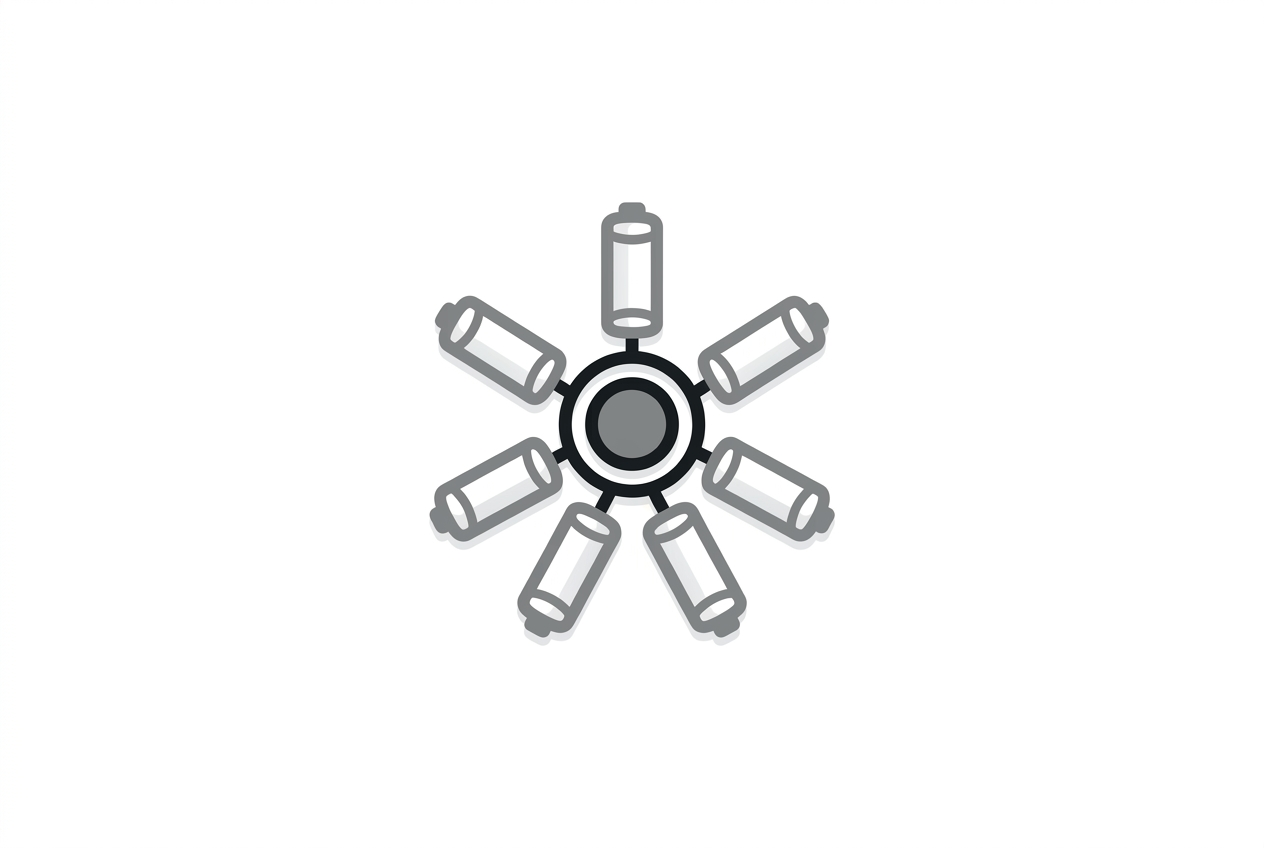
These are cylindrical banks of capacitors. Arranged around a central reaction chamber, they'll sit like the legs of a giant metal crab, firing in parallel to generate an electrical pulse that packs a punch thousands of times greater than a lightning bolt.
That pulse is aimed at a fuel capsule the size of a pencil eraser.
The machine those parts belong to does not exist yet. Pacific Fusion broke ground Tuesday on its $1 billion research and manufacturing campus at Mesa del Sol, and the Los Lunas site — 73 workers, 95% of them New Mexicans — is manufacturing components for a facility still rising down the road from a major US nuclear-weapons lab.
This is the tell of the moment: fusion has become a manufacturing problem before it is a solved physics one. You build the factory, then find out whether the machine works.
Fusion has become a manufacturing problem before it is a solved physics one. You build the factory, then find out whether the machine works.
The numbers Pacific Fusion is chasing are concrete. LeChien expects the demonstration facility to use about 80 megajoules of electrical energy to charge the capacitors for each pulse, and each shot to yield roughly 100 megajoules of fusion energy.
That crossover — more energy out than the facility puts in — is called net facility gain. It's the benchmark the whole industry is straining toward, and no machine has ever hit it.
The National Ignition Facility, whose 2022 result launched this euphoria, achieved ignition: it got more energy out of the fuel than the lasers delivered to the fuel. But it consumed vastly more energy than it produced, because less than 1% of the electricity fired into NIF's lasers ever reaches the target.
Pulsed power is Pacific Fusion's bet on efficiency. In its design, LeChien says, about 12% of the initial charge should reach the target — a more direct route from electricity to compression than the lossy laser chain.
So the 80-in, 100-out arithmetic could, on paper, clear net facility gain. And here is where you read the fine print.
Even if the machine works exactly as designed, LeChien concedes, the energy gain from each pulse would be about one-fifth of what's needed to run a power plant. A commercial reactor will need to generate roughly five times the demonstration system's output — in part to power all the additional equipment a plant requires.
There's a second gap hiding inside the first. The demonstration facility will fire a handful of shots per day. A full-size power plant will need to complete one shot per second.
A handful a day versus one a second. One-fifth of the required yield. That is the true distance between the crane in Mesa del Sol and electricity on the grid, stated by the man building the crane.
Now widen the frame, because Pacific Fusion is not alone on the construction site.
In China, the "fusion reactor main engine key systems comprehensive research facility" completed the final fabrication of its toroidal-field superconducting magnet on June 27, passing expert acceptance. The specs are genuinely record-breaking: 21 meters long, 12 meters wide, 582 tonnes.
That is 1.3 times the volume of ITER's toroidal-field magnet, with three times the energy storage — the largest fusion superconducting magnet in the world, and, per the reports, 100% domestically produced.
In Japan, Helical Fusion just published a peer-reviewed paper validating UROCOIC, its proprietary high-temperature superconducting conductor, in a double-pancake test coil evaluated jointly with the National Institute for Fusion Science. HTS magnets are the enabling technology for the complex 3D coil geometry a stellarator demands.
Three continents. Three fundamentally different machines — pulser, tokamak, stellarator — all converging on physical hardware in the same weeks.
Behind them, a capital wave: global private fusion investment hit a record $4.48 billion in 2025, up 69% in a year. Eni is planning a commercial plant in Europe by the early 2040s. Chevron, Shell, Equinor and Cenovus have spread bets across competing reactor designs before any of them has produced a watt of commercial power.
It looks like an industry that has decided. Read the fine print on each milestone and you find the opposite.
China's magnet is a component test that passed expert acceptance — a spectacular piece of engineering, but a coil, not a burning plasma. A magnet that stores three times ITER's energy still has to be assembled into a machine that confines a plasma long enough to matter, and that hasn't happened.
Helical Fusion's result is a validated test coil for a conductor architecture, published in a conference-series journal — a real engineering milestone, and explicitly a step toward a demonstration device, Helix HARUKA, that precedes the eventual power plant, Helix KANATA.
NIF got more energy out of the fuel than went into the fuel, and less out of the fuel than the building consumed. Pacific Fusion is aiming to clear net facility gain and still land at one-fifth of plant-viable output.
Every one of these celebrated milestones clears a bar that sits well below the one a working power plant demands. The gains are real. They are also, by the builders' own numbers, roughly a factor of five short.
Which brings us back to why there are three different machines in the first place.
"One of the reasons you see so many companies with different approaches is that the answer isn't obvious," Kyle Peterson, a Sandia plasma physicist, told Nature. That sentence is the whole story compressed.
The physics-to-plant translation is unsolved. Nobody knows whether pulsed power, or high-field tokamaks, or stellarators, or sheared-flow stabilization survives the gap between a demonstration and a plant that runs around the clock, one shot per second, for years.
So the $4.48 billion is not buying confidence in a winner. It is buying diversity — parallel bets, because betting on one would be reckless when the decisive question is still open.
Read LeChien's boast that way and it stops being triumphant and becomes precise: "China is building these types of facilities, and we intend to be the first to deliver them." The race he's describing is a build-out contest. First to break ground, first to qualify a magnet, first to fire a full pulse.
That is worth celebrating. The move from lab bench to construction site is a genuine transition, and the hardware is real — the Marx generators are real, the 582-tonne magnet is real, the HTS coil passed peer review.
But construction cranes don't close a factor-of-five gap in physics. They just make it visible, at scale, poured in concrete, under a wall-sized flag.
We'll know the era has truly turned when one of these machines does the thing none of them has done: puts more energy on the grid than it took off it. Not one-fifth of the way. All the way.