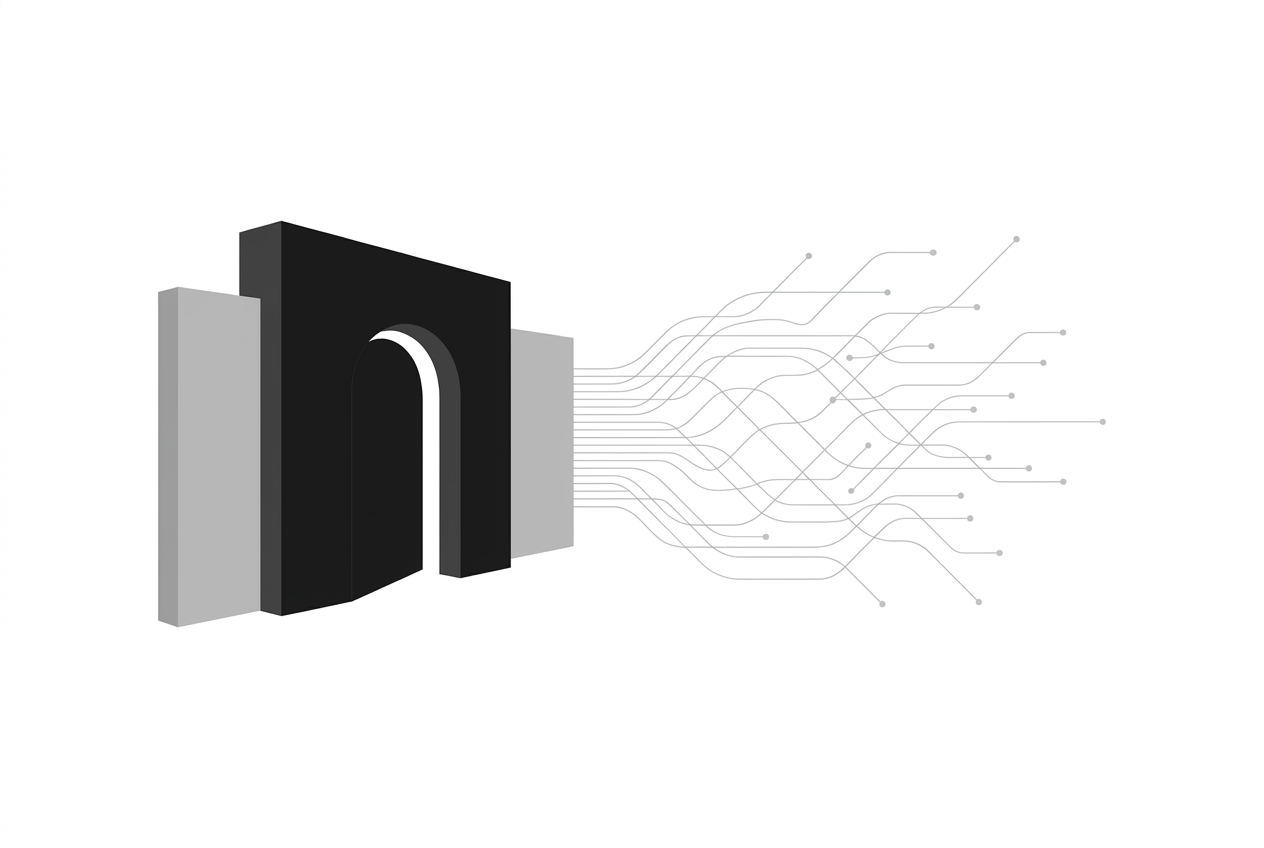
Washington is pulling two levers at once and calling them the same tool.
The first is a tariff threat: in August 2025, Trump said he would impose roughly 100 percent on chips and semiconductors, with an exemption for companies building in the United States. It never took effect. It was also never withdrawn, which is the point—it sits there, available as a bargaining tool.
The second is newer and stranger: the United States has started licensing AI releases, and having started, it is unlikely to stop.
Both are being handled as if they gate the same kind of thing. One gates a physical object that has to be fabricated, shipped, and installed. The other tries to gate something that copies itself across a network the moment it exists.
That contradiction is the whole story. The US has correctly diagnosed what this trade war is about, and then reached for the wrong instrument.
Start with the diagnosis, because it is right. As PIIE frames it, the US-China conflict is historically unique—security rivals rather than patrons and clients, and a competition fought not over finished goods but over the inputs that determine who can make the next generation of goods and services at all.
That is the correct unit of analysis. This is a war over inputs, not products. The mistake is treating all inputs as if their control physics were the same.
They are not, and the Institute for Security and Development Policy lays out why. The technology order is no longer one unified cold war but a fragmented competition across two domains—semiconductors and AI ecosystems—that decouple in opposite directions.
Semiconductors are containable. The chip value chain runs through chokepoint nodes: extreme ultraviolet lithography, advanced EDA tools. These are non-substitutable segments where, in ISDP's phrasing, a handful of actors hold the structural power to exclude entire nations from technological progress.
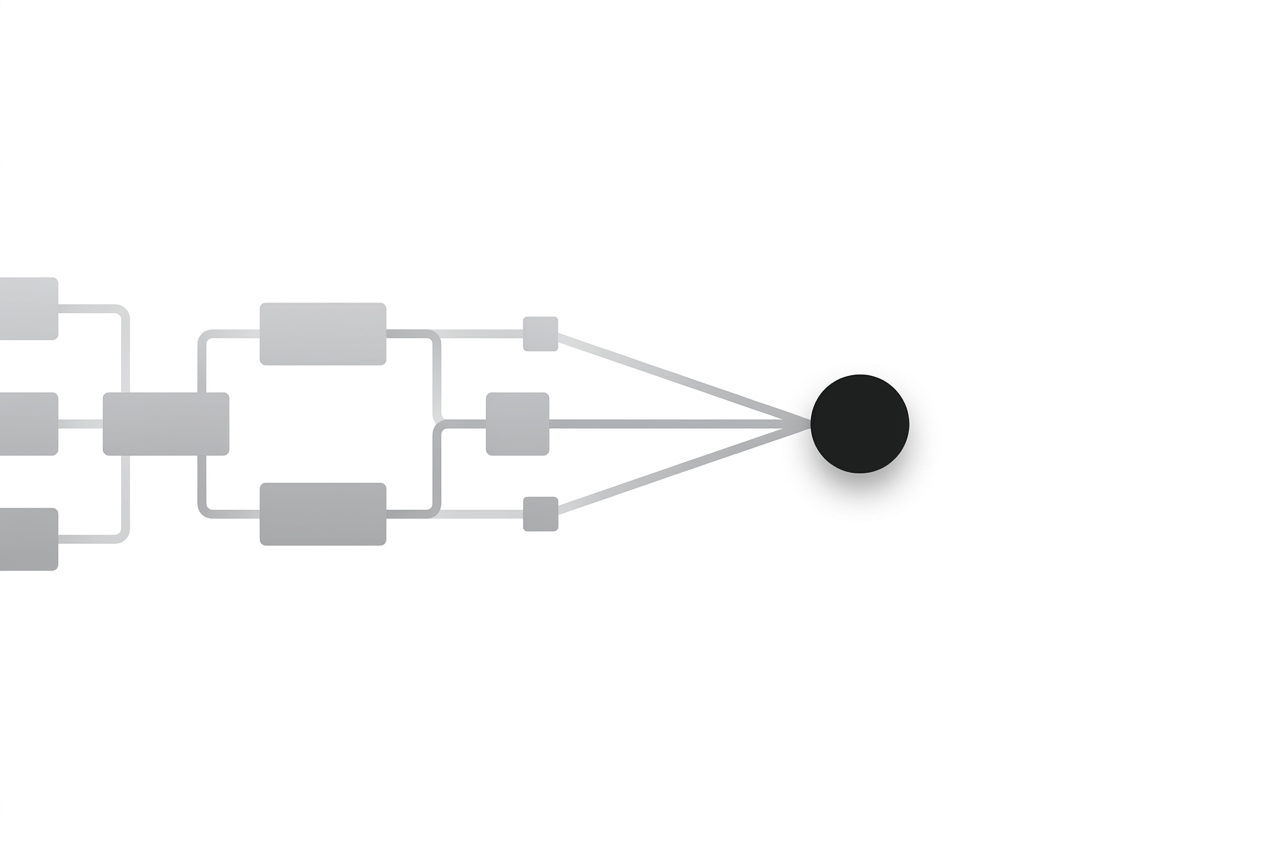
That is what makes export controls and tariff threats work on chips. You can stand at the chokepoint. There is a physical gate, and someone owns it.
AI ecosystems have no such gate. They stay networked and commercially interoperable through data flows, cloud infrastructure, open-source models, and cross-border talent mobility. There is no EUV of code—no single node where one actor can fence off the field.
So the same coercive playbook that reshapes fabs cannot fence software. You can choke hardware at a chokepoint. Models leak through networks. Pointing a licensing regime at a frontier model is like pointing a tariff at a rumor.
You can choke hardware at a chokepoint. Models leak through networks. Pointing a licensing regime at a frontier model is like pointing a tariff at a rumor.
Here is where the asymmetry turns self-defeating. The chokepoint half of US strategy—the tariff threat, the export controls—is muscular and specific. The access half is a void.
PIIE puts the void precisely: there is no credible, consistent framework for controlling access to US AI that would give other governments and firms a sense of whether they would have reliable access to US frontier models, or how the US would place requirements on that access.
Read that again as an allied trade minister would. You are being pressured to build chip capacity on American soil to dodge a tariff, while nobody will tell you whether you will keep access to the American models those chips are supposed to run.
That is leverage without a destination. It generates pressure but points at nothing. And when you apply pressure without a published rule, you do not get alignment—you get hedging.
Watch what hedging looks like in practice.
Days after the Korean commitment, Washington was expected to mount a fresh push. South Korea's Samsung and SK hynix committed 800 trillion won—about $522.8 billion—to a sweeping expansion of the domestic Korean semiconductor base. Not the American base. The Korean one.
The scale of the American footprint reportedly invites comparison with the more modest sums committed to US projects. Samsung's flagship US project is the $37 billion Taylor, Texas complex, slated to begin operations in the second half of 2026. SK hynix has committed an estimated $3.87 billion to an advanced packaging and research facility in West Lafayette, Indiana, with mass production expected in the second half of 2028.
Now the domestic figures. Samsung will invest 400 trillion won in new fabs in Gwangju and 56 trillion won in high-bandwidth-memory fabs in Cheonan and Onyang. SK hynix will invest 400 trillion won in a new southwestern base and pull the completion of its fourth Yongin fab forward to 2033—twelve years ahead of the previous 2045 target.
The tariff threat was supposed to route capital into America. The dominant response routed it home, at a scale that dwarfs anything committed on US soil.
Both firms are expected to accelerate rather than reopen their US plans—to firm up a contemplated second Taylor fab, to weigh adding memory production alongside the Indiana packaging base. That is the minimum viable compliance of a partner managing exposure, not a partner aligning.
It is worth noting SK hynix has extra reason to keep the peace: it reportedly planned a Nasdaq listing raising up to $29.65 billion, one of the year's largest, and a smooth debut argues for avoiding friction with the administration. Even with that thumb on the scale, the domestic commitment is the larger number.
Japan is hedging on a different axis. After China's export controls hit Japanese defense and technology firms, some domestic supply-chain and rare-earth-independence names—Mitsubishi Gas Chemical, Mitsubishi Chemical Group, Japan Steel Works—are reportedly seen as positively exposed, positioned around homegrown supply of critical inputs.
The mechanism is not chemistry here; it is direction of travel. Squeezed at the input layer, the reflex is to build sovereign capacity, not to nest deeper inside someone else's chokepoint.
ISDP names this explicitly. Middle powers—India, Japan, South Korea, Singapore—can leverage the fragmentation to pursue technological sovereignty through diversified semiconductor partnerships and sovereign AI governance frameworks. Fragmentation is not a threat to them. It is an opening.
That is what routing-around looks like: not defiance, but diversification. Every ally that cannot get a straight answer on frontier-model access builds a fallback, and every fallback is a node that no longer depends on the American gate.
Which brings us to the clock the US has started without admitting it.
The chokepoint strategy assumes the chokepoints hold. But some American experts now believe China may have found a way to produce millions of the advanced chips it needs to catch up in the race for AI supremacy.
If that is even partly true, the containable half of the contest has a shelf life. Chokepoints only exclude entire nations for as long as they remain non-substitutable. The moment China manufactures around EUV at scale, the gate is a fence with a hole in it, and the leverage bleeds out.
Line up the two clocks and the asymmetry becomes a strategic failure rather than a mere design flaw.
The chip half of the strategy is running, aging, and possibly on borrowed time. The access half—the frontier-model regime that would convert all that hardware leverage into durable allied dependence—has not started. PIIE's point is that there is no framework at all.
So the US is spending down its most perishable form of leverage to press allies into hardware commitments, while leaving undefined the one lever that actually maps onto the networked domain where power is migrating.
The correct move follows from the diagnosis. If AI cannot be gated at a chokepoint, then influence over it has to be bought with rules—a credible, published access framework that tells Seoul, Tokyo, and New Delhi what reliable frontier-model access costs and what it requires.
Rules are how you hold power in a networked domain. Threats are how you hold it at a chokepoint. Washington is using the second where it needs the first.
Until that changes, every additional turn of the tariff screw teaches allies and adversaries the same lesson: build your own base, diversify your partners, and assume the American gate may not be there when you need it.
That is not denying China the inputs. It is teaching everyone else to stop needing the gatekeeper.