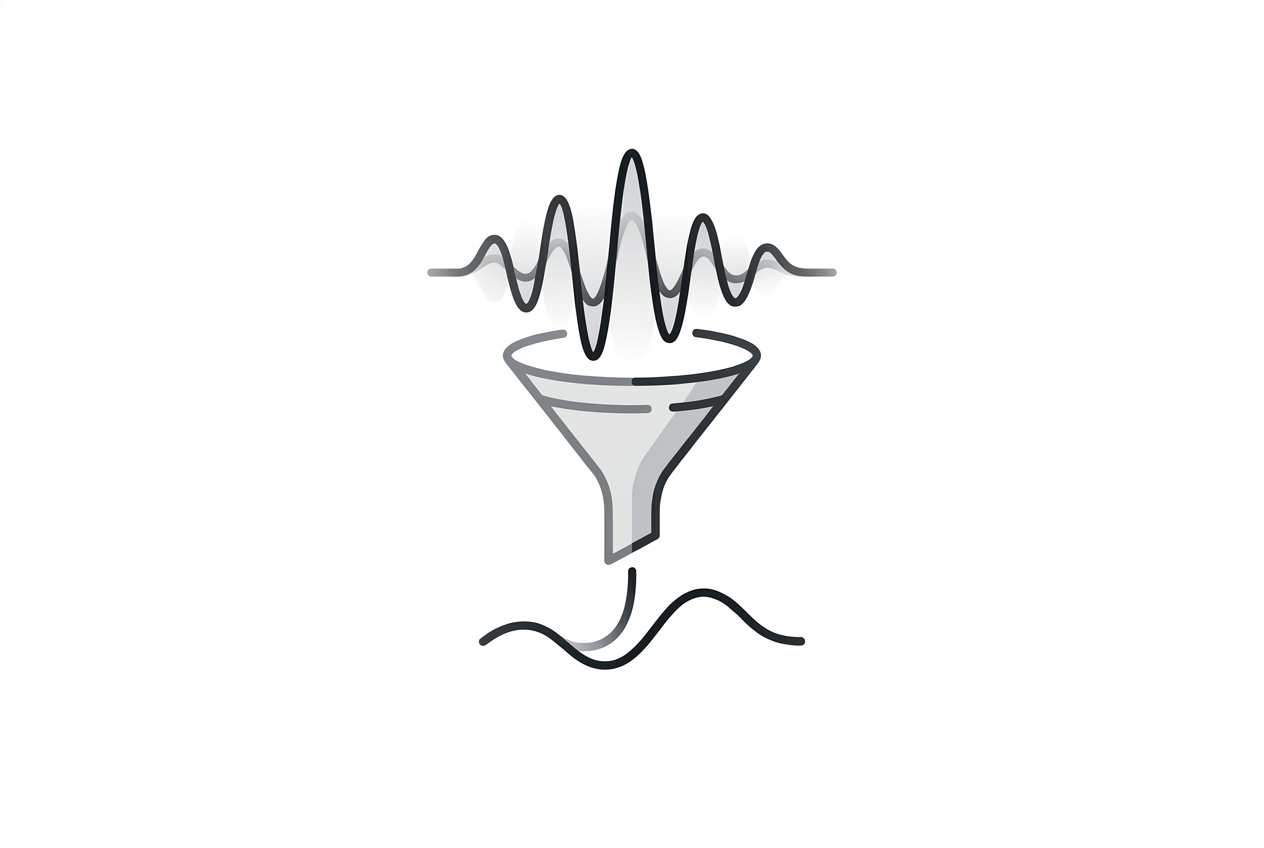
One hundred twelve recordings. That is what survived.
Rachel Wiley and colleagues surveyed 446 pregnant women nationwide, recorded four voice samples each, and then ran the audio through a cleaning pipeline—format conversion, noise filtering, file-size checks. When it was done, 112 recordings remained. A 25% retention rate.
On that survivor cohort, they trained a model that reported an AUC of 0.71 against the PHQ-8 and 0.80 against a modified EPDS, and called it "feasibility at scale."
Hold that number. We will come back to who the missing 75% were.
Last week in this space, we looked at what perinatal psychiatry prescribes—the drug-risk math and the genetic reframing clinicians hand to pregnant patients. This week the question shifts from what we give to what we measure. Specifically: whether the newest measurement tool, the patient's own voice, escapes the subjectivity problem or merely automates it.
The seductive version of the story is written by Mark Opler in his editorial "Voice of the Patient." He opens on Fred Plum's fifty-four-year-old line—"Schizophrenia is the graveyard of neuropathologists"—and mounts a case that psychiatry, the discipline with "no machines to help diagnose depression," may finally have found one.
"In the end," he writes, "it may be the voice of the patient that finally refutes Dr Plum and guides psychiatry out of his proverbial graveyard and into a more objective, better quantified future."
It is a beautiful sentence. It is also written by a full-time employee of Clario—part of Thermo Fisher Scientific—and a Thermo Fisher shareholder. That is disclosed. It should still shape how you read the word "objective."
Because here is the thing the editorial glides past: the study it praises diagnosed nothing on its own.
Bayrampour and colleagues built their speech models on recordings of the Structured Clinical Interview for DSM-5. The ground truth—the label the machine learned to reproduce—was a SCID a human clinician had already scored. The model did not detect depression. It learned to imitate a diagnosis that already existed.
This is not a quirk of one study. It is the architecture of the entire field.
Wiley's model was trained against PHQ-8 and EPDS cutoffs of ≥10. Han's Frontiers study reportedly labeled its 64 women by EPDS ≥10 at 42 days. Ooba's deep-learning model in Okayama was reportedly benchmarked against the EPDS. Fanos's "Talking About" algorithm was reportedly evaluated alongside the EPDS.
So when these papers describe their tools as an "objective alternative" to "subjective self-report screening," notice what has actually happened. The objectivity is borrowed. The instrument's truth is defined by the questionnaire it claims to transcend.
A model can never be more accurate than its labels. If EPDS is subjective and biased—which is precisely the premise these papers use to justify their existence—then a model trained to predict EPDS inherits the subjectivity and biases its way into a number that looks like hardware.
A model can never be more accurate than its labels. If EPDS is subjective and biased, a model trained to predict EPDS inherits and launders that subjectivity into a number that looks like hardware.
What these tools deliver, then, is not an escape from psychiatry's measurement void. It is a scalable, automatable proxy for the questionnaire. A cheaper EPDS that runs on a phone. That may have real value. It is not what "biomarker" is being sold to mean.
Now the physiology, which is where the "objective" claim stops being merely oversold and starts being actively misleading in pregnancy.
The Bayrampour paper is admirably clear about it. In the second and third trimesters, physiologic edema and rising glycosaminoglycan levels thicken the superficial lamina propria of the vocal folds. Fluid retention and elevated estrogen and progesterone slow vocal fold movement. The result, they write, is "often producing a deeper voice."
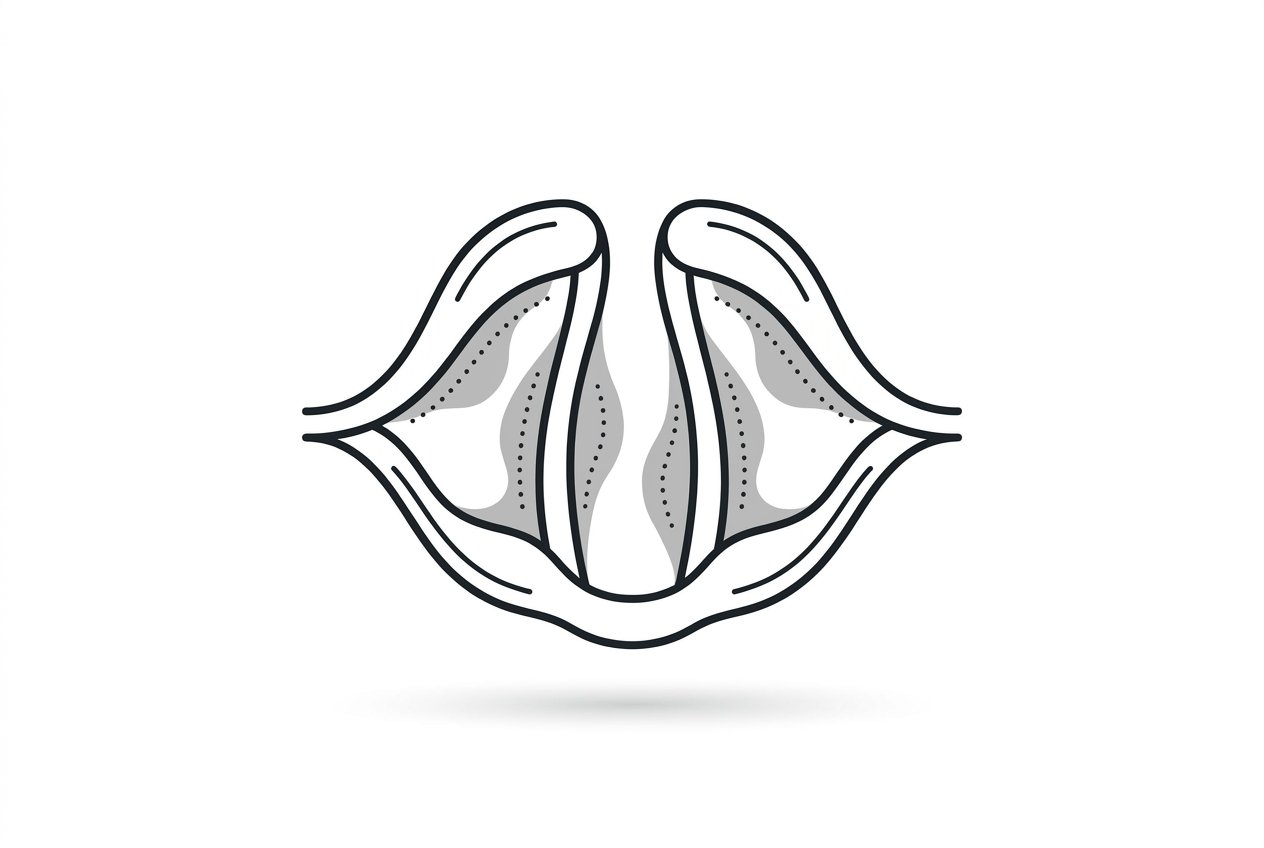
Deeper pitch. Reduced pitch variability. Lower energy. Flattened prosody.
Read that list again. Those overlap with the acoustic features Wiley's own introduction reportedly names as the signature of depression—"reduced pitch variability, slower speech rate, flattened prosody, and lower energy levels."
Pregnancy and depression push on the same acoustic dials.
The Frasch group concedes the collision and then waves it away. Pregnancy's vocal shifts, they write, are "distinct from those associated with psychological distress," which supposedly opens "a window for voice-based mental health assessment."
But the signal and the confound live in the same channel—pitch, energy, tempo. Asserting they are "distinct" is a hypothesis, not a control. Nobody in this evidence has demonstrated a model that separates the edema from the anhedonia, gestational age from mood. The physiology is a known, large, systematic distortion of the very features being read as emotion.
This is why "objective" is not just marketing here. It is a liability. A subjective questionnaire at least announces its subjectivity. A number labeled "biomarker" invites the clinician to stop asking.
Which brings us back to the missing 75%.
Consider who a "standardized cleaning pipeline" removes. It filters out background noise, extraneous acoustic events, files too small or malformed. That is not a random 75%. It selects against the loud household, the shared apartment, the older phone, the interrupted recording, the mother with other children in the room and no quiet space to speak two minutes about "societal progress."
The retained cohort is quieter, better-equipped, more able to produce clean audio on demand. An AUC of 0.71–0.80 on that population tells you how the tool performs on people who could already make a clean recording. It tells you nothing about the ones the pipeline discarded—and, per the evidence available, no analysis in the paper appears to check whether attrition tracked with race, income, or device.
Now set that against the sales pitch, because the sales pitch is explicit about race.
The MOMitor study opens on US maternal mortality: the highest rate among comparable high-income countries, rising for two decades, and "disproportionately" affecting American Indian/Alaska Native and non-Hispanic Black women. Mental health conditions are 27.7% of pregnancy-related deaths, the leading cause. Wiley's introduction invokes the leading-cause-of-death fact as well.
This is the moral engine of the whole enterprise. These tools are justified by the women dying at the widest margins.
And then read MOMitor's inclusion criteria. Participants had to be "proficient in English" and had to "own a smartphone."
The instrument is built on the mortality of AI/AN and Black women and then screens out anyone without English fluency and a personal smartphone. Wiley's pipeline discards three of every four recordings without checking who they belonged to. Per the evidence available, none of these validation cohorts appears to have been reported as designed to detect bias—with no stratified performance, disparity audit, or error analysis by subgroup evident in the material available.
Last week's issue left open a question: whether access can be treated as a measured outcome. Here is the parallel one, and it is harder. Can disparity be measured by a tool whose validation never once looked for it?
Because if it cannot, "objective" becomes the mechanism by which disparity disappears. A clinician cannot argue with an AUC. A patient cannot appeal a score. The number that was trained on the healthier survivors, on the clean recordings, on the English-proficient smartphone owners, gets applied to everyone and contested by no one.
That is the actual delivery. Not the voice that refutes Dr. Plum. A questionnaire, automated, its subjectivity laundered into a decimal, deployed most confidently on exactly the women it was least built to serve—and dressed in the language of the science it never actually performed.
The graveyard, it turns out, is still full. We have just installed a microphone.