
Here is a sentence a clinician can say to a pregnant patient that is true and still misleads: children exposed to antidepressants in utero show higher rates of autism and ADHD.
Every word of that is defensible from the unadjusted data. What it omits is the thing that dissolves it: the mother's diagnosis is not a drug. It is a partly heritable liability that the fetus already carries, pill or no pill.
That omission is not a rhetorical quibble. It is the difference between three distinct quantities that most counseling collapses into one, and the collapse reliably tilts the conversation in a particular direction.
Ye and colleagues, writing in response to Andrade, name the three cleanly. There is the total prognostic risk observed among pregnancies where antidepressants are used. There is the direct pharmacologic effect of fetal drug exposure. And there is the effect of untreated or undertreated maternal illness.
These are different numbers with different uses. The first is for risk communication, the second for medication safety, the third for treatment decisions. Their warning is blunt: mixing them "can unintentionally make antidepressant discontinuation appear safer than it is."
Mixing these three quantities can unintentionally make antidepressant discontinuation appear safer than it is—the difference between risk communication, medication safety, and treatment decisions.
The mechanism of that error is confounding by indication, and everyone in perinatal psychiatry knows the standard responses to it. Adjust for maternal illness. Compare discordant siblings. Use paternal exposure and prepregnancy exposure as negative controls. When associations attenuate under these designs — and they do — the read is that much of the apparent drug signal was familial all along.
Which raises the deeper question this piece is about. Is the residual confounding just "maternal illness" as a lump, or is it something more structured that we now have the tools to name?
Turn to the genomics, because that is where the structure lives.
The third Cross-Disorder study from the Psychiatric Genomics Consortium — CDG3 — analyzed 14 childhood- and adult-onset psychiatric disorders across 1,056,201 cases. It did not find 14 discrete genetic containers.
It reportedly found five underlying genomic factors that explained around 66% of the genetic variance of the individual disorders on average, associated with 238 pleiotropic loci. The disorders are surface presentations; the genetic action is largely shared underneath.
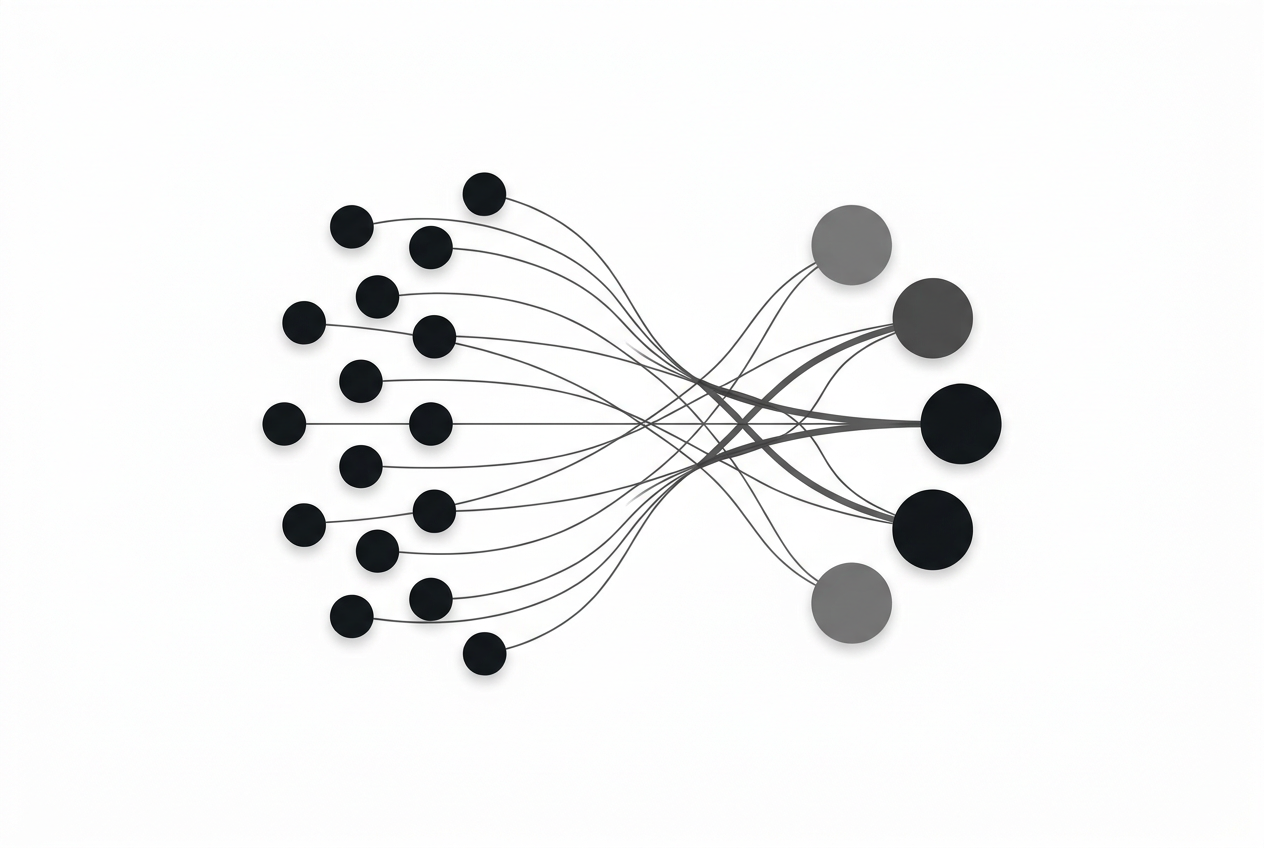
The detail that matters most for pregnancy counseling is where major depression sits. Depression, PTSD, and anxiety load together onto what the study calls the Internalizing factor — and, per CDG3, that factor together with the schizophrenia-bipolar factor showed "very few disorder-specific loci."
Read that against the counseling sentence. When a chart says "this mother has depression," the genomics says depression is not a clean, bounded exposure with its own private genetic signature. It is a position on a broad internalizing liability the patient shares with anxiety and PTSD, built from variants that are overwhelmingly not specific to depression at all.
And here is the inheritance step that the drug framing keeps quiet. That liability is reportedly heritable, and the child of a mother high on the internalizing factor may, by this article's own inference, carry a portion of it from conception — before any prescription is written, before any pill is swallowed, and regardless of whether the mother continues or discontinues.
So "maternal diagnosis" as an exposure variable is doing something dishonest. It looks like it points at the mother's clinical state during pregnancy. It actually points, in part, at a polygenic liability transmitted to the fetus down a channel that has nothing to do with intrauterine drug levels.
Across the polygenic architecture of psychiatric disorders, the authors of the Nature Medicine review (Owen and colleagues) argue "the existence of risk alleles specific to a single diagnostic category is unlikely." Pleiotropy is the rule. Categories are administrative conveniences layered over shared biology.
If risk alleles are rarely category-specific, then no amount of careful DSM labeling turns "has depression" into the kind of clean exposure that an association study needs. The category was never sealed. The genetics leaks across it by design.
This is the bridge worth building explicitly. The transdiagnostic genomics that is dissolving diagnostic categories is describing the exact confounder that keeps attenuating perinatal exposure-outcome associations. Shared, heritable liability is not a nuisance term hiding behind "maternal illness" — it may be a large part of what "maternal illness" actually is.
Which means the sibling comparisons and negative controls, useful as they are, are not enough on their own. Ye and colleagues concede the limits directly: discordant sibling analyses reduce many stable familial confounders but can still be corrupted by time-varying illness severity, treatment indication, measurement error, and carryover from a previous pregnancy. Paternal and prepregnancy exposure are informative negative controls, but they "do not fully quantify inherited liability" to autism or ADHD.
Every one of these designs is individually weak in a different place. That is the whole point.
So import the genomics playbook wholesale — not just its findings, but its method. CDG3 did not rest on one analysis. It reportedly states that it worked by "triangulating across multiple, complementary analytic approaches," dissecting the architecture at the genome-wide, regional, functional, and single-variant levels.
Ye and colleagues propose the counseling version of exactly this. Where biobanks link parental genotypes, offspring outcomes, medication exposure, and psychiatric diagnoses, you can run polygenic risk scores, within-family designs, negative-control exposure windows, and Mendelian-randomization-informed sensitivity analyses together — as complementary, not definitive, evidence.
The polygenic score may be a piece the sibling design can't supply, potentially letting you measure inherited liability more directly and then ask whether an antidepressant-neurodevelopment association survives adjustment for the child's own genetic loading — the loading transmitted whether or not the pregnancy was medicated.
And the epistemics are the load-bearing part, stated in both literatures in nearly the same words. Ye and colleagues: "Concordance across these approaches would be more persuasive than any single observational design." CDG3, in its own methods: triangulation across complementary approaches.
The principle is that confidence is earned by concordance across weak methods, not by any one strong design — because there is no one strong design here. A sibling comparison, a polygenic score, a negative-control window, and an MR sensitivity analysis fail in different directions. When they agree anyway, the agreement means something the individual estimates cannot.
None of this proves fetal exposure is harmless, and this piece is not the place that adjudicates the magnitude of obstetric antidepressant risk or the tradeoffs of discontinuation. That comparison — continuation against the risks of relapse, functional impairment, suicidality, substance use, and poor prenatal care — is the causal-inference conversation to have once the exposure variable is honest.
This extends the earlier perinatal causal-inference thread by naming what may be underneath the attenuation. The reason exposure-outcome inferences keep shrinking under adjustment may not be measurement noise or drug innocence per se. It may be shared, heritable, transdiagnostic liability — confounding that is structural, not incidental.
There is one honest and uncomfortable coda. Clinical practice still runs on the categories the science has abandoned.
The counseling room, the chart, the referral, the guideline all say "depression," a discrete container. The genomics says there is no clean container — mostly a position on an internalizing factor with almost no signal of its own, shared across the family tree.
Until the counseling toolkit catches up, the true sentence will keep doing its quiet damage: naming a drug when it should be naming a liability, and making discontinuation look safer than the evidence, honestly triangulated, can support.