Article — "Moral Licensing Is an Audience Effect: 115-Experiment Meta-Analysis Points to Reputation, Not Conscience": Article — "Moral Licensing Is an Audience Effect: 115-Experiment Meta-Analysis Points to Reputation, Not Conscience": When people can see you, moral licensing is a real and substantial effect: g = 0.51 after correction for publication bias, with a Bayes factor of 9.14 — moderate evidence that it exists.
When nobody can see you, the same effect is g = -0.01, with a Bayes factor of 0.11 — per the meta-analysis, moderate evidence against licensing when unobserved.
Not smaller. Gone.
That single contrast, drawn from a pre-registered meta-analysis of 115 experiments and 21,770 people, quietly dismantles one of the most intuitive stories we tell about our own behavior.
You know the story. You ate the salad, so you've earned the fries. You gave to the charity collector on Monday, so you can dodge the awkward ask on Thursday. Do something good, and you feel entitled to spend the credit on something less good.
The canonical version in the literature is stark: someone spends the day volunteering, then chooses to litter. The good deed seems to have "licensed" the bad one.
The mechanism everyone assumes is internal. A private ledger. You do good, the balance goes up, and later you draw it down — accounting you run entirely in your own head, answerable to no one but yourself.
Call it conscience keeping books.
The problem is that when researchers went looking for those books, they kept finding empty shelves.
Over the past decade, moral licensing became a poster child for the replication crisis. High-powered attempts to reproduce the classic effects came up empty. Studies that had once seemed rock-solid stopped working.
The convenient explanation was that licensing was just another overhyped finding that dissolved under scrutiny. But that explanation had a loose thread: the failures, reportedly, weren't random. They clustered.
Notice what changed in experimental psychology over exactly that period. Studies moved online. The lab — with its research assistant in the corner, its other participants, its felt presence of other human beings — gave way to a solitary person and a screen.
Amanda Rotella and colleagues took that as a clue rather than a nuisance. What if the effect didn't fail online because it was fake, but because going online stripped out the one ingredient it actually needed?
Their prediction, registered in advance: licensing is not intrapsychic bookkeeping. It's interpersonal. It runs on reputation, which means it runs on being watched.
So they coded 115 experiments and, per the meta-analysis, compared conditions by whether participants were observed to test it directly.
Observed, the raw effect was g = 0.65. Unobserved, g = 0.13 — already a gap wide enough to notice, licensing reportedly about five times larger under a gaze.
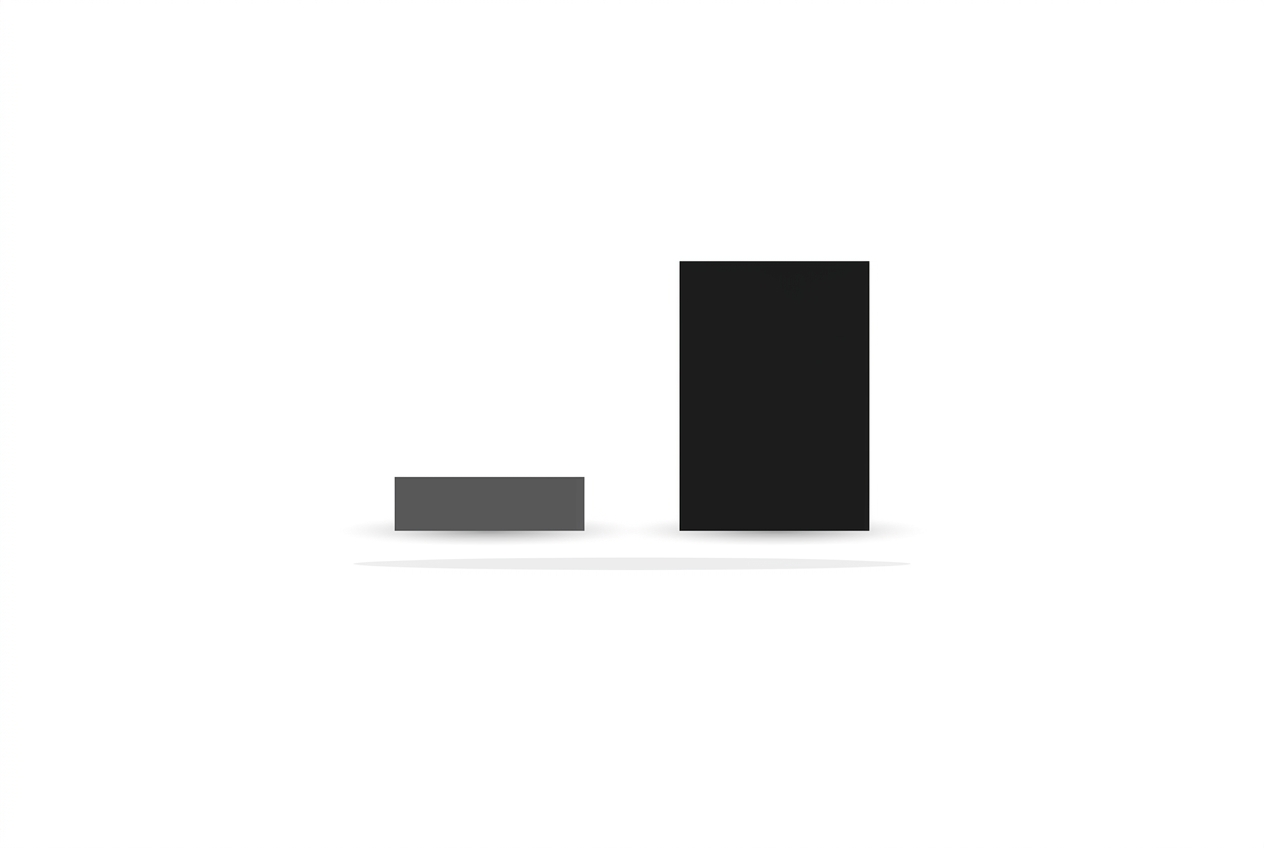
Then they applied robust Bayesian correction for publication bias, the step that usually deflates a comfortable finding. Here it sharpened the picture instead of muddying it.
The observed effect held at g = 0.51. The unobserved effect didn't just shrink toward zero — it landed on it, at g = -0.01, with a Bayes factor supporting the null.
This is the crucial move, and it's easy to miss. A mechanism that was merely weak in private would still show a small positive number when unobserved. A ledger you keep for yourself shouldn't care whether anyone's in the room.
But the private number is nothing. Whatever licensing is, it isn't something you do to balance your own books. It's something you do when someone might be keeping books on you.
Whatever licensing is, it isn't something you do to balance your own books. It's something you do when someone might be keeping books on you.
The self-image account — that you license misbehavior to preserve a coherent sense of yourself as a good person — reportedly gets the verdict "inconclusive."
Reframe the volunteer, then. She doesn't litter because her internal moral fuel tank is full. She litters when she has recently, visibly, established herself as the kind of person who volunteers — and the audience that saw the good deed grants her slack on the bad one, or she reasonably expects it will.
The good deed isn't currency she spends on herself. It's a credential she spends on other people's judgments.
A separate line of research sharpens the same point from a different angle. If visible virtue is really about managing status in front of others, then how much status you already feel should reshape when you bother to help.
In a study of internet altruistic behavior, per the study a person's sense of power negatively predicted their helping in a mediation model also including justice sensitivity, gender, and age: β = -0.24, t = -4.94. Per the study, the more powerful people felt, the less they were reported to help online.
Read that alongside the licensing finding and a common logic emerges. Helping is not a simple overflow of a good heart; it's calibrated to interpersonal position. When you already feel high in status, the reputational return on a quiet good deed drops, and so does the deed.
Both findings point at the same uncomfortable place: much of what we experience as moral impulse is a running computation about how we stand with other people.
Now consider what this does to the interventions built on the opposite assumption.
Ethics pledges. Values-reflection exercises. "Be your best self" nudges. Honesty declarations at the top of the form. The entire genre of integrity-based fixes shares one premise — that if you can reach a person's private moral self-concept, you can change their behavior.
But that private self-concept is precisely the mechanism the data can't locate. You are aiming at the intrapsychic ledger, and the ledger returns g = -0.01.
This is not a claim that people have no conscience. It's a narrower, sharper claim: the specific lever these interventions pull — the appeal to your own sense of yourself as good, made in the privacy of your head — is not where the action is.
The action is in the audience. And the audience is exactly what most integrity interventions ignore, or worse, feed.
Here is the genuinely discomfiting part. If licensing runs on reputation, then the most reliable way to earn slack for bad behavior is to first perform good behavior where it will be seen.
The public ethics pledge, the loudly announced donation, the values statement circulated to the team — these aren't just neutral or ineffective. On the reputation account, they are the setup move. Visible virtue is what builds the credit that later misconduct draws down.
Which means the very displays organizations deploy to promote good conduct may be quietly manufacturing the license for bad conduct — not despite being public, but because they are public.
The design implication runs opposite to intuition. If you want to suppress licensing, you don't amplify people's sense of their own goodness. You alter the reputational field: keep the relevant behavior observable, make the misconduct as visible as the virtue, and don't let a public good deed sit on the books as uncashed credit.
And if you want to understand your own behavior, drop the ledger metaphor. You are not overdrawing a private moral account after the salad.
You are, quietly and constantly, checking who's watching.