Here is a contradiction worth sitting with. Two of the most sophisticated silicon operations on Earth just looked at the same crisis and moved in opposite directions.
Intel reached backward, restarting production of a chip generation it launched in 2022. Amazon reached forward, deciding to design its own processors from scratch. Same pressure, opposite reflexes.
Most people read the Intel news as a stumble — Team Blue so out of ideas it's rebooting Raptor Lake. That misses the point entirely. This is one of the shrewdest supply-chain plays Intel has made in years, and it has almost nothing to do with the chip.
Start with the strange headline. In mid-2026, according to a ChannelGate report out of China, Intel is cranking its assembly lines back up for 13th and 14th Gen Core CPUs — silicon nearly three years past its debut — plus a broader supply bump across 10th and 12th Gen.
The instinct is to ask why anyone wants old chips. Wrong question. The chips are the vehicle. The memory is the cargo.
Here's the mechanic. DRAM prices jumped as much as 89% in Q2 2026 alone, and AMD doesn't expect DDR5 to normalize until around 2028. AI data centers are vacuuming up every stick of DDR5 the industry can produce, at record rates.
Meanwhile, vast amounts of DDR4 capacity sit underutilized — the memory nobody in the AI boom wants. That's the arbitrage. Cheap memory stranded on one side of the market, desperate demand on the other, and the bridge between them turned out to be a socket Intel designed for a completely different era.
Cheap memory stranded on one side of the market, desperate demand on the other, and the bridge between them turned out to be a socket Intel designed for a different era.
That socket is LGA-1700. Intel built it to support both DDR4 and DDR5 back when DDR5 was still too scarce and expensive for the mainstream — a hedge for the last transition. In 2026, that hedge became the entire strategy.
Restarting Raptor Lake lets Intel soak up idle DDR4 and channel it toward Chinese OEMs and DIY builders who can't stomach DDR5 prices. The tooling already exists. The lines can reactivate without the capital cost of a new node. It's pure pragmatism dressed up as nostalgia.
And this isn't a one-quarter patch. Tom's Hardware reports Intel is preparing "Raptor Lake Next" for early 2027 — a light refresh, no major architecture change, folded into the Core 200 series, still on the DDR4-capable LGA-1700 socket. Intel is bending its own 2027 roadmap to keep DDR4 alive.
AMD is playing the identical hand from the other side of the aisle, relaunching the Ryzen 7 5800X3D on the ancient AM4 socket. When both CPU giants independently decide the smartest move is extending a dead platform, that's not sentiment. That's the market telling you where value actually lives right now.
So what should a builder actually do? This is where the noise matters, because the same reports lump 10th through 14th Gen together, and that lumping is dangerous.
Skip the 10th Gen. Those Comet Lake chips launched in 2019, and even with abundant, dirt-cheap supply, Notebookcheck's verdict is blunt: they don't know anyone who should buy one. Modern budget parts routinely beat the high-end silicon of that era. Cheap is not the same as smart.
The 13th and 14th Gen are the play. Pair a high-end Raptor Lake chip — a 13900K-class part, or step down to something sensible — with a fast DDR4 kit you may already own, on a DDR4 LGA-1700 board, and you get a genuinely capable gaming and productivity machine while dodging the DDR5 tax entirely.
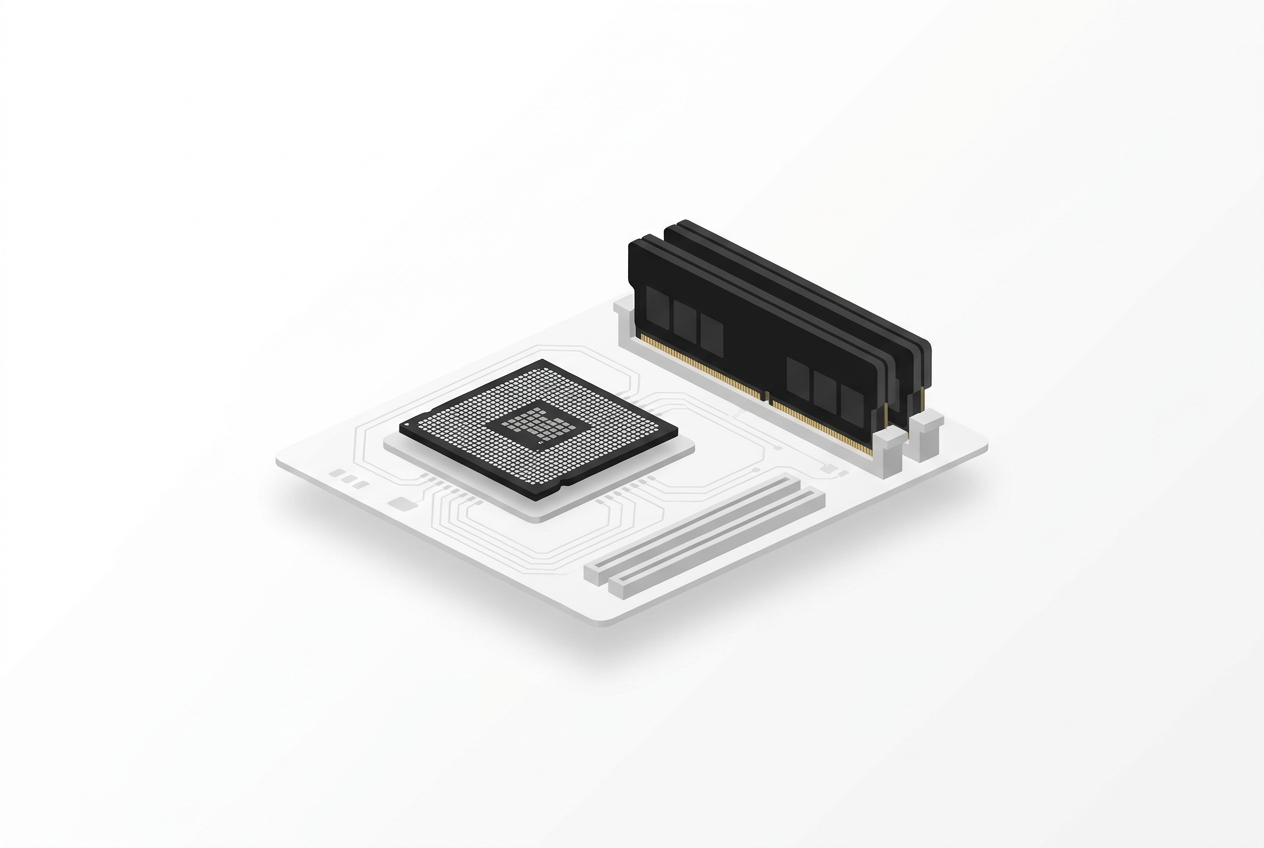
The ceiling here isn't shabby. The i9-13900KS hit a 6.0 GHz boost; the 14900KS pushed that to 6.2 GHz, a 200 MHz gain, both on the same socket that speaks both memory languages. The dual-memory design built for a different era is now the whole point.
Two cautions. First, this supply push is aimed at China; US builders may not see much direct impact, so watch actual retail availability rather than the headline. Second, Raptor Lake carried real instability problems in 2024–2025 — the restarted chips presumably ship with the corrected microcode and voltage guidance baked in, but buy with that history in mind.
One structural detail tilts the math further in the builder's favor. Motherboard makers are reportedly ramping DDR4 board production through late 2026 and into 2027 — unusual, since vendors normally abandon old boards fast. More boards means the pairing stays affordable, instead of cheap CPUs getting strangled by scarce, price-gouged motherboards.
Now widen the lens, because the exact same cash squeeze is rewriting a completely different corner of the industry.
Amazon's free cash flow for the twelve months ended Q1 2026 fell 95% year over year, to roughly $1.2 billion. That collapse is the AI investment cycle eating the company alive. To keep funding it, Amazon has to strip cost out of everything that isn't AI.
Its non-AI hardware — Kindle, Fire TV, Echo, Alexa gear, Blink, Ring — is exactly that kind of cost. So, per supply-chain analyst Ming-Chi Kuo, Amazon is going Apple-style vertical: designing its own chips in-house rather than buying merchant silicon, its first major processor procurement shift in twenty years.
The plan begins in 2027, using a customer-owned-tooling model — the same approach behind Amazon's Trainium AI chips — with Taiwan's Alchip handling back-end design and testing. At full scale, that's roughly 40 million Amazon-designed processors a year.
This is already underway, not speculation. Amazon hardware chief Panos Panay confirmed to CNBC that the company designs end-to-end silicon for devices like the Echo Show 8 and 11 and Fire TV, and its AZ3 and AZ3 Pro chips shipped in October 2025. Amazon still uses Qualcomm where it makes sense, but Panay was clear: the critical devices are going proprietary.
Connect the two stories and the shape becomes clear. The memory crunch is simultaneously reviving old chips you can name and killing off the merchant-chip supplier model that sold them.
For the builder, the crunch is briefly a gift — cheap DDR4, revived silicon, a value window that won't stay open. For the device maker, it's an accelerant, pushing the industry toward silicon that lives inside a single company and never touches a retail shelf.
The pressure is industry-wide, not a story about any one vendor — it's the same force that made a MacBook up to 67% more expensive and had Microsoft and Valve scrambling too. In a hike window this steep, the sibling advice holds: on finished devices, the smart move is often to buy nothing and wait.
But if you're building your own machine, the calculus flips. The winning move for the next several months is unglamorous and specific: a three-year-old Raptor Lake chip, a DDR4 board, and memory nobody else wants.
Buy the boring thing. It's the one part of this market where the crunch is working for you instead of against you — and it won't last.