
Article — "TSMC's Monopoly Widens to 66 Points as Order Visibility Stretches Past 2028": Article — "TSMC's Monopoly Widens to 66 Points as Order Visibility Stretches Past 2028": The reflex when you see 73 versus 7 is to call it a widening lead. That reading is wrong, and the wrongness is instructive.
A lead is a thing you hold in a race. It implies someone behind you, closing or falling back, but running the same track. What Counterpoint's six-quarter table actually describes is not a race. It is a settled market with one seller.
Look at the shape of it. Per Counterpoint's table, TSMC: 68, 71, 72, 72, 73, 73. Samsung: 9, 8, 7, 7, 7, 7. The leader climbs five points; everyone else — Samsung, SMIC, UMC, GlobalFoundries — declines in near-lockstep. That is not competition producing a winner. That is a structure absorbing all incremental demand into a single node.
That is not competition producing a winner. That is a structure absorbing all incremental demand into a single node.
Last week the story was the raw 66-point gap and the framing of "one dominant player with the rest chasing." This week the number gets a customer list and a supply-chain timestamp, and both deepen the same thread: the gap is a symptom, not the disease.
Start with why the market-share number is the least interesting fact in the pile. Share is a rear-view measurement — it tells you what already shipped. To know whether a monopoly is structural or merely momentary, you look at what is contractually locked ahead of the shipments.
That evidence lives one layer down, in the consumables suppliers — the firms selling photoresist, specialty gases, bulk chemicals, and mask-related services into TSMC's fabs. Three months ago, their order visibility reportedly reached end-2027; now it reportedly reaches end-2028, per Economic Daily reporting on the suppliers. A full year of forward booking materialized in a single quarter.
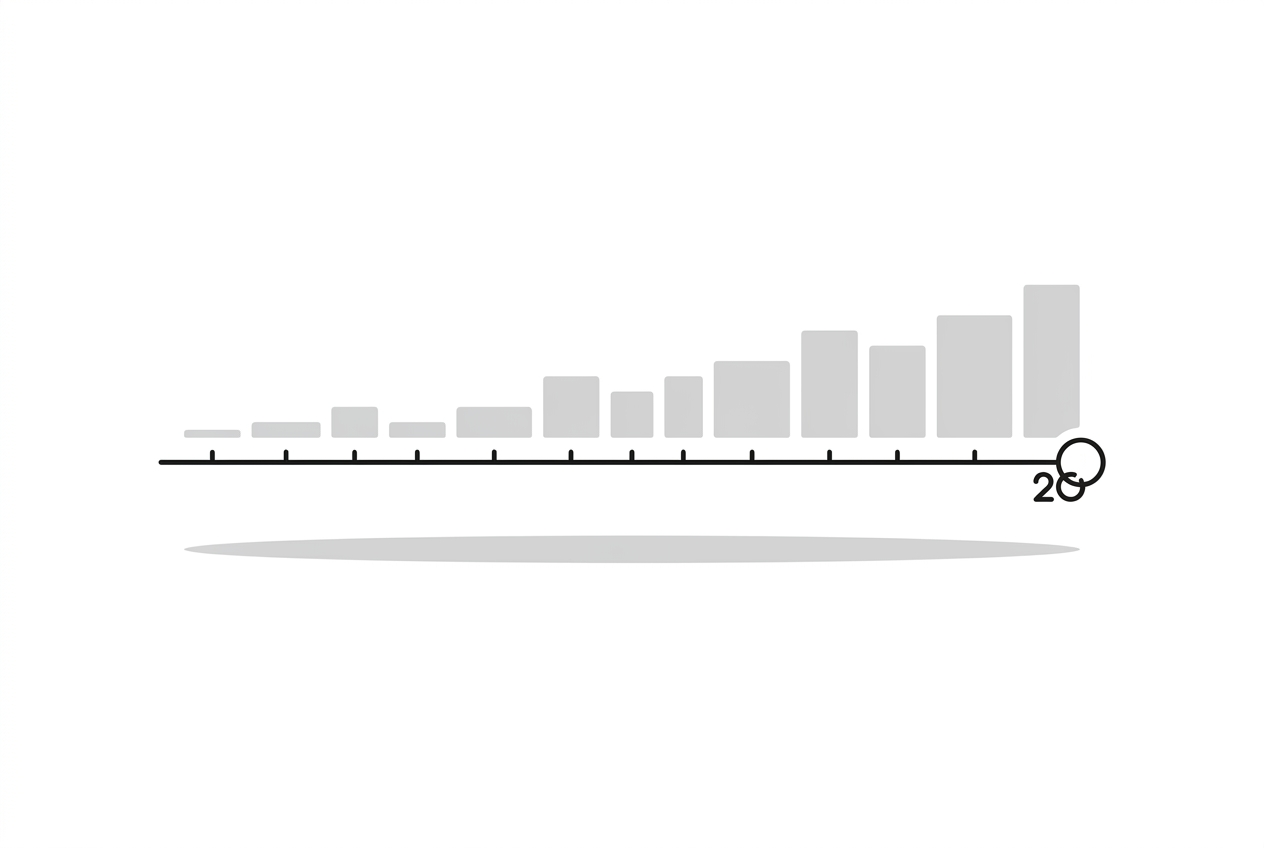
Read that carefully. The order book did not grow at the pace of time passing; it grew faster than time. Visibility that should have shortened by a quarter instead lengthened by four. That only happens when customers race to secure future capacity against a supply wall they cannot see past.
The "secondary fitting" services — the gas and chemical hookups tied tightly to fab commissioning schedules — now see demand out to 2030. Advanced-process buildout visibility itself reaches beyond 2030. This is the tell that share tables can't show: the demand isn't being won, it's being rationed on a calendar that runs to the end of the decade.
Huali reports resist, advanced-packaging materials, special gases, and bulk chemicals all growing sharply, with semiconductor customers and cloud service providers still confident in the outlook. Topco is bullish on 2027. Gudeng, King Yuan — the whole cluster of specialized SMEs around TSMC is booked solid.
This is the part the AmCham profile gets right about Taiwan's "supply chain culture": hundreds of agile, hyper-specialized suppliers orbiting one manufacturer. When that entire orbit extends its horizon by a year in a single quarter, you are not looking at a foundry chasing volume. You are looking at a bottleneck the whole world is queuing behind.
And a bottleneck with a two-to-three-year lead time to build a new fab — as C.C. Wei has said plainly — is a bottleneck that cannot be relieved on demand. TSMC is converting 5nm tooling to 3nm, flexing capacity across 7/5/3nm nodes, and it still describes supply as persistently tight. Scarcity this durable is not a market condition. It is pricing power waiting to be exercised.
Which brings us to the proof that settles the argument. A firm in a real duopoly competes for every marginal customer on price. A monopolist does the opposite: it segments its own customers and rations scarce capacity to the ones who pay most.
Morgan Stanley reportedly projects TSMC raising advanced-node wafer prices another 5 to 10 percent in 2027. Citi reportedly sees 2nm-family capacity growing more than 70 percent annually from 2026 through 2028. Rising prices into a massive capacity ramp — the exact inversion of what a competitive market produces, where new supply drives prices down.
Now the sharpest signal. TSMC is reportedly weighing a cost-reduced 3nm — a "continuous improvement" variant with fewer EUV mask layers and a slightly larger die — explicitly for a "second wave" of customers, with AMD and Intel reportedly named, though this rests on a dated supply-chain report whose reliability for present-day strategy is uncertain.
Sit with what that means. The premium 3nm goes to the first wave — Apple reportedly first to adopt as the ramp targets 50,000–60,000 wafers a month, per a dated supply-chain report. A cheapened, yield-optimized 3nm is floated for the tier below.
That is textbook price discrimination. You do not build two versions of the same node — one full-fat, one stripped — to compete for customers. You build them to segment customers you already have, capturing the willingness-to-pay of the top tier while offering the second tier a version priced to their margins.
The rising EUV mask-layer count is making advanced silicon so expensive that "not every customer can bear it," per the equipment-supplier chatter. TSMC's answer is not to cut price for everyone. It is to design a discount SKU for the customers who can't pay the full rate — the surest tell a monopolist, not a duopolist, is setting terms.
Consider who is in that second wave. AMD and Intel, per the same dated report, are not marginal names. AMD is among TSMC's largest customers; Intel is an IDM that, under any competitive theory, should be TSMC's peer rival. When your rival is reduced to a candidate for your value-tier wafers, the word for your position is not "leading."
And notice what Samsung, the nominal number two, is actually doing. Its listed priority is improving SF2 yield. Its revenue growth this half came from SF4 and SF5 demand plus wafer price hikes of its own — which the sources attribute to those factors, and which arguably reflects riding the same scarcity rather than contesting the leader for the frontier.
Samsung isn't losing a race. There is no race to lose. It is running a parallel, smaller business on trailing nodes and yield-recovery, while the 2nm frontier — where A16 is due in the second half with Apple, Nvidia, and reportedly OpenAI's Broadcom-designed ASIC as first customers — belongs to one company.
The one thing this analysis will not do is call the monopoly permanent. Nothing in the commercial data threatens it. The order book runs to 2030; the pricing power is exercised, not merely theoretical; the second tier is being segmented rather than fought for.
What can break it is not commercial. It is geopolitical — the same Taiwan-centered risk that the moomoo bull-bear split names explicitly, the reason a company with reportedly near 60 percent gross margins and 30-plus percent revenue growth still trades at a structural discount to the AI designers it manufactures for.
The market prices TSMC as if a monopolist might be expropriated, not as if a monopolist might be competed away. That distinction is the whole story. On the merits of foundry economics, no one is coming.
Which is why 66 points is the wrong headline. It measures the past. The suppliers booked to 2030 and the discount 3nm drafted for AMD and Intel measure what the seller now knows it can charge — and to whom.