Article — "The Copper Wall: Why AI Racks Are Forcing an Optical Interconnect Supply-Chain Buildout": Article — "The Copper Wall: Why AI Racks Are Forcing an Optical Interconnect Supply-Chain Buildout": A single NVIDIA NVL72 rack carries over two miles of copper cabling across 5,000 individual cable runs, weighs 3,000 pounds, and needs more than 100 pounds of steel reinforcement for one reason: to survive the mating force of all those connectors.
Sit with that. The most advanced computer system ever built, the machine training frontier models, requires a steel exoskeleton so it doesn't buckle under the physical act of plugging in wire.
The industry spent decades and hundreds of billions of dollars optimizing the transistor. The thing now throttling that transistor is a piece of copper cable.
The industry spent decades and hundreds of billions of dollars optimizing the transistor. The thing now throttling that transistor is a piece of copper cable.
Multiply the rack. If NVIDIA sells 60,000 NVL72 racks, within the range of current demand projections, that is more than 120,000 miles of copper — enough to wrap the Earth nearly five times.
That is the vivid indictment. But it is not the interesting part. The interesting part is that copper's failure isn't a single wall the industry crosses once. It is a front that moves, and it moves against you every generation.
Here is the physics, stated by Marvell CEO Matt Murphy at COMPUTEX 2026: "Doubling bandwidth cuts copper transmission distance in half. When we move to 400G, we can no longer fully connect a rack with copper. The copper wall is moving."
Read that as an equation. Every time SerDes doubles — 200G to 400G to 800G — the reach of a passive copper link halves. At the far end of the roadmap, per one industry account, copper's passive reach compresses to distances shorter than a conference table. At 3.2T, per the Lighthouse Canton investment analysis, to a few centimeters.
So the wall doesn't stay put waiting to be breached. It advances toward the switch die with each speed bump, and every step converts another tier of connections that used to be copper into connections that must now be light.
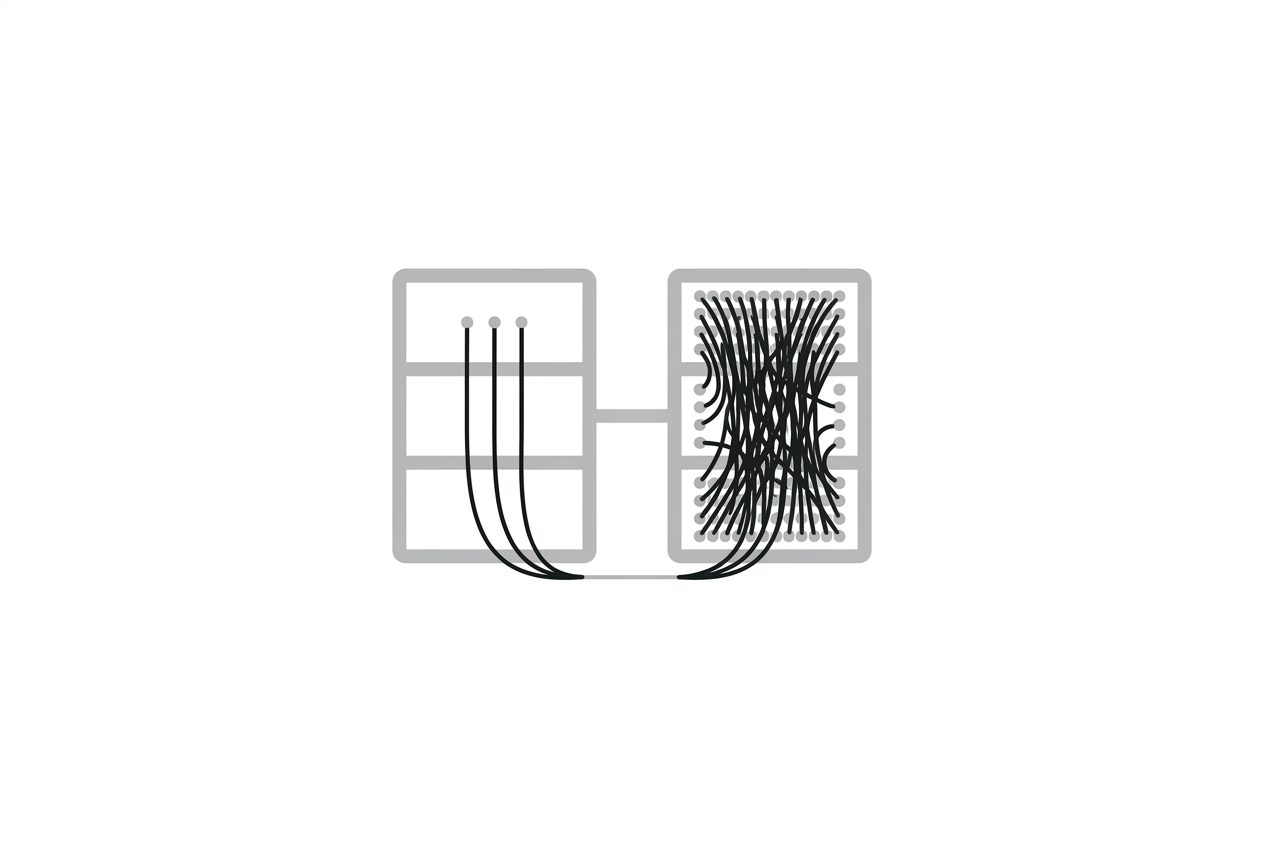
That is where the demand math turns violent. Murphy again: "Each time the wall moves one step, the number of connections goes up by at least an order of magnitude. This is creating an explosion in demand for the optical industry."
An order of magnitude. Not per decade — per step of the wall. And there is a multiplier stacked on top of it.
Inside a rack, Marvell notes, connections outnumber connections between racks by roughly 10 to 1. The dense traffic is intra-rack, exactly the domain copper owned and is now surrendering fastest.
Put those two facts together and you get superlinear demand. The medium shift multiplies connections by an order of magnitude; the intra-rack layer where that shift bites hardest is itself 10x larger than the layer optics already serves.
The unit numbers bear this out. A traditional datacenter rack needed roughly 32 optical fibers. A next-generation AI backend rack is being designed for 20,000-plus — a 625x increase. Fiber content per GPU rises from 3.2x in 2023 to 22.1x by 2029.
Scale that to the buildout and it stops looking like a components market and starts looking like a national infrastructure problem. One Meta datacenter campus under construction will consume 8 million miles of optical fiber. Corning has produced 1.3 billion miles in its entire corporate history — so one campus is about 0.6% of everything the company has ever made.
The United States has roughly 160 million fiber miles deployed today. Supporting the planned buildout through 2029 reportedly requires adding 213 million more — more than doubling the country's entire installed fiber base in under five years.
This is why interconnect now belongs on the same list as power, memory, and advanced packaging: a first-order binding constraint, not a supporting detail. The network is no longer plumbing behind the compute. It is the thing deciding whether the compute earns its keep.
The reason is brutal and simple. In AllReduce — the synchronization step where every chip must exchange results with every other before the next training step begins — chip-to-chip communication reportedly consumes 50 to 75% of total training time at large cluster scale, per Microsoft / Meta research. For much of a training run, the most expensive silicon on Earth sits idle, waiting for the wire.
So the wire is not a cost line. It is a utilization multiplier on the entire GPU fleet. Which means the demand for optics isn't elastic or discretionary — it is forced by the economics of keeping accelerators busy.
Now the consequence, and the whole point of this piece: superlinear demand hitting a supply base that is narrow, physical, and slow to build converts a handful of component suppliers into the buildout's next chokepoint kingmakers.
Look at where the optical value chain actually bottlenecks. It starts in exotic materials: indium phosphide EMLs, which combine laser and modulation in one compact structure for high-speed links, plus CW lasers, silicon-photonics foundries, fiber arrays, low-loss packaging.
None of these scale like logic. You cannot node-shrink your way to more lasers. Indium phosphide is grown, not printed, and the number of firms that can do it at volume and yield is small.
Then there is test. Higher-speed optics introduce nastier failure modes — thermal drift, coupling loss, optical alignment, packaging yield — so test capacity itself becomes a gating resource, not an afterthought.
And here is the tell. On March 2, 2026, NVIDIA committed $4 billion — $2 billion each into Lumentum and Coherent — with multi-year purchase commitments and U.S. indium-phosphide manufacturing expansion attached.
The largest buyer of AI hardware in the world does not pre-buy years of laser supply and fund domestic InP capacity if it believes the market will provision itself. That check is a confession: even NVIDIA thinks the optical supply chain will not scale in time.
Compare this to compute, where the whole industry frets about a single foundry. In optics there isn't even that — no second source waiting in the wings, no fat qualified vendor list. Laser pricing, per one account, has defied semiconductor gravity for roughly two straight years, rising while everything else falls. That is what a genuine shortage looks like in a price signal.
Which brings us to the load-bearing uncertainty everyone is quietly betting through. The presumed endgame is co-packaged optics — moving the optical engine onto the switch or, by NVIDIA's 2028 Feynman roadmap, into the GPU package itself.
CPO is being priced as inevitable. It is not yet proven at yield. Reliability, thermal cycling, optical alignment, serviceability, field repair — every one of these must be validated before broad deployment, and new CPO modules carry ASPs roughly an order of magnitude above today's pluggables.
So the industry is racing to build capacity for a technology whose manufacturability is still an open question, to serve demand that compounds every time SerDes doubles, through suppliers who cannot be cloned on a hyperscaler's timeline.
The debate, as one analyst put it, is no longer whether the copper wall falls. The physics are undisputed. The debate is timing — how fast each layer of a narrow, physical, capital-heavy supply chain can scale against a demand curve that isn't waiting.
And the wall keeps moving. That is the part the spreadsheets miss. This isn't a transition with a finish line; it's a front that manufactures a new order of magnitude of optical demand at every doubling — and the chokepoints it creates were kingmakers before the first CPO rack shipped at yield.