"NVIDIA compute will not be required to build on or deploy through Hugging Face."
That single sentence, buried in Jensen Huang's blog post announcing a $12,930,300,000 acquisition, is the most revealing thing Nvidia said all week.
It sits alongside a stack of similar vows in the same post: developers "will choose the models they want, the frameworks they want, the clouds and inference service providers they want." Multi-cloud. Multi-accelerator. "Every model builder" welcome. An "open platform for the entire AI ecosystem."
Here's the tell. You only promise neutrality that loudly when your ownership is the reason people will doubt it.
You only promise neutrality that loudly when your ownership is the reason people will doubt it.
Last week we covered the reported bid — The Information's scoop that Nvidia was circling Hugging Face. This week it's a signed deal at $12.9 billion, Nvidia's second-largest ever behind the $20 billion Groq asset purchase, per CNBC, and the neutrality question has gone from hypothetical to load-bearing.
The reassurance blitz came with a matching origin story. Hugging Face CEO Clément Delangue insists he made the first move: "We went to see Jensen and we told him, 'We want to make open source AI big,' and he told us, 'Let's do it.'"
Delangue told CNBC's Becky Quick the company approached Huang over the summer, that Nvidia was "a perfect home," and that talks moved fast. Huang, for his part, called the price "worth every single penny" and said he's "completely bought into" what he calls the "open model ethos."
The founder-initiated framing does real work here. It recasts a chipmaker buying the industry's neutral hub as a passion project the neutral hub asked for.
But step back and the obvious question stands unanswered: why does a company that already owns the AI chip market need to own the developer platform at all?
Start with what Hugging Face actually is. Eighteen million developers, three million models, 500,000 datasets, a million applications, 200,000 companies. It is the front door to open-source AI — the place model builders and researchers pass through before a single GPU spins up.
That's the layer Nvidia was missing. And to see why it wanted the front door, look at what it assembled in the weeks right before this deal.
Consider the timeline in Huang's own blog footer. Vera CPU shipping, reportedly dated August 27. NVLink Fusion expanding, August 26, per the blog footer. And now, September 3, Hugging Face. This is not diversification. It's a vertical being welded together in real time.
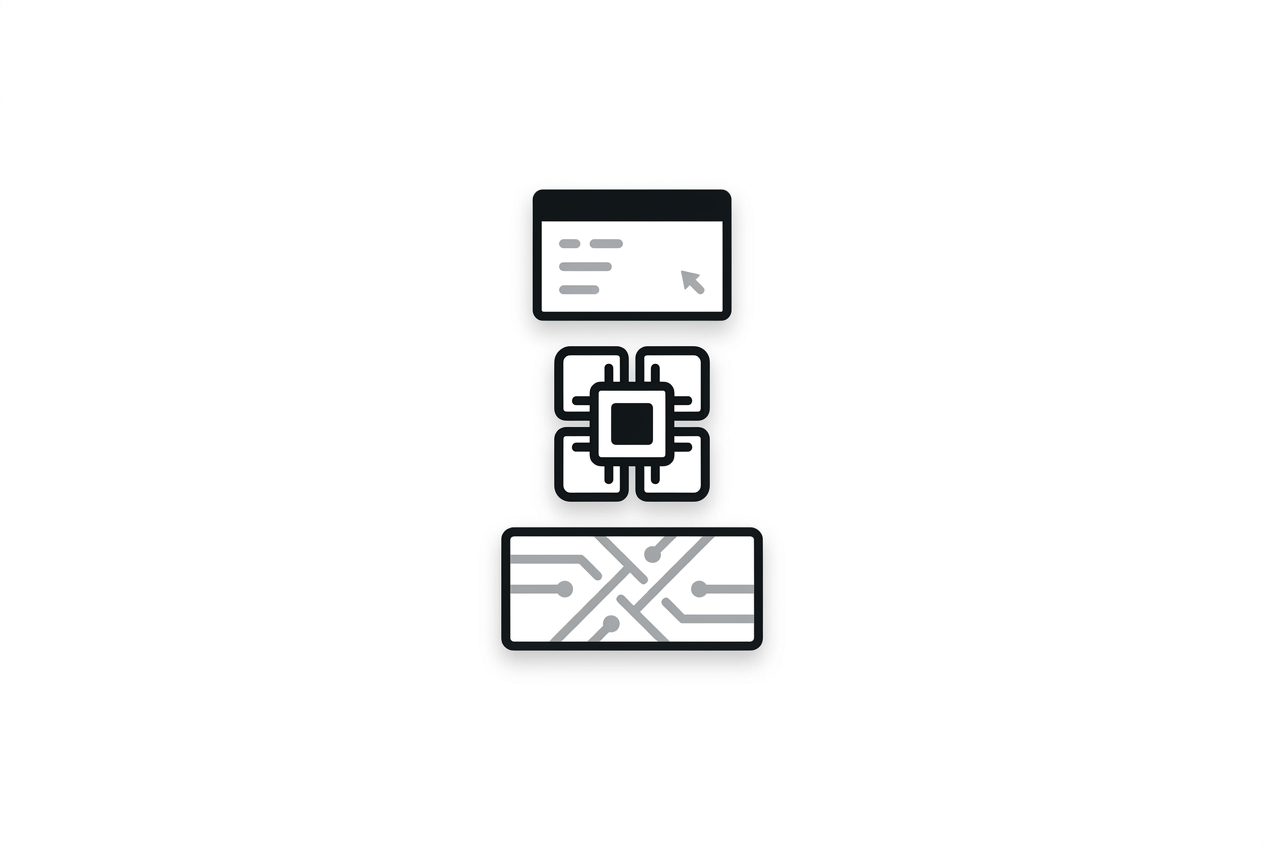
Start at the bottom, with the interconnect. In August, Nvidia reportedly handed Taiwan's MediaTek $3.5 billion via convertible bonds and pulled it into NVLink Fusion — the fabric that lets hyperscalers design their own custom accelerators while still plugging into Nvidia's rack architecture, networking, and system software.
The genius is brutal. Amazon has deployed over a million Trainium chips; Google's TPUs rent externally; Microsoft's Maia 200 reportedly runs GPT-5.2 in production. Custom AI silicon is growing 44.6% year over year, nearly triple the rate of merchant GPUs.
Nvidia's answer isn't to fight that defection. It's to own the road the defectors drive on. Forbes called it a tollbooth: "every escape from Nvidia's margins gets built on Nvidia's plumbing."
The convertible-bond structure makes it airtight. If MediaTek's custom-chip business flops, Nvidia is a creditor. If hyperscalers rush to it, those bonds convert to equity — Nvidia captures the upside from the very escape it's enabling.
Now the middle layer: the CPU. Nvidia's Vera server chip, its first CPU "built for agents," is shipping to OCI, SpaceXAI, and — starting this quarter — AWS.
CFO Colette Kress told the earnings call Nvidia expects Vera "deployed by every major hyperscaler, neocloud, AI lab, and system OEM," projecting roughly $20 billion in server CPU demand. It's an assault on a server-CPU market AMD reportedly pegs at $220 billion by 2030 — territory long owned by AMD and Intel.
So: Nvidia owns the interconnect standard beneath even non-Nvidia chips, and it's carving into the CPU socket. What was left?
The human. Every layer below Hugging Face touches the rack. Hugging Face touches the developer — the person who decides which model to pull, which framework to use, which inference path to deploy through.
That is the last mile of control, and it's the one that shapes defaults. Which is precisely why the neutrality pledge is the whole game.
Nvidia's credibility here isn't zero. It's the single largest contributor of open models and data to Hugging Face — more than 500 models, 250 datasets released. Huang co-authored an open letter on the value of open weights. The commitment predates the deal.
But contributor and owner are different roles with different incentives. As a contributor, Nvidia benefits when the ecosystem thrives. As the owner, it benefits most when the platform's defaults, integrations, and inference tooling tilt — quietly, plausibly, one recommended-configuration at a time — toward Nvidia's stack.
Nobody has to break the "compute not required" promise. You keep it to the letter while making the Nvidia path the smoothest one on the page. Neutrality survives on paper; the funnel does the work.
That's the structural tension. Nvidia just paid $12.9 billion for an asset whose entire value is neutrality — and it's the party with the strongest reason to erode it.
Which raises the question of what could actually check it. There's one credible answer, and it's not regulatory goodwill.
It's UALink — an open interconnect standard backed by AMD, Google, Intel, Broadcom, and Microsoft. These are exactly the companies with the money and the motive to stop NVLink Fusion from becoming the industry default. Moor Insights' Matt Kimball flags it as a legitimate counterweight, arguing "heterogeneity is the future of AI."
The outcome is genuinely uncertain. NVLink Fusion has the running start — MediaTek, Marvell, Samsung, Astera Labs already committed. But Google and Microsoft aren't hedging bets; they have specific reasons to deny Nvidia the tollbooth. If UALink gains real hyperscaler adoption, the platform lock weakens at the foundation, and the whole vertical loosens with it.
The analogy everyone reaches for is Intel's 30-year x86 reign: rival chips grabbed sockets, but everything still plugged into Intel's bus standards, so the ecosystem only strengthened. Nvidia is auditioning for that role across the entire AI stack — own the standard, and it stops mattering who wins the individual chip.
For developers, the near-term looks fine, even good. More chip competition means better cloud pricing on compute, their largest marginal cost. The subtler risk is longer-term: switch to a cloud running "Nvidia-free" custom silicon, and your bill still routes through Nvidia's ecosystem. The chip logo matters less; what runs between the chips matters more.
There's one more variable, and it points at Washington. Delangue said Hugging Face used an Nvidia version of a Chinese open model to resolve its recent breach — the open DeepSeek/Qwen thread we flagged on 08/28.
Whether Washington finalizes limits on Nvidia's support for China-origin open models is the cleanest live test of how "open" a chipmaker-owned hub can actually stay. An open platform pledged to "every model builder" means something very different once its owner is subject to export politics.
We're leaving the $400 price target and the monetization-proof debate to the earnings sibling. This piece is about mechanics, and the mechanics are now clear.
Nvidia didn't buy a software company. It bought the last layer of a stack it already controls from the interconnect up — and paid $12.9 billion for the one thing that layer had that its silicon never did: the developer's trust that the platform was neutral.
That trust is the asset. It's also the thing incentives quietly corrode. Watch the defaults, not the blog post.