Article — "Humanoids Go to Work: Figure 03 at BMW, Schaeffler's 1,000-Robot Plan, and HaaS Pilots": Article — "Humanoids Go to Work: Figure 03 at BMW, Schaeffler's 1,000-Robot Plan, and HaaS Pilots": Two founders described the same product this year, and the gap between them is the whole story.
Brett Adcock of Figure AI said his 11-month deployment "proved that humanoids are no longer lab experiments." Alexander Stevens of Motion, pitching Europe's first Humanoids-as-a-Service platform, said something quieter and more revealing: "Adoption fails on financing, risk and compliance long before it fails on technology."
If the technology were proven, financing and risk would be the boring part. That they are the pitch tells you where the actual uncertainty lives.
Last week we tracked whether humanoids could chase real jobs at all. This week the jobs are signed—Schaeffler's thousand-robot rollout, Motion's five live Benelux pilots, Figure 03 headed into BMW logistics—and the question sharpens: signed on what terms, and measured by what?
Start with the one number nobody disputes.
Figure 02 supported production of more than 30,000 BMW X3 vehicles over ten months at Spartanburg, inserting sheet-metal parts in the body shop for the welding process. That is the most concrete humanoid deployment fact of 2026, and BMW's own vice president of production control called Spartanburg "the birthplace of humanoid robotics in BMW Manufacturing's operational day-to-day activities."
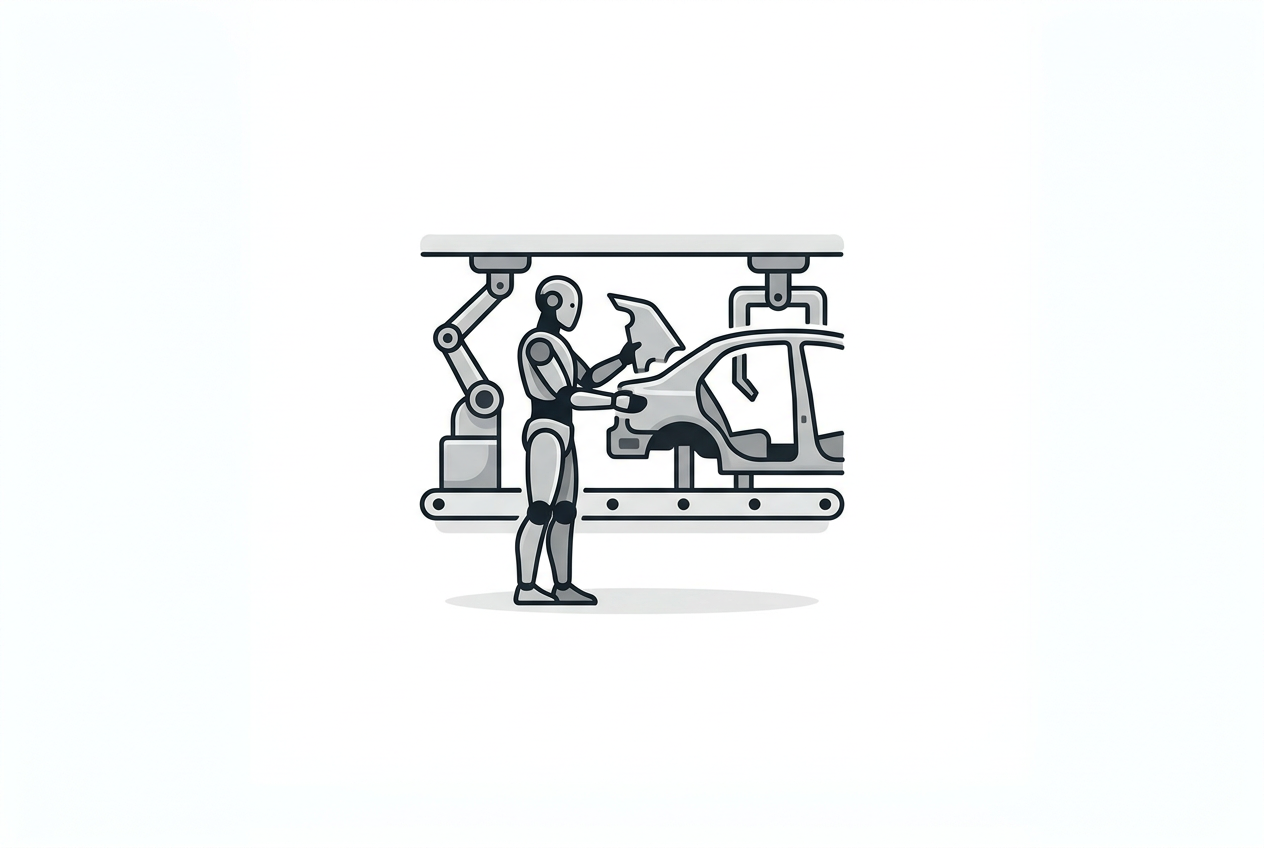
Now read what that fact actually contains. A task: insert sheet metal. A duration: eleven months. A backdrop count: 30,000 vehicles.
What it does not contain: how many robots ran, how many operators supervised them, how often a human intervened, or what percentage of scheduled uptime the robot actually hit.
The 30,000 figure is a vehicle count, not a robot-throughput number. It measures how many cars rolled off a line that a Figure 02 happened to be standing beside. It says nothing about how much of that work the robot did unassisted.
This is the pattern, not the exception. And BMW's next move makes it clearer.
Figure 03 is now headed to Spartanburg for a "sequencing use case in logistics." Here is the entire published spec: components arrive in larger containers, unsorted; Figure 03 picks them up and sorts them into a sequencing trolley; the trolley goes to a collection point; a tugger train or transport robot carries the parts to assembly employees "just in sequence."
That is a task description. Read it again and look for a throughput target, an autonomy percentage, an intervention rate, a robots-per-operator figure. There is none.
BMW describes what the robot will do, never how well or how alone. The press release lists new hardware—soft components for safety, wireless charging, tactile-sensor hands, palm cameras—as capabilities, not as results. Capability is what a robot can do in principle. Production metrics are what it did last Tuesday. Only one of those is being published.
Now watch the business model, because this is where the missing metrics go to hide.
Schaeffler's deal with UK firm Humanoid is structured as Robot-as-a-Service. Under it, Humanoid supplies the robots, fleet-management connectivity, maintenance, software updates, 24/7 technical support, and ongoing operational management—all bundled.
Motion's HaaS model is the same shape, more explicit: "one monthly fee with no upfront capital, covering everything adoption requires: data collection, robot selection, task training, IT integration, fleet management, financing, insurance, compliance and maintenance."
Read that list as a customer would. Every human function needed to keep the robot working is folded into a single line item the customer never sees decomposed.
"24/7 technical support" and "ongoing operational management" are where interventions live. If a robot stalls on a mis-sorted bin, a human resolves it—and under RaaS, that human is the vendor's cost, absorbed into the monthly fee, never surfaced as an intervention count on the customer's dashboard.
This is the elegant part. The subscription model doesn't just sell reliability; it structurally prevents the reliability question from ever being asked in numbers. The customer buys an outcome and a flat rate. Whether that outcome took one supervising engineer per fifty robots or one per three is precisely the information the pricing model is designed to make irrelevant to the buyer.
The subscription model doesn't just sell reliability; it structurally prevents the reliability question from ever being asked in numbers.
Stevens says the goal is that "hiring a robot should be as easy as hiring a person." The slogan works only if nobody asks how many people it takes to run the robot. HaaS is the answer engineered so that nobody has to.
And there is a tell inside Humanoid's own stack. Its KinetIQ framework has a System 2 layer that "evaluates execution, and escalates to human assistance when required." Escalates to human assistance. The human backstop isn't a hidden failure mode—it's a documented feature of the architecture. The only undisclosed number is how often it fires.
Now the actuator deal, which is where the real bet shows itself.
Alongside the deployment, Schaeffler and Humanoid signed a five-year supply agreement making Schaeffler the preferred supplier for more than 50% of Humanoid's actuator demand through 2031—a seven-digit number of actuators.
Forbes did the arithmetic. At roughly 18 to 22 relevant actuators per wheeled robot, a million-plus actuators at 50% coverage could correspond to around 100,000 robots over five years. That is an analytical estimate, not a stated unit target—but the direction is unmistakable.
Compare the two commitments. The deployment number is soft: "a four-digit number" by 2032, expanded from "several hundred," with phase one just box-handling at Herzogenaurach and a capability demonstration at Schweinfurt.
The actuator number is hard. It is a binding, dated, quantified supply contract with a component maker who books revenue on volume, not on autonomy.
That asymmetry is the argument. When a deal's most concrete, most binding figure is a component count and its softest figure is the deployment count, the real bet is on manufacturing volume, not on proven work.
Schaeffler behaves accordingly. Its COO frames the company's role as "serving as a preferred supplier of actuators," and its CEO reportedly says Schaeffler's humanoid robotics division is engaged with roughly 45 humanoid players and expects an order book in the hundreds of millions of euros by 2030. It has separately committed to at least 1,000 robots from Hexagon and a partnership with Neura that could reach 4,000 to 6,000 units.
That is not a bet on any one robot succeeding. It is a bet that many robots ship and every one of them needs joints. Schaeffler wins on component volume whether or not the autonomy ever arrives.
Even the humanoid.guide analysis, no skeptic, concedes the point: the Schaeffler contract is "a credibility test," and the next milestones are "operational rather than promotional"—"evidence that the service model can support larger fleets." Translation: nobody has shown the fleet-per-operator ratio yet either.
A scattered set of signals shows the industry knows exactly which number matters. Agility's job post for a systems engineer to own architecture "once the robot is on a live floor" is a tell—Digit isn't hiring for the lab anymore. Mobileye's Mentee unit is pivoting AV productization experience into humanoids, betting that "economically viable systems in the real world" is the unsolved part.
Everyone is organizing around live-floor operation. Nobody is publishing what live-floor operation costs in human labor.
So here is the standing challenge, unchanged from prior issues and still unmet. Not a demo. Not a vehicle count that happens to include a robot. One number: a robots-per-operator ratio, or an intervention rate, and ideally the same number a quarter later showing it fell.
Figure 02's eleven months at Spartanburg is real, and it is the strongest evidence we have. That it still ships without an operator ratio, an intervention count, or an uptime figure is not an oversight. Under the model everyone is now adopting, it's the design.
Until one of these companies publishes the ratio, "operating in production" means a supervised task with an undisclosed human backstop—and the monthly fee is what keeps the backstop off the invoice.