
On August 17, a humanoid robot called Superman clocked 12.66 meters per second, beating Usain Bolt's record, and then ran face-first into a wall.
Two days later, its maker, Unitree, listed on Shanghai's Star Market and the shares leapt roughly 460 percent, touching 1,100 yuan. Then they did structurally the same thing Superman did.
Over the following nine trading sessions the stock shed close to half its value, falling as low as 555.80 yuan, wiping out about 216.4 billion yuan — roughly $30 billion — of market capitalization.
The record and the crash were the same event. That is the governing fact of this sector right now, and it applies to more than one robot.
The record and the crash were the same event. That is the governing fact of this sector right now, and it applies to more than one robot.
Last week this column tracked the IPO pop and the Morgan Stanley-fueled PR frenzy around it. This week the tape corrected, insiders started using words like "sobriety," and the two loudest stories about humanoids — the bull case and the China-dominance case — turned out to rest on the same mistake.
Both mistake countable proxies for the one thing that actually decides who wins.
Start with the price move, because it looks like information and mostly isn't.
Only 7.4 percent of Unitree's shares were available for trading. That tiny free float, analysts agree, is what amplified both the 460 percent launch and the 44-to-48 percent slide — blind retail speculation swinging a thin market in both directions.
At the trough, Unitree traded at a static price-to-earnings ratio of about 877 times. The average for China's general equipment manufacturing sector is 38.56 times.
"The market is voting with its feet, not because Unitree isn't good, but because the valuation got too high," veteran robotics investor Jin Nan told China Business Journal.
Read carefully, "investors reassess humanoid valuations" translates to something narrower: investors discovered that a robot company is not a foundation model, and cannot be priced like one.
The underlying business did not break during those nine days. Unitree turned its first-ever half-year profit — 274 million yuan against a 32 million yuan loss a year earlier — on revenue up 48.5 percent to 1.15 billion yuan.
But growth slowed hard from the 330-plus percent revenue expansion of 2025, profit before one-off items actually fell 19.3 percent, and hardware still accounts for nearly 99 percent of the top line. The company also lost its shipment crown to AgiBot, which delivered about 8,400 units for a 44 percent global share against Unitree's roughly 5,900 and 31 percent.
None of that is a catastrophe. It's simply a hardware company growing like a hardware company — which is fatal only if you paid an 877x multiple for a software revolution that hasn't shipped.
Founder Wang Xingxing has said as much. At the World Robot Conference he told the room that factory adoption remains limited by weak efficiency and generalization, and that embodied AI may be two to ten years from its "ChatGPT moment."
That two-to-ten-year range is precisely what the selloff repriced. The stock wasn't correcting on bad news; it was correcting on the founder's own honesty.
Now turn the identical skepticism on the story running in the opposite direction: that China has already won.
The evidence looks overwhelming. Around 95 percent of the world's humanoids are made in China. Chinese vendors took the top five global shipment slots in the first half. Chinese entities hold six of the top ten spots in a LexisNexis innovation ranking and 73 percent of morphology-related patents.
Each of those is a countable proxy. None of them measures whether the machines do paying work.
Take the patents first. A 73 percent share of morphology filings is not 73 percent of the useful robotics in the world; it is 73 percent of the paper. Patents are, as one analyst put it, paper promises — legal moats, filed under a national policy that treats patent counts as a strategic target. Quantity filed to block rivals is not the same as capability shipped.
The 1980s rhyme is worth noting: Japan dominated semiconductor production while the U.S. kept design and IP. The scoreboard that mattered was not the one everyone was counting.
Now take the shipments, which are the more seductive number because they sound like demand.
They aren't, mostly. More than 60 percent of global humanoid shipments in the first half still went to entertainment, performance, data production, and research — not to industry.
And inside China the concentration is starker. In the first half of 2026, up to 70 percent of the humanoids made there — roughly 13,000 machines — went to state-backed training centers.
These are not customers in any normal sense. They are 53 built facilities, with another 34 planned or under construction, where robots spend hours mimicking humans to generate training data. Around four-fifths are state-backed, often structured so a local government buys the humanoids and sells the resulting data back to the maker.
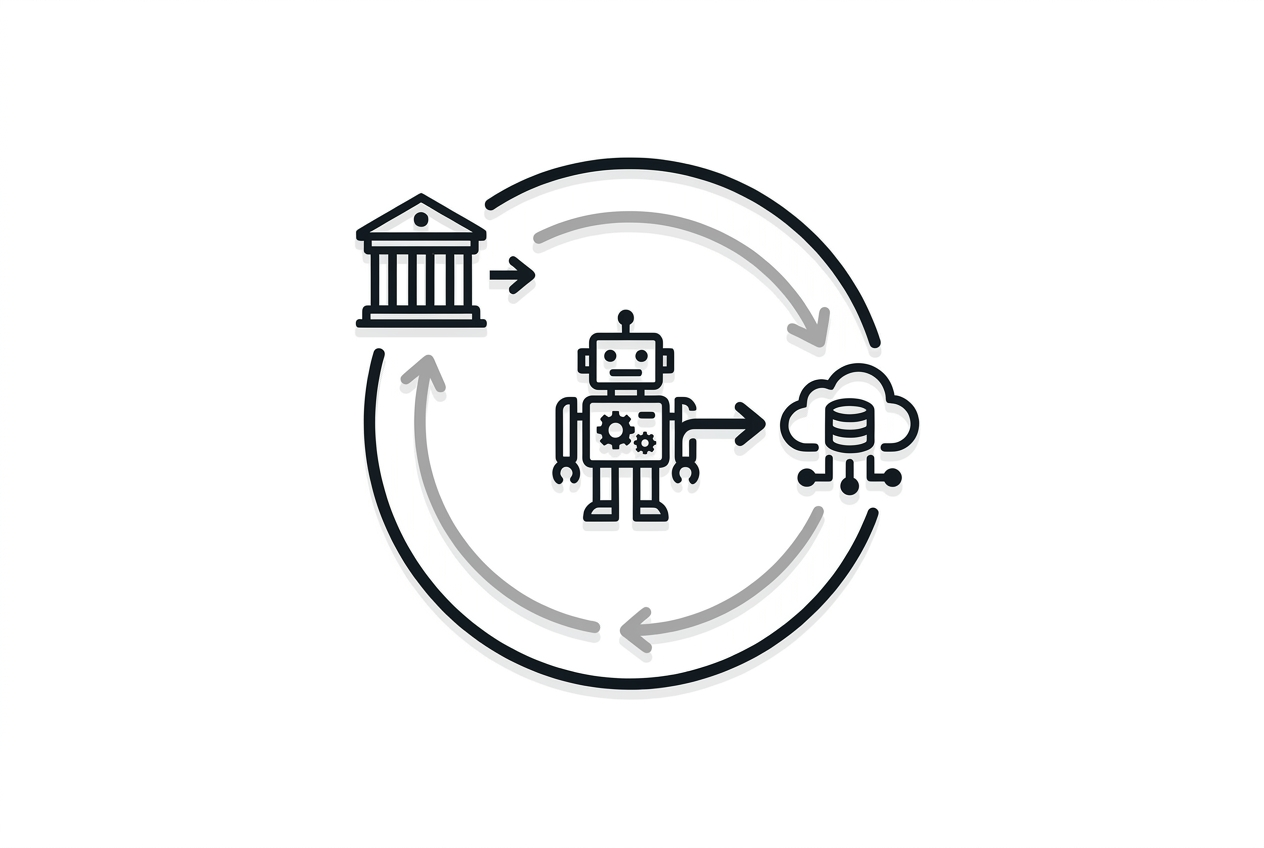
That is a subsidy loop wearing the costume of a market. A local official builds a center to "shore up demand for robots that are being manufactured in their area." The shipment gets counted. The capability does not necessarily exist.
The economics inside those centers are their own reality check. For every eight hours of coffee-pouring at a training station, a robot produces just three hours of usable data; the rest is spoiled by errors engineers don't want the machine to learn.
HSBC's Corey Chan reckons that runs 500 to 700 yuan per hour, and one estimate puts the total requirement at 100 million training hours to build a robot that handles a wide variety of daily tasks. This is the cost of the software gap, itemized — and it is being paid largely by the state, not by anyone buying a robot to do a job.
So the volume story and the price story collapse into the same admission. Shanghai's tape was measuring speculation on a 7.4 percent float. The shipment charts are measuring subsidy and demos. Both were built, consciously or not, to stand in for a capability nobody has yet demonstrated at scale.
Which brings us to the only scoreboard that would settle any of this.
Agility Robotics co-founder Jonathan Hurst put the frame bluntly: "There's so much hype and so much storytelling that is not connected to reality," and the work that matters "rarely goes viral."
The metrics that decide whether a humanoid is real infrastructure are not sprint times or patent tallies. They are uptime, intervention rate, recovery after faults, maintenance hours, and task performance across changing sites.
Those are field traces. They come from robots doing the same job, day after day, at multiple locations, with the failures logged rather than edited out.
The experts building the models say the same thing in a different accent. Physical Intelligence's Karol Hausman admits people "are not very good at judging progress in robotics" — a robot can do a backflip and still fail to pick up a Coke can. Genesis AI's Theophile Gervet calls manipulation "the really, really core unsolved problem" that unlocks 90 percent of the value.
Dancing is easy, as one roboticist noted, because "the floor doesn't do anything." Superman ran faster than Bolt because running, too, is mostly a floor that doesn't fight back. The wall is where it got interesting.
Here is the point that both the bulls and the China-hawks miss: nobody has put the real scoreboard on the table. Not Unitree, not AgiBot, not Figure, not Agility. Not the Shanghai tape, and not the LexisNexis chart.
The market didn't lose faith in humanoids over those nine days. It started, clumsily and through the wrong instrument, to price the software gap the volume story existed to hide.
What happens on a factory floor — the uptime numbers, the robots-per-operator ratios, the economics of renting a humanoid by the hour — is a separate reckoning, and a real one. That story is coming.
But it will be won by whoever publishes the field traces first, in whatever language. Until then, every record run ends the same way. Fast, spectacular, and into a wall.