"We have commercialized."
That is Agility Robotics CEO Peggy Johnson, three words in TechCrunch, past tense, on what sets her company apart. It is a remarkable thing to say. It is also a claim that invites exactly one question: commercialized measured by what?
In the same stretch of days, Agility opened a new Fremont facility—"a physical AI hub in the heart of Silicon Valley"—and announced it was hiring nearly 200 people to run it. Johnson also laid out "six pillars for a healthy humanoid regulatory environment," arguing the U.S. must lead and that building humanoids at home "hardens a critical industry — much like semiconductors."
What the company did not publish, in that same week: an intervention rate. An autonomous revenue figure. Any generalization metric. Anything that would let an outsider check whether Digit works without a human quietly steering it.
That gap is the whole story. And Agility is not alone in it.
Line up the quarter's commercialization claims and a pattern appears immediately: every single one cites a proxy the company controls, and none cites the one output that would prove the robot actually works.
Samsung reportedly reorganized much of its robot business into a new "RX Business Promotion Office" under CEO TM Roh, pulling scattered teams into one control tower explicitly to drive "commercialization." It reportedly recruited a Boston Dynamics strategy alumnus, and two university professors are reportedly set to join. It announced, per BigGo Finance, a 60 trillion won investment plan for South Korea's Yeongnam region and a "Data Factory" at its Gumi plant to collect behavioral, visual, and tactile data at scale.
Count what Samsung is counting: org charts, headcount, floor space, capital, data volume. Every one is an input. None is a robot completing a shift on its own.
ILE, in Korea, reportedly announced it is "expanding the supply" of its ILBOT humanoid, citing an initial supply contract with "Company H" worth roughly 3 billion won and its Cheonan smart factory running ILBOT "on mass production lines at all times." Its representative was explicit about the theory: "The competitiveness of humanoid robots depends on how much operational data can be secured from real industrial sites."
Again—contract value, hours on the line, data accumulated. Inputs. ILE frames the factory as a place to "simultaneously improve manufacturing automation and AI performance," which is another way of saying the robots are still being taught while they run.
Yuequan Bionics, in China, reportedly raised hundreds of millions of yuan and announced mass production of 10,000 bionic dexterous hands with orders reportedly exceeding 100 million. Its flagship hand's palm weighs 299.7 grams and the hand packs 26 degrees of freedom; a second model claims 38, billed as the world's highest-degree-of-freedom bionic dexterous hand.
Those are hardware parameters. Even Yuequan's own coverage concedes the sector is trapped in an "involution" of "competing for hardware parameters such as degrees of freedom and torque"—stacking joints because joints are countable.
So four companies, four "we're commercializing" postures, four sets of numbers—and the numbers are all headcount, hardware output, supply contracts, and data collected. Not one is an autonomous intervention rate that falls over time without a human in the loop.
Here is why that omission is not an oversight but a structural tell. The proxies do not just fail to prove autonomy. They actively disguise the absence of it.
Nikita Rudin—who reportedly was part of the team behind Isaac Gym and Isaac Lab at NVIDIA before founding Flexion—lays out the mechanism. Teleoperation and human demonstration have become "the dominant method for training physical AI systems," and a majority of the billions raised in the last 18 months is, per Rudin, "quietly funding hiring humans to operate robots."
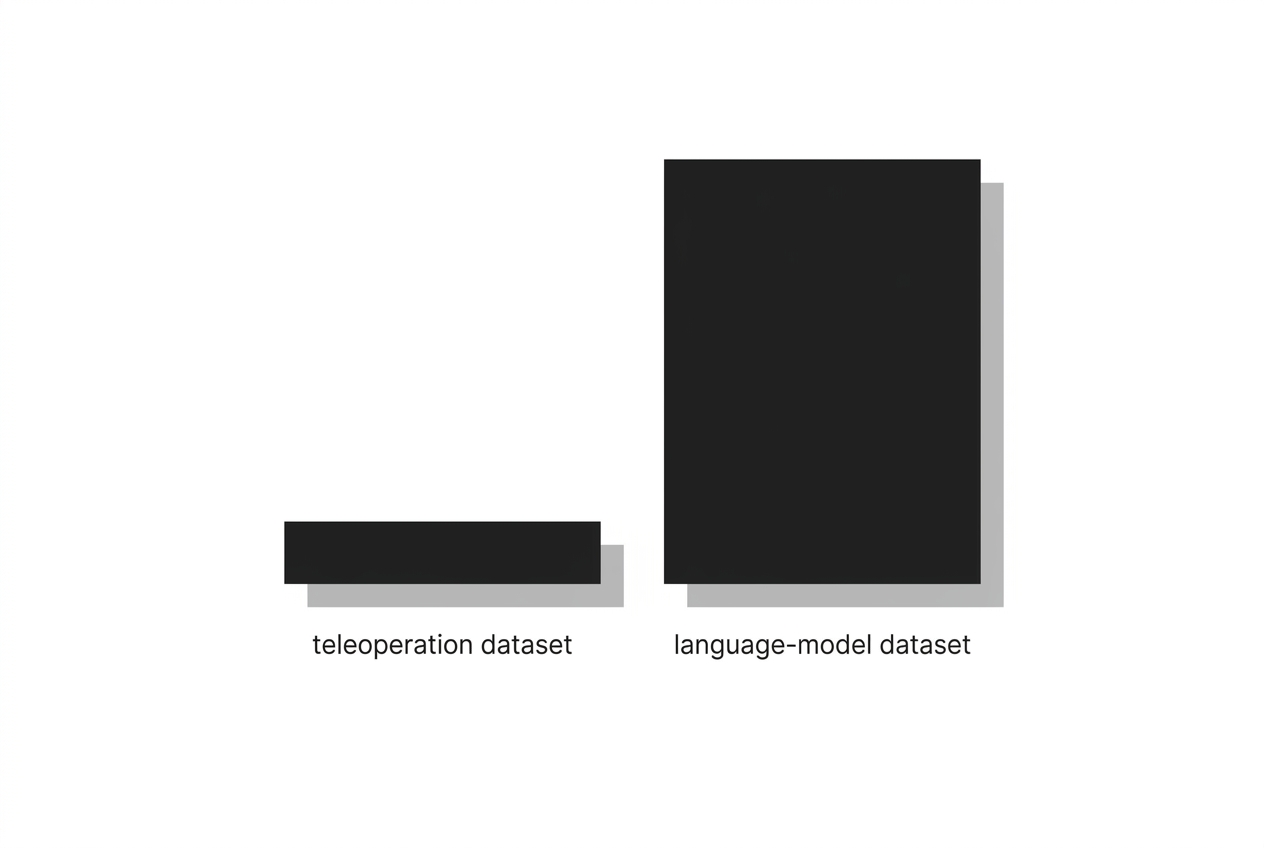
His key number: teleoperation datasets are "over 100,000 times smaller than what's used to train today's language and vision models." And that gap does not close by hiring more operators, "because the real world never stops changing." A shelf moves, a door handle differs, a new package appears—each variation demands a fresh demonstration. The problem grows faster than the workforce.
Which produces his sharpest line, and the one every claim above should be read against: "A system that can't handle anything new without fresh human input is essentially just a labor system."
A system that can't handle anything new without fresh human input is essentially just a labor system.
Now re-read the proxies. A 200-person hiring wave. A Data Factory built to collect demonstrations at scale. A smart factory generating operational data "at all times." These are not evidence of autonomy approaching—they are the operating cost of a labor system, dressed as momentum.
Rudin names the sleight directly. The field "is tracking what's easy to count — demonstrations collected, hours of footage logged, tasks completed in controlled settings — none of which tells you whether the robot can handle something it hasn't seen before, in a place that wasn't set up for it."
Building more of that infrastructure, he warns, "deepens that dependency on humans rather than resolving it." The counting is not neutral. It points away from the thing that matters.
And there is a version of this that is fine. For "narrow, repetitive tasks in controlled environments," Rudin allows, teleoperation as a bridge "is fair." The problem is the account nobody provides: "If you don't have data showing the dependency on humans reduces over time, teleoperation moves from a stopgap to the permanent method."
Dependency reducing over time. That is the intervention rate again, from a different direction. It is the exact figure Agility has not published while declaring itself commercialized.
Burro's Vibhor Sood explains what that missing number actually protects against—the collapse between a demo and a deployment.
"In 2018, Burro did a demo. The robot worked. We were excited. We thought we understood the problem. We did not understand the problem."
A demo, he writes, "is a proof of concept for a best-case scenario." It is emphatically "not a proof of concept for Tuesday morning in November when it's raining, and the lighting is flat, and a worker approaches from an unexpected angle, and the robot is operating in a country it has never been to before."
That is the line the whole sector keeps stepping over. "We have commercialized" is a statement about the best case. Tuesday morning in November is the actual case, and the only way to know a robot survives it is to measure how often a human has to save it.
Sood's second lesson raises the bar higher still. Once a customer depends on a system, "when it fails, they are not mildly disappointed. They are angry in the way you are angry when critical infrastructure fails." The reliability threshold that shift creates "is higher than any lab environment will prepare you for."
A Data Factory in Gumi does not clear that bar. A 3-billion-won contract does not clear it. Ten thousand dexterous hands off a line do not clear it. Only sustained performance without intervention does—and none of it can be "solved from inside a lab," or "through simulation alone, no matter how sophisticated the simulation becomes."
So here is where the quarter lands. "Commercialized" has become a load-bearing marketing term with no auditable definition under it. Every company ramping "production" is measuring inputs it controls, because those inputs are easy to count and flattering to report.
The one output that would settle the argument—an intervention rate trending down, with no human in the loop—remains conspicuously unpublished by all of them.
Until that number appears, read "commercialized" for what it is: an accounting of what's easy to count. Not proof that the robot works on Tuesday morning in November when it's raining.
The company has since claimed the past tense. The figure is still missing. That absence is the finding.