"We banned @AnthropicAI last week and have never had a better time agentic coding than we are now with @Zai_org GLM 5.2 and @opencode."
That's Comma.ai, a company that raised over $800 million, announcing that it dropped a frontier lab in favor of a Chinese open-weights model. The kicker: "Our GLM runs downstairs, right next to the machines training our open source driving agent."
The tweet ends with a battle cry. "Open source is dying. We raised over $800M to save it."
It's a good post. It's also the wrong lesson, or at least a much narrower one than the retweets implied.
Because the thing that made Comma's switch rational isn't the thing the tweet is celebrating. It isn't that open weights caught up. It isn't the headline price. It's the word "downstairs."
The thing that made Comma's switch rational isn't the thing the tweet is celebrating. It isn't the headline price. It's the word 'downstairs.'
Start with the number that undermines the triumphalism. On SWE-Marathon, a difficult long-duration agentic coding benchmark, GLM 5.2 completed just 13 percent of tasks. Anthropic's Claude Opus 4.8 doubled that.
Opus also took wins of 10 percent or more over GLM in NL2Repo, DeepSWE, and Tool-Decathlon. Z.ai's own launch-day research report—which you'd expect to be generous to its own model—claims outright wins only in two easier reasoning benchmarks, and none in coding.
So the frontier still holds where the work is hardest. GLM ties or nearly ties on some agentic benchmarks like FrontierSWE and PostTrainBench, but the gap widens exactly as the tasks get longer and gnarlier—the tasks that actually justify a frontier lab's price.
Which means the practitioners aren't replacing anything. They're routing.
Zain Hasan, an AI engineer at Together AI, describes the workflow plainly: send the hard reasoning problems to a frontier model like Anthropic's Fable, and send the straightforward stuff to something cheaper. Right now the cheaper thing is GLM 5.2.
David Nix, a principal engineer at MetaRouter, estimates GLM handles 10 to 20 percent of what he sends an LLM on a given day. He reportedly says it's "really close" to Opus and GPT-5.5, close enough to earn a permanent rotation slot, and that it's his first stop for some specific tasks, such as front-end design.
Hasan says GLM has "really good taste" in web design. Kacper Michalik at Screen Studio got good results generating web forms. The pattern is consistent: bounded, well-specified, front-end-flavored tasks. The easy tenth to fifth of the pile.
And the cheapness has a ceiling too. Sai Kiran Myadaram at Bengaluru's Indhic AI signed up for Z.ai's subscription the week GLM launched and exhausted his weekly quota in "less than two to three days."
That's the collapse in miniature. GLM's API runs $4.40 per million output tokens—under a fifth of Opus 4.8, a tenth of Fable. Per token it's a bargain. Run it at real agentic volume, on long-horizon work, and the quota evaporates in a weekend.
So the price advantage is real but conditional. It survives on the easy 10-to-20 percent of tasks. It does not survive at the frontier, because there you either burn through your quota or you don't complete the task at all.
Now back to Comma.ai, and the actual reason the switch was rational.
Comma trains an open-source driving agent. That is a physical-AI workload built on proprietary sensor data—the exact kind of data a company should not be piping through someone else's API, least of all a competitor's.
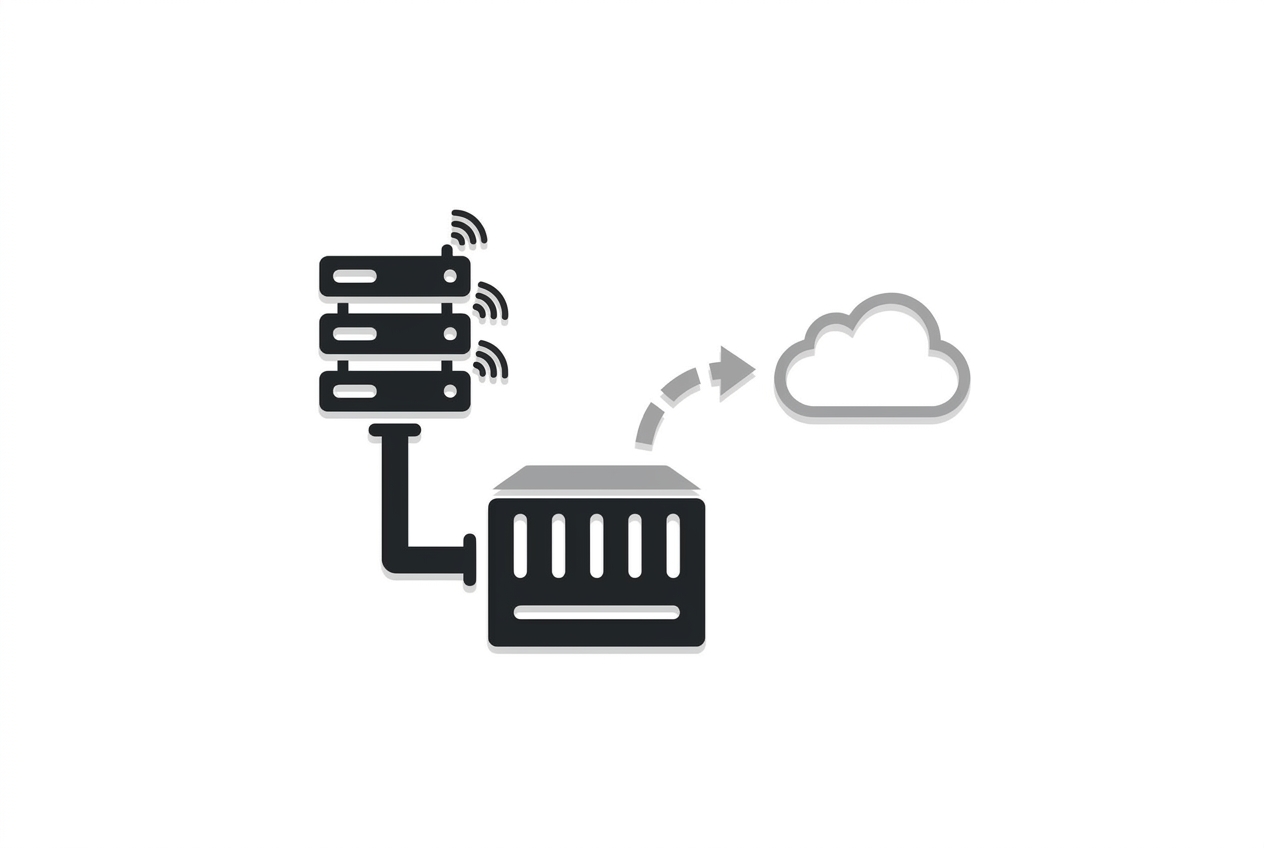
GLM 5.2 is released under an MIT license with 753 billion parameters, only 40 billion active at once. Anyone with sufficient hardware can download it and run it. Comma has the hardware; it's already running training rigs downstairs.
That's the whole play. The deciding factor wasn't capability and it wasn't the per-token price—it was self-hosting a sensitive workload on machines Comma controls.
This is the one thing gated frontier APIs structurally cannot offer. As IEEE Spectrum puts it, most frontier-level models are locked behind an API with no self-hosting option. You cannot run Opus 4.8 downstairs.
For a company nervous about routing proprietary data through external infrastructure—and, given GLM's Chinese origin, plenty of U.S. firms are nervous about routing data to Z.ai's API specifically—open weights provide the out. You take the weights and cut the network out of the equation entirely.
Note what this is not. It's not a network-reliability story and it's not a silicon-vendor story. The forcing function here is data control and token economics, full stop. Comma didn't self-host because the cloud is flaky; it self-hosted because the workload is sensitive and the weights were downloadable.
Which is why "open source is dying, we raised $800M to save it" reads better than it argues. Comma didn't prove open weights beat the frontier. It proved that when your workload demands on-prem control, a good-enough open model you can run yourself beats a better model you're forbidden to touch.
That's a specific constraint. Outside it—when you can use an API, when the task is hard, when volume is high—the cost advantage falls apart, as Myadaram's two-to-three-day quota burn shows.
So the real fracture in coding economics isn't open-versus-closed. It's vertical and deployment lines, and the market is already sorting itself along them.
Google is building the specialization tier explicitly. Gemini 3.6 Flash is pitched for "writing production-ready code faster without getting stuck in loops." 3.5 Flash-Lite is the "fast, cost-effective model for scaling repetitive use cases like sorting tickets and extracting data."
This is a menu—cheap, cheaper, and specialized—designed to capture exactly the 10-to-20 percent that people currently hand to GLM.
Which surfaces the uncomfortable part for the open-weights victory lap. The frontier labs' widest moat may not be capability at all.
Hasan names it directly: most companies are still figuring the technology out, "and so there isn't really a token budget." When someone else is paying, the rational move is to skip tabulating costs. "The easiest thing is to pick the most powerful model."
Read that again. The moat protecting the U.S. frontier labs is that engineers don't bother to check the bill.
Every routing story—Hasan splitting tasks by difficulty, Nix reserving GLM for front-end, Comma running weights downstairs—is an act of price discipline. It requires someone to care what a coding project actually costs.
Comma cares because Comma controls its own stack, hardware and data both, and can act on it. Most companies don't, and won't route, and will keep reaching for the most powerful model because no one is counting.
That's the sober read on the swagger. GLM 5.2 downstairs is a genuine production defection, and a real signal about where the easy tokens are going.
But it saved open source only for companies shaped exactly like Comma: sensitive physical-AI data, on-prem hardware, engineers who count. For everyone else, the frontier's moat isn't the benchmark. It's the invoice nobody opens.