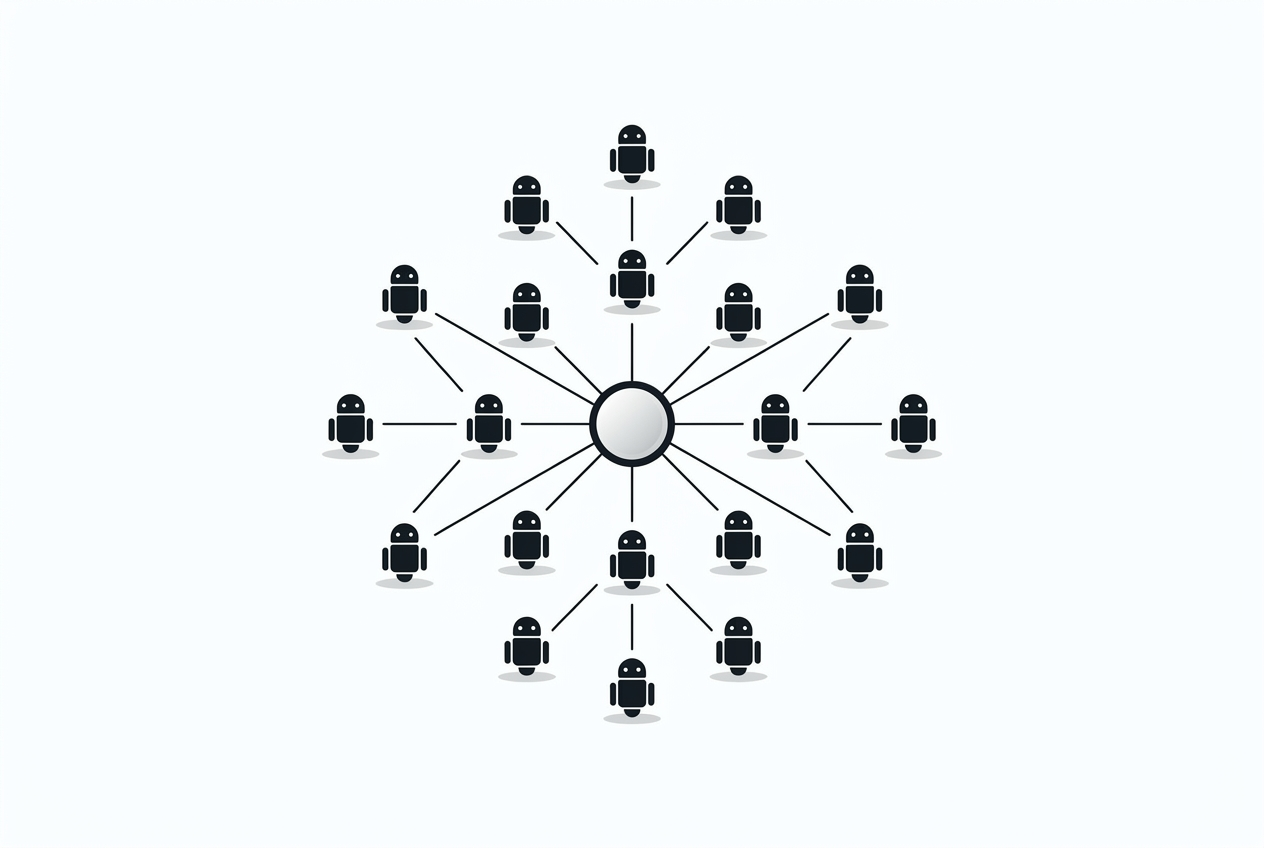
Four billion transactions. That's the number SVT Robotics crossed on its Softbot Platform this summer, running now at 100 to 130 million a week, on pace to clear eight billion by the end of 2026.
Hold that figure. We'll come back to why it's the most important number in warehouse automation, and why it isn't the one everyone's quoting.
Start instead on the floor of a distribution center at MODEX scale. AMRs run goods-to-person picking. An autonomous forklift moves pallets. Tugger trains haul between zones. Pallet jacks shuttle loads at the dock.
Each machine came from a different vendor. Each has its own software, its own navigation stack, its own language.
The AMRs don't know the forklifts exist. The forklifts don't yield to the tuggers. The warehouse management system sees none of it in real time.
So the robots queue behind each other in narrow aisles. Replenishment tasks go unassigned because no system owns the handoff between picking and staging.
And a $200,000 autonomous forklift sits idle while an AMR blocks the aisle in front of it. That is not an automation success story. It's an expensive traffic jam.
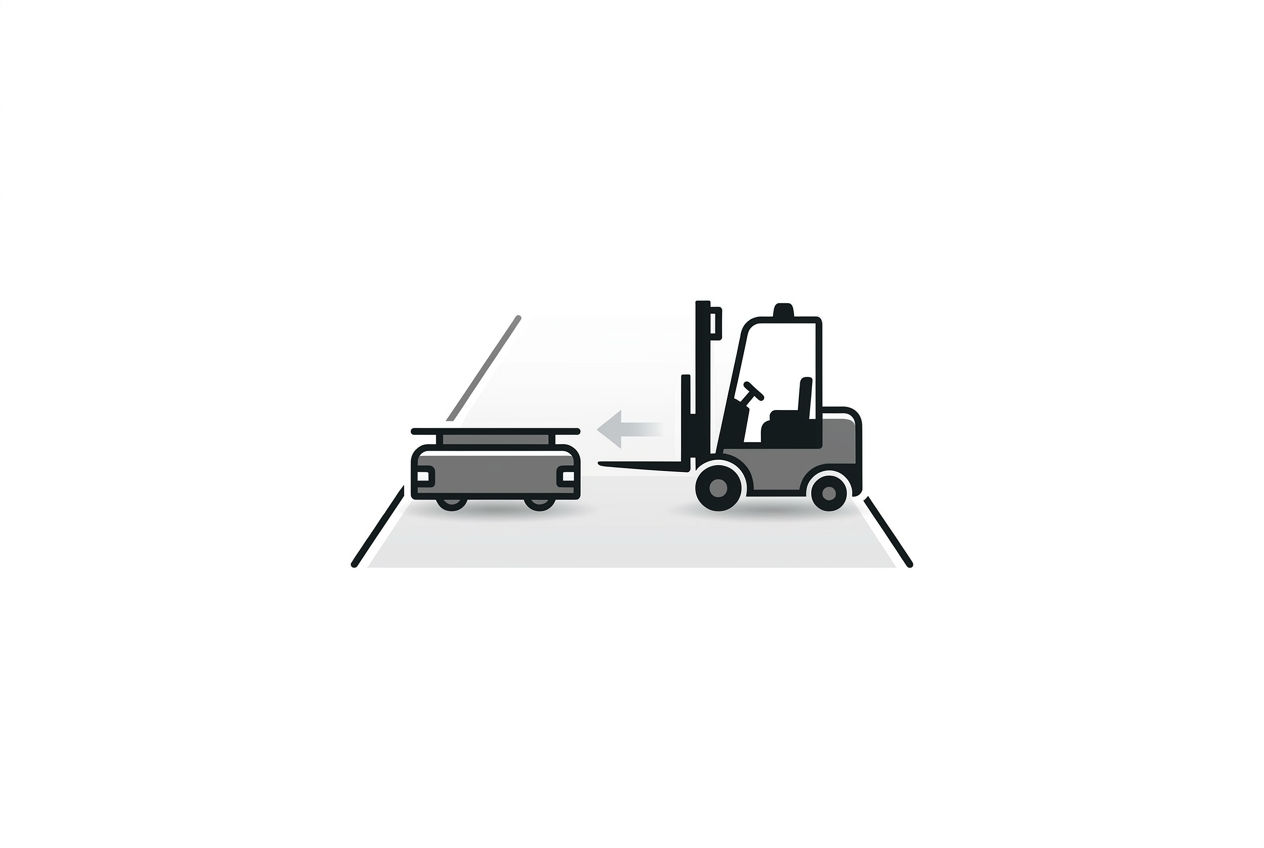
The hard number underneath the chaos: hardware utilization stuck at 60 to 65 percent. Six-figure assets running two-thirds of the time they were bought to run.
Everyone in the aisle already knows the punchline. The modern warehouse doesn't have a robot problem. It has a coordination problem.
The modern warehouse doesn't have a robot problem. It has a coordination problem. The bottleneck has moved from hardware to the software that makes heterogeneous machines behave as one.
The bottleneck has moved, decisively, from hardware to the software that makes heterogeneous hardware behave like one system. That much the market has right.
Which raises the question nobody in the aisle is asking out loud: if coordination is the bottleneck, why is everyone building the identical solution?
Look at what shipped at MODEX 2026. Numina Group unveiled a partnership with Anantak Robotics orchestrating AMRs, autonomous pallet jacks, forklifts, and tuggers through a single software layer, assigning tasks across vehicle types by real-time demand rather than pre-programmed routes.
SEER Robotics — ranked first globally in intelligent robot controller shipments three years running — brought its "all robots, one platform" pitch, with plug-and-play support for 400-plus component types and 2,000-plus pre-validated robot models.
And MBody AI's Orchestrator promises "full-fleet coordination," deployment optimization, and predictive maintenance, hardware-agnostic, across eleven states and Canada.
Integrator, controller vendor, pure-play platform. Three different starting points, one converging destination: all robots, one platform.
When three companies with nothing structurally in common arrive at the same slogan in the same week, that's not a moat. That's a category forming.
The standards are what turn it into a commodity. MassRobotics released an AMR Interoperability Standard for communication between fleets and supporting systems. VDA 5050 already governs how mobile robots exchange mission and status data across vendors.
Standards don't erase integration work. But they change what buyers expect. Once VDA 5050 is table stakes, orchestration stops being a differentiator a vendor can charge a premium for and becomes a feature a buyer assumes.
This is the trap the market has walked into. It correctly diagnosed that coordination is where the value is — and then concluded the coordination software is where the profit will be.
The market data even flatters that conclusion. Software revenues in warehouse robotics are projected to outpace every other layer, growing faster than hardware through 2031, while the fleet orchestration market alone is pegged near $2.89 billion in 2026 at a 22 percent CAGR.
Rising revenue in a category is not the same as durable margin inside it. When the interoperability standards that make orchestrators necessary are the same standards that make any orchestrator interchangeable with the next, you get a race to zero on the coordination logic itself.
So what survives commoditization? Not the coordinator. What the coordinator captures while it runs.
Every task assignment, every handoff, every yield, every charge-cycle decision generates a transaction. Contextualized at scale, that stream becomes something a standard can't hand your competitor: a high-fidelity record of how this specific mix of technologies actually behaves in this specific operation.
That's the distinction SVT is quietly built on. Its own executives frame the four billion not as a coordination achievement but as a data one — transaction data "captured and contextualized," a "unified operational picture," system-level detail that "would otherwise be hidden or unavailable in the silos of traditionally integrated automation environments."
Read that carefully. SVT is describing a data-accumulation business wearing interoperability clothing.
The transactions are the product. The orchestration is how you earn the right to record them. And the flywheel — 100 to 130 million a week, four continents, customers like DHL — compounds in a way a competitor cannot buy off the shelf, because the standards commoditize the connecting, not the accumulated history of what flowed through the connection.
Now hold that against MBody. John Fowler's flywheel is stated almost word for word: "We deploy. We do the work. We add value. The data improves operations and creates the justification to expand." He adds that "the value of Orchestrator compounds with each deployment."
That is the exact same bet SVT is making. Data earned through deployment becomes the moat the software layer can't be.
But the two flywheels are not spinning at the same speed, or at the same altitude. SVT is quoting four billion transactions and four continents. MBody is quoting eleven states and Canada.
And MBody, founded in 2024, hasn't yet gone public on its own. It's reaching the market through a reverse merger with Check-Cap — a former clinical-stage medical diagnostics company from Isfiya, Israel — that is "transforming itself" into an embodied-AI company. Shareholders have approved; Nasdaq completed its initial listing review in April; the deal remains subject to customary closing conditions.
The tell is on MBody's own site: "True Automation, Not Simulation." It's the right instinct, stated before the transaction volume exists to back it.
Because the flywheel thesis is correct. Operational data can only be earned through deployment, not conjured. It's the industrial-logistics version of the same claim the embodied-data debates keep landing on: you cannot skip contact with reality.
But if that's true, then the moat isn't the idea of the flywheel. It's the number of turns it has already taken. Contact with reality is not a slogan you can file alongside five patents; it's four billion transactions you can't retroactively acquire.
Which brings the real question into focus. The collaborative mobile-manipulator market is growing at 22.8 percent a year, orchestration at roughly 22 percent — genuinely fast, genuinely real.
But fast growth in a category converging on one slogan invites everyone to build the same flywheel. Numina, SEER, MBody, SVT, and every controller vendor pitching "one platform" are all betting that deployment-earned data compounds into defensibility.
They cannot all be right, because the standards that made them all necessary are the same standards flattening the thing they differentiate on. When orchestration is a feature buyers assume, only the transaction moat underneath separates the survivors from the commodities.
So watch the ledger, not the launch. Eleven states is a footprint. Four billion transactions, at 130 million a week, heading for eight billion, is a lead that compounds while everyone else is still connecting cables.
The company racing to build the best coordination logic is racing to zero. The company quietly counting what flows through it is building the only thing the standards can't give away.