Two men said the same thing this year, and only one of them meant it as a confession.
At Seoul's COEX in March, a Shanghai Jiao Tong researcher named Yan Weixin stood in front of a room full of Korean engineers and did the math on his own program out loud. His team had defined 33 fundamental hand motions. It had succeeded with 32.
The one that beat them was chopsticks. A task, as Yan put it, demanding "very precise force control and tactile perception." A task most five-year-olds master at the dinner table.
That is the whole industry in one number. Not 33 problems away from a working hand—one problem, and it happens to be the problem.
Not 33 problems away from a working hand—one problem, and it happens to be the problem.
The useful frame comes from Choi Hyouk-ryeol, a Sungkyunkwan University professor who runs the sensor firm Aidin Robotics. Walking, he says, is a "closed problem"—a flat factory floor is predictable, and mass data collection solves it. Manipulation is "open": every object, every surface, demands a different grip, and the tactile data needed to teach that sensitivity barely exists.
Close your eyes and pick up a paper cup, Choi says. Your hand instantly registers whether it's empty, half-full, or hot, and adjusts. A robot's camera sees the cup and has no idea how hard to squeeze.
This distinction matters commercially, not just academically. China ships, per the Wall Street Journal, roughly 87 percent of the world's humanoids, but a research fellow at Korea's KIET points out that most of those deployments are logistics and patrol—tasks that live in the legs. The 30 to 40 percent of an automotive line that generates real industrial value lives in the hand.
So the machine that walks your factory floor but can't insert a cable is, in her words, an expensive courier.
Now watch what everyone builds in response. Because the tell isn't in the marketing—it's in the convergence.
Walk the ICRA 2026 hall and the specs blur together. Wuji Hand 2: 20 degrees of freedom, full tactile arrays, under 570 grams. Xynova Flex 2: 23 DoF, 3D fingertip sensors, wrist camera. OmniHand 3 Ultra-M: more than 300 tactile sensing points across palm and fingertips, demonstrated folding a balloon dog, which the company notes is difficult because balloons are easy to pop.
The hardware is genuinely impressive. It is also no longer the point.
Look at what these same booths quietly position alongside the hands. TARS DexHand is described not as a hand but as "part of a larger hand-control and embodied-data system," covering tactile prediction and manipulation data collection.
And PaXini didn't just bring a hand. It brought PXCap V—a data-collection glove that doesn't grasp anything. It has 82 degrees of freedom, 30 six-dimensional tactile modules, and 3,015 tactile points, worn by humans to capture what video data cannot: contact, force, joint movement, and trajectory as a person actually manipulates an object.
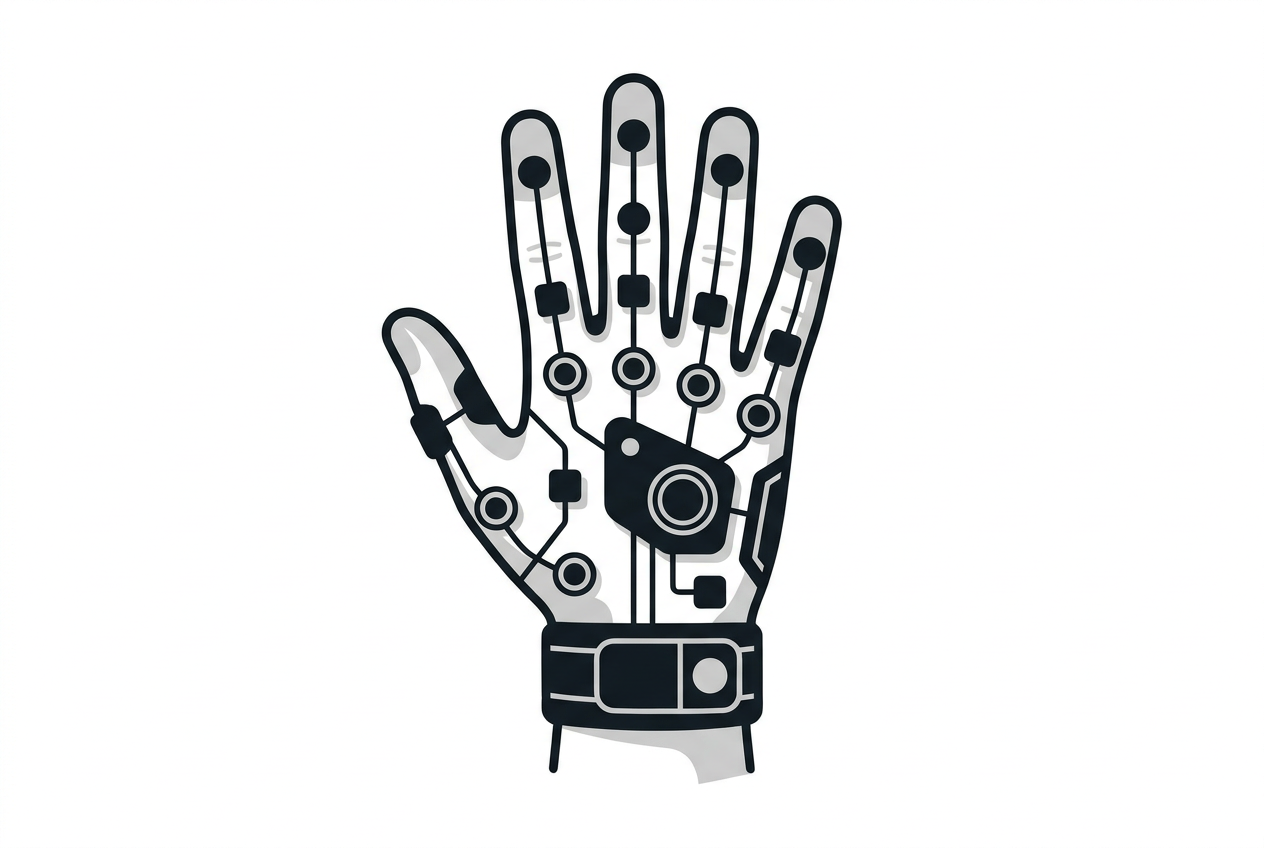
That is the shared secret hiding in plain sight. The fingers are the demo. The glove is the product.
ABB and Psyonic say it almost outright. Their collaboration takes the Psyonic Ability Hand—built originally as a human prosthetic—and puts the same hand on people and on robots, so touch and grip-force data from human prosthetic use can train the robot.
Psyonic's founder Aadeel Akhtar is blunt about why: "Dexterous manipulation is ultimately a data challenge as much as a hardware challenge."
Everyone has independently arrived at the same workaround. Robots still can't reliably feel their way through a task outside a demo, so you capture the feeling from humans first—gloves, prosthetics, headsets—and hope it transfers.
Which brings us to the lawsuit that everyone read as courtroom drama and almost nobody read as diagnosis.
Tesla accused Jay Li, who led technical work on Tesla's Optimus humanoid program, of downloading sensitive files on advanced hand sensors before he left in September 2024 and founding Proception days later. The designs, Tesla said, looked too similar. The timing looked too neat.
Then Tesla lost the part that mattered. A federal judge in San Francisco denied the injunction, ruling the company couldn't show strong enough odds of winning on the merits—even while conceding likely harm.
And on the same day the suit was dismissed, Proception announced an $11 million seed round led by First Round Capital, with Y Combinator and BoxGroup in. First Round's Bill Trenchard: "We think they will have the best hand in the market."
Read those two facts together and the diagnosis writes itself. The thing Tesla could try to protect—CAD files, sensor hardware designs—was exactly the thing a judge found didn't warrant an injunction. You can copy hardware files. Courts understand hardware files.
What you can't sue your way into owning is the capability, because the capability doesn't live in the files yet. It lives in data nobody has.
And notice what Proception's actual moat is. Not the 22-degree-of-freedom hand—though that puts it in rare company against the two-finger clamps that still dominate. The moat is a sensor-packed glove and headset that human testers wear to interact with objects, no robot in the loop, capturing task-specific movement at volumes video can't.
Li said it himself about hardware and data: "You need both." Investors didn't fund the stolen-CAD accusation. They funded the pipeline Tesla's files couldn't contain.
So the battleground is real. The hands are real. What's missing is the only number that would tell us whether any of this works.
Because right now the field is quoting projections and dressing them as results. ABB's headline—advanced gripping and digital integration can cut engineering time by up to 30 percent—is explicitly an International Federation of Robotics projection about tooling and integration broadly. It is not a measured outcome of the ABB-Psyonic work. Read the sourcing and the "up to 30%" evaporates into a forecast.
Meanwhile Sharpa, which ran autonomous manipulation demos in eight-hour shifts at CES, has a VP who names the actual bar. Alicia Veneziani says commercial deployment requires task success rates approaching 99.9 percent—and that Sharpa's tactile data is meant to push VLA models "toward" that number, which is another way of saying current systems don't hit it.
Eight hours of blackjack in front of a crowd is a reliability test. It is not a production intervention rate.
For manipulation, nobody has published a generalization number at all.
Northwestern's Kevin Lynch told reporters it could take another decade before robotic hands become truly functional in everyday settings. Musk has called the hand roughly half the engineering effort of the entire Optimus robot.
Take them at their word, and the convergence makes sense. Twenty-DoF hands with 300 tactile points aren't the breakthrough. They're the instrument you need to go collect the data that might, eventually, become one.
Until someone ships a real generalization number—a success rate on unseen objects, an intervention rate on a shift—force sensing remains a demo capability wearing a deployment costume.
China nailed 32 of 33 motions. The one it missed is the one you'd hand a toddler a bowl of rice to prove. Everyone racing to close that gap has landed on the same quiet answer: they can't teach the robot to feel yet, so they're paying humans to feel for it.
That's not a hardware launch. It's an admission, wearing gloves.