Two officials said two things at the same groundbreaking, and only one of them can be right.
Under Secretary of Commerce William Kimmitt framed the Louisiana steel mill as the template for reshoring: "We want the steel here. We want the parts here. We want the suppliers here... the entire industrial ecosystem here in the US." A hedge against imports, in other words — build the wall, then build behind it.
But Chung Euisun, standing on the same graded ground, described something a wall cannot protect: steel for humanoid robots, for AI data centers, for power generation, "SpaceX or for rockets." Not a defense against tariffs. A bet on a specific American industrial future.
The distinction matters, because one of these is reversible and the other is not.
Last week we tracked the trade-law machinery that turns policy volatility into an FDI drag. This week the story moves down to the ground itself — to the concrete being poured on it, and to what that concrete assumes.
Start with the scene, because the scene is the argument. On Friday in Donaldsonville, Louisiana, more than 250 senior officials and business leaders reportedly gathered on 7.37 million square meters of graded sugarcane farmland to celebrate a steel mill that does not exist.
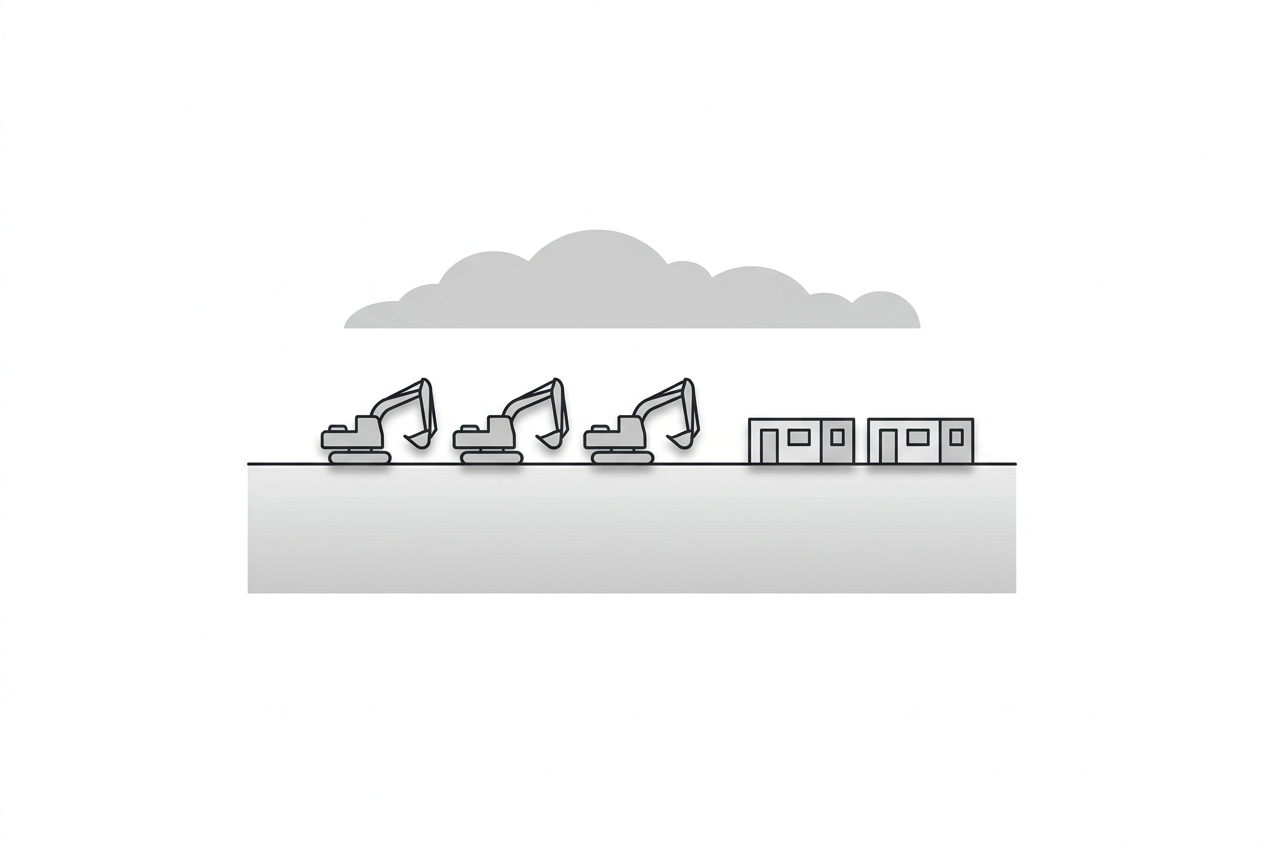
There was no mill. A handful of excavators, bulldozers and dump trucks, some temporary buildings serving as site offices, and rain earlier in the day. Full-scale construction begins in the fourth quarter, once permitting clears. Commercial production is targeted for the first quarter of 2029.
So the ceremony's optimism was staked against a near-empty field and a payoff more than three years out. The gap between the banner and the ground is the whole risk.
Here is the mechanism that makes this bet irreversible, and it isn't the $5.8 billion headline. It's the integration depth — the specific, physical choices that assume a specific future and cannot be unwound once they cure.
You do not build a captive DRI facility to hedge against a tariff you expect to lapse; you build it to run for decades.
Take the metallurgy first. Hyundai-Posco Louisiana Steel, or HPLS, won't buy its iron feedstock on the market. It will produce direct reduced iron on site, reducing iron-ore pellets with natural gas and feeding them straight into electric arc furnaces.
That on-site DRI plant is the point of no return. You do not build a captive DRI facility to hedge against a tariff you expect to lapse; you build it to run for decades.
The quality claim rides on the same commitment. Hyundai Steel says laboratory tests using a 75 percent DRI and 25 percent scrap mix confirmed automotive sheet comparable to blast-furnace output — and it plans to run exactly that 75 percent ratio.
The timeline is telling. The mill starts up in early 2029 making easier-to-form exterior panels, then develops premium exterior panels — the most technically demanding category — between 2030 and 2031, using that same DRI-heavy mix.
That is a decade-long refining-tech roadmap, not a switch you flip. The premium-panel earn-out arrives in 2030-2031, which means the economics don't close until roughly five years after the concrete pours.
Now the offtake. HPLS has pre-committed 400,000 tons each to Hyundai Motor's and Kia's US plants — 800,000 tons locked before a single furnace is lit. Posco layers on a 600,000-ton sales plan through its North America network.
Full utilization of the 2.7 million-ton mix would generate roughly $4 billion in annual sales, per executive vice president Kim Taek-jun, at margins he expects "in line with other electric arc furnace steelmakers" — with "significant volatility depending on market conditions." Translation: the base case needs volume, and volume needs sustained US auto production.
That's the automotive floor. The ambition is the ceiling, and the ceiling is where the policy bet becomes explicit.
Chung wants HPLS steel in the Atlas humanoid robot, in AI data centers, in power generation, and — "in the future, I hope" — in SpaceX or rockets. The mill is being sized and specified for demand that does not yet exist at scale.
This is not one firm's eccentricity. It's the pattern.
CJ Logistics just opened its Elwood, Illinois hub — 102,775 square meters, about 14 soccer fields, 130 loading docks, wired to BNSF and Union Pacific rail. It is pursuing foreign-trade-zone designation so it can import battery components and hold them pre-positioned, shipping on actual orders rather than after them.
Read that FTZ strategy plainly. It only pays off if the battery and advanced-industry demand it's staging inventory for actually materializes on the timeline CJ assumes. You don't pre-position inventory for a market you think might not show up.
Korea Zinc is building Project Crucible in Clarksville, Tennessee — an integrated smelter designed to produce 11 critical minerals under one roof, plus a rare-earth recycling plant to extract rare earths from spent permanent magnets. Its separation-and-refining technology is targeted for development through December 2030.
Again: a 2030 technology horizon, poured now, betting that the US-led critical-minerals supply chain outside China becomes a durable buyer.
And Wistron, Nvidia's server supplier, opened a $700 million Texas plant in July to build Nvidia's latest AI systems, then raised $1.47 billion in a global share sale — capital to fund the raw materials feeding that capacity. Its Q2 net profit rose 128 percent year on year; it says AI server demand still exceeds supply.
Line them up and the demand-side reach is unmistakable: steel for robots and rockets, 11 critical minerals for magnets and EVs, servers for AI. These firms are not diversifying against a bad outcome. They are pricing in one specific outcome — a decade of American advanced-manufacturing expansion behind a stable tariff wall.
Both halves have to hold. The wall justifies making it here instead of importing it; the demand justifies making this much of it. Remove either and the integration depth becomes stranded cost.
Which is the vulnerability. The 50 percent US steel tariff is what makes HPLS's on-site DRI and captive offtake rational rather than reckless.
But the wall is exactly the thing that moves month to month — the same policy volatility we measured last week, now functioning as the literal ground under these foundations.
The mismatch is structural. The capex is committed on a 2029-2031 clock. The assumptions underneath it are committed on no clock at all — they can revise between a groundbreaking and a commissioning.
Hyundai's own posture shows the ratchet at work. What began, in the group's telling, as a way to "shield" Hyundai Steel from the tariff has become, in Chung's telling, "a solid foundation for advanced industries." The framing escalated from hedge to conviction — and the concrete escalated with it.
A hedge you can walk away from. An integrated DRI-to-premium-panel complex with 800,000 tons of pre-signed offtake and a 2031 tech roadmap, you cannot.
That is the real exposure in Donaldsonville. Not the $5.8 billion — money can be written down. It's that the plant's design encodes a decade-long bet on both US protectionism and US advanced-manufacturing demand, and the firm cannot unbundle the two once the furnaces are built to assume both.
The 250 officials flew home. The excavators stayed. And somewhere between the empty field and the 2031 premium-panel line, a policy that shifts by the month has to hold still for ten years.
The concrete is being poured on that assumption. The concrete does not get a vote on whether the assumption holds.