
Start with the contradiction the Treasury has to hold in its head.
Bessent says the bond market is misreading the fundamentals. He also says his job is "to make sure that the market is looking at fundamentals and that the market does not dictate policy."
Read those two together and the tension is obvious. If the market is wrong about the fundamentals, you correct the record. You don't spend billions buying back your own long bonds to move the price. The buyback is the tell that Bessent doesn't actually trust the argument to win on its own.
The buyback is the tell that Bessent doesn't actually trust the argument to win on its own.
Last week this column read the initial buyback failure as a botched liquidity story. This week the story has hardened into two things: a public feud between Bessent and his mentor Stanley Druckenmiller, and a documented rift between Treasury and a Fed under Kevin Warsh that is pulling in the opposite direction. The mechanics haven't changed. The stakes have.
Go back to the tape, because the tape already graded this.
On Aug. 19 the Treasury announced it would double its long-dated buybacks — from $2 billion to at least $4 billion per operation, aimed at the 10-to-30-year sector, running Sept. 9 through Nov. 4. The announcement reportedly landed right after the 30-year yield touched a 19-year high.
Yields fell within minutes. By the next afternoon they had round-tripped to levels above where they started.
That is not a market failing to understand the intervention. That is a market pricing it correctly and then pricing past it.
The giveaway was the Treasury's own justification. It framed the larger operations as liquidity support in sectors with "consistent strong sponsorship from market participants." But strong sponsorship is the definition of a healthy market. There were no failed auctions, no dealer balance-sheet seizure, nothing like March 2020 or the U.K. gilt crisis of September 2022. The machine was working. Bessent moved to quiet it anyway.
So look at what the buyback actually does under the hood, because it is not what "buyback" makes it sound like.
The Treasury issues short-term debt and uses the proceeds to retire outstanding long-term debt. The average maturity of the debt stock goes down. This is a maturity swap, not a reduction in what the government owes.
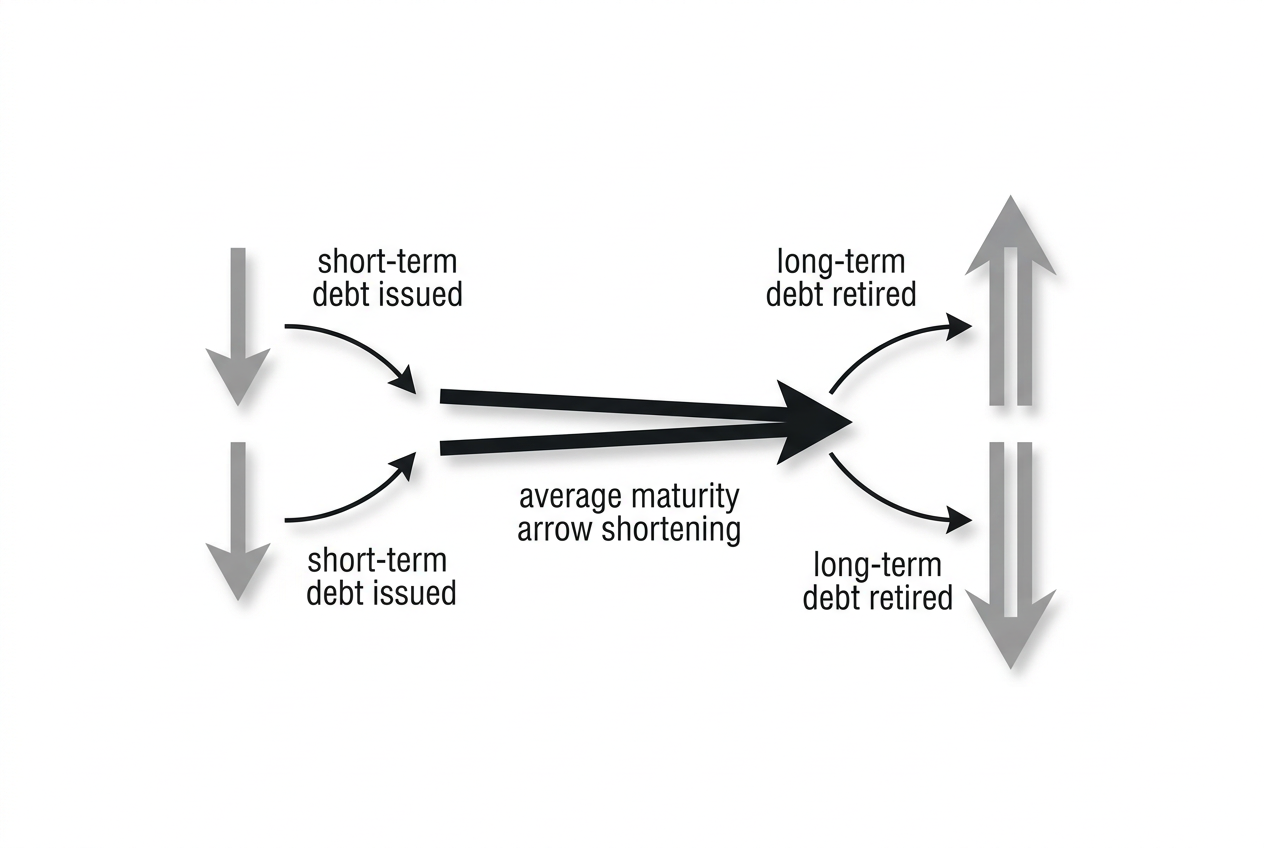
The arithmetic looks great in isolation. The 10-year yields 4.7%; the 1-year yields 4.0%. Swap from ten years to one and you save 0.7% in interest today.
That 0.7% is not free money. It is compensation the Treasury is choosing to stop paying — and choosing to owe again, sooner, at whatever rate prevails when the short paper rolls.
Here is the timing problem that turns the trade from clever to reckless. Warsh, at Jackson Hole, signaled the Fed may still have to raise its short-term rate if inflation stays elevated. Inflation is reportedly running near 3.7%. The market-implied odds of a September hike reportedly jumped to 62% after he spoke.
So Bessent is shortening the government's duration into a hiking regime. He is trading a locked-in long coupon for exposure to exactly the front-end rate the Fed is threatening to push higher. If Warsh is right about inflation, the "savings" evaporate at the first rollover and then go negative.
That is the substance of Druckenmiller's objection, and it is why it stung.
"You can't buy your way out of a solvency conversation with liquidity tools," he wrote in the Wall Street Journal on Aug. 24. "You can only postpone the conversation and raise the eventual price."
The word doing the work there is solvency. Druckenmiller's claim is that a 6%-of-GDP deficit at full employment, with above-target inflation, funded at roughly the economy's nominal growth rate, is not a plumbing problem. It is a fiscal one. Buybacks address plumbing. They cannot touch the deficit.
Bessent's reply told you he knew he was on the weaker side of the argument. Rather than rebut the mechanism, he attacked the man.
"Stan's a great investor. He changes his mind a lot, and he doesn't like losing money," Bessent said at the G20 in Asheville. "I think he lost money the day he sent in the editorial." He added that the U.S. bond market "has been the best performing market since the president came in" and that yields are "flat since the president came in."
Flat is a stretch — yields have moved higher on tariffs and sticky inflation — but leave that aside. Notice what he isn't defending: not the rollover risk, not the maturity math, not the timing against Warsh. He's defending a scoreboard.
Now widen out to the thing the buyback is actually spending, which is not $4 billion.
It is credibility. And the evidence says that account is already overdrawn.
Hanno Lustig's work, which Adam Tooze has been walking through, lays out the erosion in the terms that matter. Pre-2020, Treasurys behaved like a safe asset on three counts: they traded at a premium to close substitutes, they hedged equity risk, and they rallied in stress. Post-2020, all three have failed.
Treasurys are, per Lustig, "no longer expensive compared to close substitutes like German sovereign bonds or AAA US corporate bonds," Lustig writes, "especially at longer maturities." Worse: they now "trade at a discount to many G10 sovereigns."
Sit with that. The world's reserve asset is no longer the expensive one in its own peer group. The premium that lowered U.S. borrowing costs for decades — the exorbitant privilege priced into yields — has thinned toward zero.
The hedge is gone too. The U.S. stock-bond correlation turned positive in 2020. Treasury allocations no longer offset equity risk in a portfolio, which is why you can watch 30-year yields above 5.30% while the S&P 500 sits near records — two things that, in the old regime, could not both be true.
You can argue this is a shock-mix artifact — that a run of supply shocks moves stocks and bonds together and will revert. But Lustig's point is that the flip loads on the wrong part of the yield to be explained away that cleanly. Something in the sovereign risk premium is repricing, not just the macro weather.
This is the setting into which Bessent chose to manipulate the price.
And that is the paradox that swallows the whole gambit. A safe asset is safe because its issuer does not need to defend the price. The defense is the signal that the thing being defended is no longer self-evident.
When the U.K. Treasury and the Bank of England pulled against each other in 2022, the gilt market coughed up a "moron premium." What Bessent has built is stranger and larger: a U.S. Treasury actively buying bonds to suppress the long yield while a Warsh-led Fed tries to break the habit of official bond-buying entirely. The two central instruments of the state are pulling in opposite directions in the $32 trillion market that anchors the dollar system.
Krishna Guha of Evercore ISI noted the Treasury's move may have unsettled not just investors "but folks on the FOMC as well." That is the rift in one sentence.
The long yield, as Druckenmiller put it, is "the only fiscal disciplinarian the U.S. has left." Neither party will run on entitlement reform. No budget office table changes a vote. The price is the discipline. Spending credibility to mute the price doesn't remove the constraint — it removes the messenger and lets the underlying problem compound quietly.
And the verdict travels. Watch Singapore, where analysts describe intermediate-to-long SGS yields as maintaining a high correlation with U.S. dollar bond yields, cushioned domestically but not decoupled. When the anchor drifts, the moorings tied to it drift with it — not as a capital-flows drama, just as a measurement. The correlation is a thermometer reading the anchor's temperature from the far side of the planet.
The one-line summary of the whole episode is the round-trip itself.
Yields fell for minutes, then closed higher than where they began. Bessent got his headline and the market got the last word. He insists the market is misreading the fundamentals. The market's reply was to price the fundamentals plus a new line item: an issuer willing to spend its own credibility to argue otherwise.
That line item has a name. It's the discount that used to be a premium.