
Look at oil futures and you'd think the crisis is over. Prices "suggest we're back to normal," as Adam Tooze reportedly put it this week — Brent has settled, the panic bid has drained out. Meanwhile prediction markets carry grave doubts that shipping through the Strait of Hormuz will resume in earnest any time soon.
That gap between a calm crude tape and a stalled physical trade is the whole story. And it points somewhere most readers aren't looking.
Last week we covered the crude shock and the safe-haven dollar: oil past $79, gold sliding as rate-hike bets firmed, the two-year Treasury yield touching its highest since February 2025. This week the tension has migrated downstream — away from barrels of crude and toward the thing you actually put in a truck.
The world, as CNN's David Goldman framed it, no longer has an oil problem. It has a gasoline problem — and, per the Economist, a diesel one and a jet-fuel one too. The scarcity has moved from the raw material to the refined product.
Here's why that distinction matters. Crude is a commodity you can reroute. Refined product is a supply chain you have to rebuild.
Crude is a commodity you can reroute. Refined product is a supply chain you have to rebuild.
The evidence for the reroute is real. Saudi Arabia has been pushing roughly 4 million barrels a day through its East-West pipeline — Petroline, a 750-mile line from Abqaiq on the Gulf coast to Yanbu on the Red Sea, with design capacity around 7 million barrels a day after expansions. Bob McNally of Rapidan called moving that extra oil through Yanbu "a master stroke."
The UAE is doing something scrappier: chartering its own tankers to shuttle crude from inside the strait to waters outside it, then lightering it onto larger ships bound for Asia. Andy Lipow of Lipow Oil Associates describes the mechanics plainly — keep UAE sales flowing, and get barrels to the countries that need them.
So crude finds a path around Hormuz. That's why the futures curve looks relaxed.
But notice what those workarounds move: crude. Not diesel, not jet fuel, not petrol. You can divert a barrel of oil onto a pipeline. You cannot divert the refinery that turns it into something a diesel engine burns.
That is the physical lead-time problem, and it doesn't respond to a calm oil price. Refining capacity sits where it sits. When the specific grades of crude that particular refineries are built to process get stranded, or when product tankers can't move through the region, the shortage shows up not in the price of oil but in the price at the pump.
Which is exactly where it showed up. In the week ending July 13, average U.S. diesel jumped 22 cents to $4.80 a gallon. Gasoline rose 8 cents to $3.86.
A 22-cent weekly move in diesel is not a rounding error. Diesel is the fuel of freight, farming and construction — it prices into everything that gets shipped, which is to say, into everything. That's the number to watch, and it's the number that decoupled from the reassuring crude tape.
Now stack the limits of the workarounds on top. The IEA says only Saudi Arabia and the UAE have operational crude pipelines that bypass Hormuz, offering somewhere between 3.5 and 5.5 million barrels a day of alternate capacity. Everyone else — Iraq, Kuwait, Qatar, Bahrain, Iran — still ships the vast majority of their oil straight through the strait.
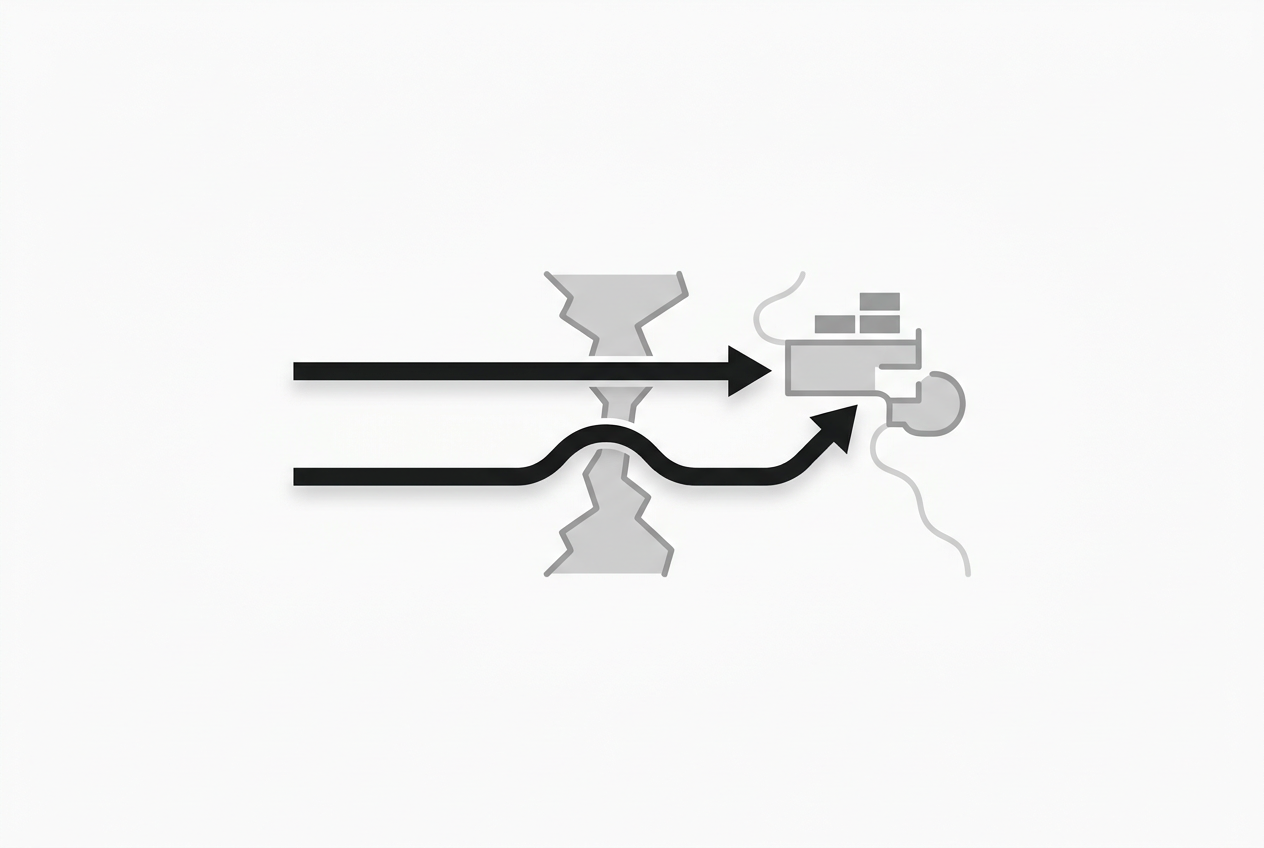
And the bypass routes don't erase risk so much as relocate it. Tankers loading at Yanbu still have to run the Red Sea and thread the Bab el-Mandeb, where Houthi attacks could threaten the corridor. Lipow warns that choking off those vessels could pull several million more barrels a day off the market.
So the "solution" for one chokepoint deposits the cargo at another chokepoint. Geography is stubborn like that.
The Gulf knows it. Trump's threat of a 20% toll on cargo through Hormuz, layered onto the renewed U.S.-Iran escalation, has turned a slow diversification into a scramble. DP World is reportedly in talks to build a new port and terminal at Fujairah, on the UAE's east coast, specifically to sit outside the strait and reduce dependence on the Jebel Ali hub.
Ahmed bin Sulayem of the Dubai Multi Commodities Centre called it both an "immediate action" and a "medium- and long-term plan." His read on the near term is blunt: "Until conditions in the Strait of Hormuz are safer, as of now, I don't believe there will be much focus on shipping lines going there."
Carole Nakhle of Crystol Energy points to the strategic payoff. Every unit of exposure the UAE removes from Hormuz is a unit of bargaining power gained against Iran — and, she argues, a deflation of Iranian leverage in the region.
But building a port is not diverting a barrel. It's a multi-year capital project.
Adam Posen of PIIE put a clock on it: 18 to 24 months for countries to develop enough pipelines, shipping routes and other workarounds to meaningfully reduce reliance on the strait. That is the lead-time number that anchors this entire episode.
Sit with the mismatch. The oil market prices a return to normal in weeks. The infrastructure that would make normal durable takes a year and a half to two years to build. Markets clear crude fast and physical capacity slow, and the space between those two speeds is where the diesel spike lives.
For the macro reader, this reframes the inflation channel. Last week's story was crude feeding a headline oil price feeding rate expectations — traders reportedly moved to almost fully price a September Fed hike, up from roughly 66% a week earlier.
This week's story is subtler and stickier. A refined-product crunch bleeds into inflation through freight and logistics costs, and it doesn't unwind just because Brent settles down. The Fed's own report to Congress named war-related energy costs as one of the forces pushing inflation up this spring, alongside tariffs and the AI buildout.
That's three inflation impulses pointing the same way, and the energy one now has a physical floor under it. You can't cut a rate to conjure a refinery, and you can't sanction your way to a new tanker fleet.
The trap for anyone watching only the oil screen is to mistake a settled crude price for a settled problem. Crude found its detours. Diesel didn't — not yet, and not for 18 to 24 months if Posen is right.
Watch the product cracks, not the barrel. Watch whether Fujairah breaks ground and whether Bab el-Mandeb stays open. And watch that diesel number — because a 22-cent week is the market telling you the reroute solved the wrong problem.
The oil problem has a workaround. The gasoline problem has a construction timeline. Those are not the same thing, and pretending they are is exactly how the next inflation surprise gets priced too late.