Nearly three times. That is how much more likely older adults with chronic insomnia were to reach remission when they got cognitive behavioral therapy for insomnia rather than a course on sleep hygiene—and, crucially, their bodies appeared to age more slowly on a molecular clock as a result.
For decades the framing ran the other way. Poor sleep was a symptom of aging, a gauge you read as the years piled up, something you resigned yourself to along with stiffer knees and a shorter memory.
The UCLA trial inverts that. Here, treating insomnia bent a biological-aging clock. Sleep becomes a lever you can pull, not a dial you merely watch.
The UCLA trial inverts the old framing. Treating insomnia bent a biological-aging clock. Sleep becomes a lever you can pull, not a dial you merely watch.
The study, led by Judith Carroll and published in The Lancet Healthy Longevity in 2026, was a secondary analysis of a randomized controlled trial. One group received CBT-I over eight weeks; the comparison group got general sleep education. Researchers drew blood before treatment and across two years of follow-up.
They ran three biological-aging measures on that blood: DunedinPACE, GrimAge, and PC-PhenoAge. These read chemical marks on DNA that shift with age and experience, not the calendar.
The signal landed on DunedinPACE, the measure designed to estimate how fast aging is happening. Participants whose insomnia was treated showed a significantly slower pace of aging on that clock.
This is the genuine news. Not another correlation between bad sleepers and early graves, but a randomized intervention that moved a biological-aging readout.
Hold the celebration long enough to read the fine print, though. The team tested three clocks and the slowing showed up on one. According to the study, the slowing was seen with DunedinPACE rather than being a uniform finding across every clock.
It was a secondary analysis of fewer than 100 older adults at a single Los Angeles site. And a slower molecular clock is not proof of a longer life or a dementia dodged; these are research tools, not verdicts.
So why treat this as more than a fluke? Because a mechanistic story is filling in underneath it—one that explains what sleep might physically be doing to the aging brain.
The story runs through the glymphatic system, the brain's perivascular waste-disposal network. Cerebrospinal fluid flows along vessels, exchanges with the fluid bathing brain tissue, and carries off metabolic garbage—including amyloid-β and tau, the two proteins central to Alzheimer's.
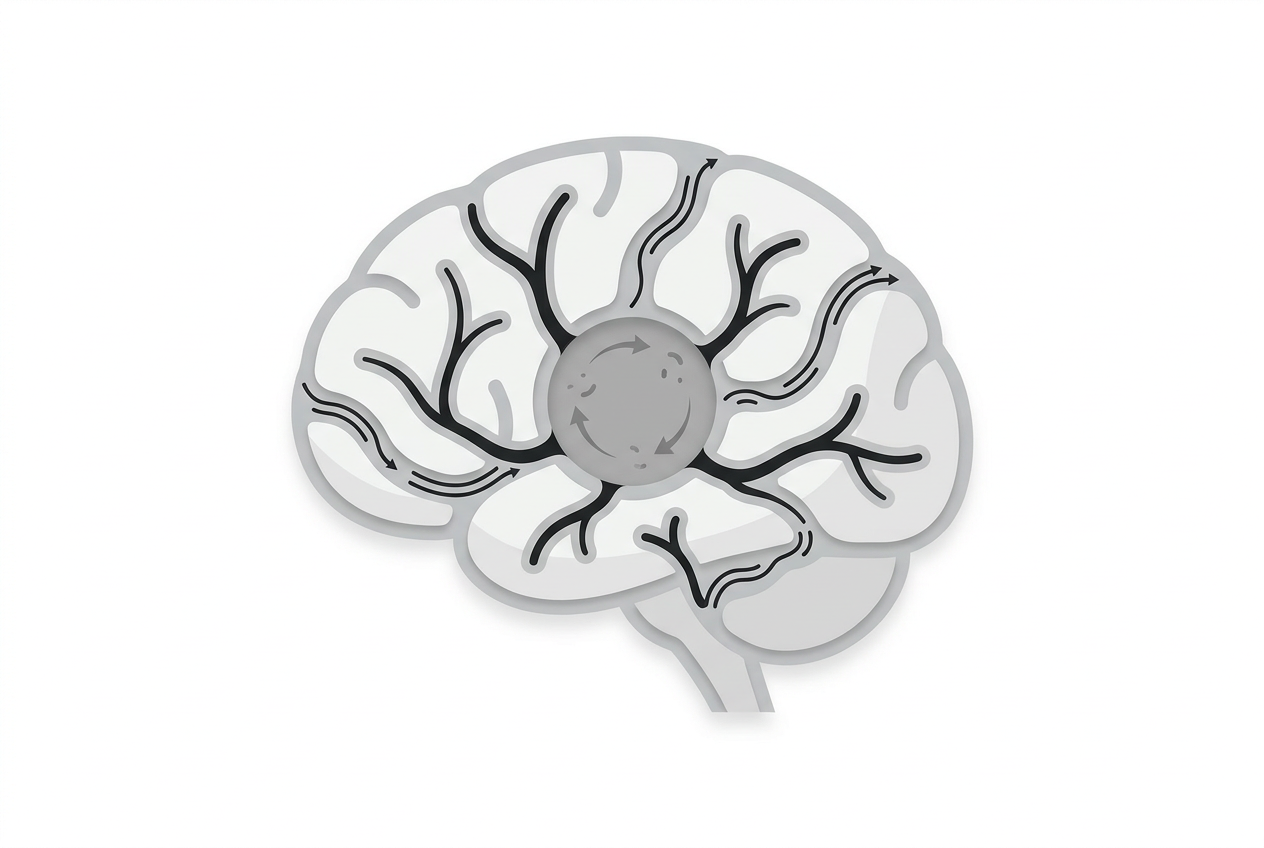
That clearance runs faster during sleep, driven by the slow, synchronized brainwaves of deep non-REM. This has been shown in mice for years. The open question was whether it does anything measurable in intact humans.
A randomized crossover trial with 39 participants supplies the strongest human answer yet. On nights of normal sleep, morning plasma levels of amyloid-β and tau rose compared with nights of sleep deprivation.
Read that carefully: more of these proteins in the blood after sleeping. The interpretation is that sleep-active clearance pushes them out of the brain and into circulation—per the study authors, human support that sleep moves Alzheimer's proteins brain-to-blood rather than merely correlating with them.
A companion finding tightens the loop from the pathology side. In a Berkeley-led study using overnight EEG and tau PET imaging, slow waves in older brains no longer traveled as far or recruited as many cortical regions.
The waves became, in the authors' word, "lonely"—isolated local events instead of coherent sweeps across the cortex. Greater frontal tau predicted this fragmentation, and the people whose waves stayed collaborative retained more memory overnight.
That is a plausible vicious cycle: tau degrades the slow waves, and degraded slow waves clear tau less efficiently. Fixing sleep architecture is no longer an abstract wellness goal but a candidate intervention in that loop.
Then come the gadgets and the neurons, and here the evidence gets thinner fast.
The pink-noise experiment is the one making headlines. The idea: play brief bursts of sound timed to the peaks of slow brainwaves, strengthen those waves, and boost the fluid flow that follows.
The engineering is genuinely clever. Because MRI interferes with EEG, the team trained an AI to predict a slow-wave peak "in about 70 milliseconds," so they could schedule a 50-millisecond burst to land on target.
"They really don't sound like much, they're just little staticky beeps," says Joshua Levitt of Boston University. The bursts did strengthen the coinciding slow waves.
Now the fine print. The team recruited 27 healthy adults, average age 29, to nap in a scanner. Only 14 managed to fall asleep and reach N2. "It's a difficult place to fall asleep," says MIT's Laura Lewis.
So the pink-noise result is a 14-sleeper, afternoon-nap, young-adult signal about fluid flow—not overnight sleep, not older brains, not protein clearance, not cognition. The researchers say those are the next questions, which is exactly the point: they are questions, not answers.
The sleep-onset neurons are further still from any clinic. A team led by a researcher now at Mount Sinai, publishing in Nature, reportedly identified Sst-Chodl neurons—roughly 0.2% of cortical neurons, yet conserved from amphibians to humans.
When mice were awake, these cells were quiet; as the animals slid into deep NREM sleep, the cells fired. Activating them slowed and synchronized cortical activity and made the mice fall asleep more readily.
That is elegant, and the evolutionary conservation hints the cells matter. But this is a mouse study establishing a circuit. There is no drug, no human data, no therapy—only a target to investigate.
So rank the evidence honestly. CBT-I is a real randomized trial that moved a real aging metric—caveated by one site, under 100 people, and one clock of three. The 39-person crossover is solid human causal evidence for the clearance mechanism. Pink noise is a proof-of-concept in 14 nappers. The neurons are mouse-only.
The strength of the evidence and the glamour of the finding run in opposite directions. The neurons are the most exciting story and the least actionable; the gadget is buyable and barely tested; the boring behavioral therapy has the RCT.
That asymmetry is the whole practical lesson. The intervention with the best evidence is also the cheapest, the safest, and the most widely available.
CBT-I requires no device, no scanner, no prescription—structured sessions that change the habits and thoughts sustaining insomnia. It nearly tripled remission odds in the UCLA trial and outperformed the treatment most people default to, generic sleep advice.
For an older adult with chronic insomnia—a condition affecting an estimated 10% to 25% of adults over 65—the case is straightforward even before you invoke aging clocks. Better sleep improves energy, mood, and daytime function on its own.
The responsible longevity move follows directly. Treat the insomnia now, with the therapy that has the trial behind it.
Watch the mechanism space with interest—the glymphatics, the timed sound, the ancient sleep neurons. Just don't confuse a promising slide from a 14-person nap study, or a beautifully conserved neuron in a mouse, with a reason to open your wallet for a pink-noise headband tonight.
The chain from bad sleep to a faster-aging brain is becoming legible. Only one link in it has been forged in a human randomized trial, and it happens to be the one you can act on immediately.