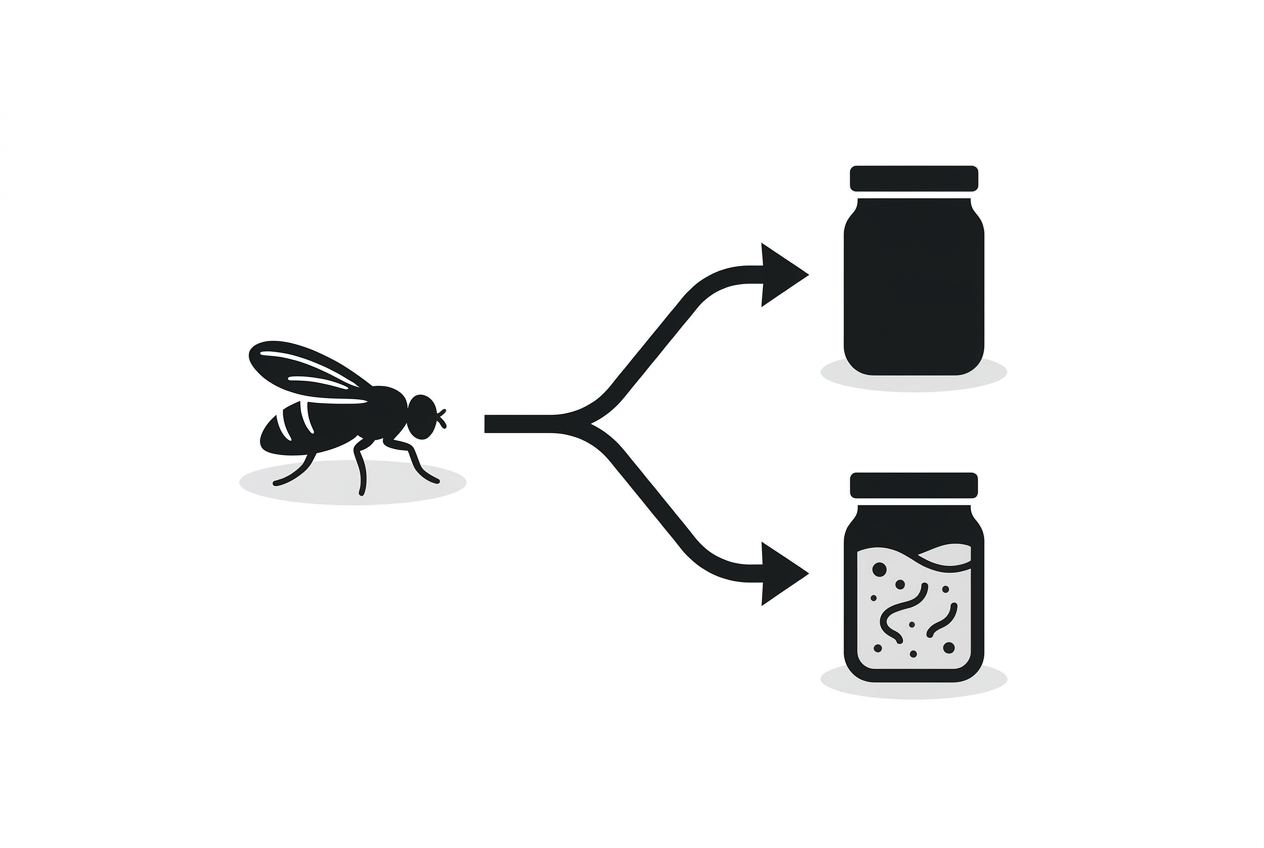
Take one drug, one species, two jars of food. In flies raised on a cornmeal and torula yeast medium, rapamycin extended life in one experiment, had no effect in six, and was harmful in 19. Move the same drug to a nutrient-rich brewer's yeast medium and it was never significantly harmful in a single experiment—beneficial in eight, neutral in fourteen.
Same molecule. Same species. The only thing that changed was what the flies were eating.
That is the destabilizing result at the center of a new GeroScience paper from Lauren Jackson, Robin Mockett, and colleagues. Its plainest reading is this: in Drosophila, diet doesn't merely tune how much rapamycin helps. It decides whether the drug extends life or shortens it.
In Drosophila, diet doesn't merely tune how much rapamycin helps. It decides whether the drug extends life or shortens it.
The magnitude is not subtle. Median lifespan effects across their experiments reportedly ranged from minus 51.3 percent to plus 5.4 percent. On one side of that range, rapamycin reportedly cut a fly's life roughly in half. On the other, it added a rounding error's worth of days.
This matters because of a mismatch most readers get wrong. The off-label rapamycin movement talks about the drug as though it has a fixed dose-response curve with near-universal upside—the debate is over milligrams and dosing intervals, "what dose do I take." The fly data says that is the wrong question. The right one is: in what context does my body sit?

Now, one might object that this is a single lab with a quirky fly strain and a specific grievance. Mockett's group had reportedly already reported that DMSO-solubilized rapamycin shortened the lives of male flies from a long-lived y w strain by 26 to 45 percent on torula medium—an odd result they set out to nail down. Maybe the flies, not the principle, are the anomaly.
They are not the anomaly. The context-dependence shows up across independent labs, on different axes, in different designs.
Start with sex. A Nature Aging study reportedly found that rapamycin extends lifespan in female flies but not males. The mechanism was specific: rapamycin boosted autophagy in female gut enterocytes via a histone–Bchs axis, slowing age-related intestinal pathology. Male enterocytes already sat at high basal autophagy that rapamycin couldn't push higher.
That dimorphism was reportedly conserved in mice, where intestine, brown fat, and muscle showed sex differences in autophagy and in the response to rapamycin. Tissue sex, the authors argued, is a determining factor in whether an mTOR-targeting drug works.
Now genotype. In a 2021 study of six isogenic fly lines, rapamycin reportedly raised male longevity and heat-stress tolerance on average—but the effects were strongly genotype-dependent, with clear genotype-by-treatment interactions. The authors' verdict was blunt: a "one size fits all" approach to rapamycin is not advisable.
Then the deepest layer. A 2024 Aging Cell paper from A. Dobson's group at Glasgow built flies with every combination of Australian and Beninese mitochondrial and nuclear genomes, then dosed them. Rapamycin's lifespan effect was modulated by mito-nuclear epistasis—the interaction between the two genomes altered age-specific mortality.
The most useful finding there is a warning about how we reason about the drug. An early-life fitness cost of rapamycin did not track with the lifespan benefit across genotypes. In their words, mito-nuclear epistasis can "decouple costs and benefits of treatment."
Read that again with an off-label user in mind. It means the side effects you feel are not a reliable readout of whether the drug is helping your lifespan. Cost and benefit can come apart, governed by genetics you can't see.
And nutrition, the axis the new paper foregrounds, was flagged a decade ago. A 2014 study by Villa-Cuesta, Fan, and Rand reportedly found that under low-nutrient diets, rapamycin reduced Drosophila longevity in a dose-dependent way—but had no effect under outright starvation, meaning the harm required some nutrients to act on. On a balanced yeast-and-sugar diet, they found no repeatable longevity benefit at all.
So the pattern is not one weird strain. It is diet, sex, nuclear genotype, and mitochondrial background each capable of moving rapamycin's lifespan effect—and, in the diet case, flipping its sign outright.
Why food, specifically? The mechanism is not mysterious. mTORC1 is a nutrient sensor; rapamycin's whole job is to blunt nutrient sensing and shift the cell away from growth toward processes like autophagy. Change the nutrient signal the drug is acting on, and you change what the drug does. That places rapamycin at the interface of nutrition and longevity—which is exactly where its effect becomes unstable.
Context isn't noise around the experiment. Context is half the experiment.
Which brings us to the study the off-label crowd actually cites. A 48-week trial reportedly gave 5 to 10 mg per week of compounded rapamycin to healthy adults aged 50 to 85 and found no major safety concerns, plus improved lean tissue mass and self-reported pain—in female participants.
That is a genuinely reassuring safety result, and I want to be precise about what it reassures us of. It tells us that at low weekly doses, over 48 weeks, healthy older adults did not experience major harms. That is worth knowing.
Here is what it cannot tell us. It measured safety and a couple of surrogate markers over less than a year. It did not measure lifespan, because no human study has. And it certainly did not sort participants by where their particular diet, sex, and genotype place them on the beneficial-versus-harmful ledger the fly work just exposed.
Notice, too, that the one signal in that human study—benefit concentrated in women—rhymes with the fly and mouse data showing female-biased responses. That is a suggestive alignment, not proof. But it is the opposite of evidence that the effect is uniform across people.
So we are left with a strange asymmetry. The animal evidence is now rich enough to show, repeatably, that rapamycin's lifespan effect is contingent on context, sometimes to the point of sign reversal. The human evidence is a short safety window with no lifespan endpoint and no ability to resolve any of those contingencies.
That asymmetry does not license a green light. It also doesn't license a blanket contraindication—the flies are flies, doses differ by orders of magnitude, and rapamycin's mouse lifespan record remains the most robust in the field.
What it licenses is a specific posture: hypothesis-generating caution. The fly data is loud enough to reframe the question and quiet enough not to answer it for any individual human.
If you are considering rapamycin off-label, the honest version of the situation is not "what dose extends life." It is that the most reproducible finding in the model organism is that the same drug can add days or subtract them depending on inputs you currently cannot measure in yourself—diet, sex, and a mito-nuclear genotype interaction that can uncouple how you feel from whether you benefit.
Nobody can yet tell you which side of the ledger you sit on. That, not a milligram figure, is the load-bearing uncertainty—and the marketing has it exactly backwards.