
Six thirty-second all-out sprints—three minutes of maximal work—triggered 714 significantly changed proteins in the blood immediately afterward. That is nearly a quarter of every protein the researchers detected, and more than 98% of them went up. Ninety minutes of moderate cycling, by contrast, moved seven.
Hold that ratio in mind, because it reframes a ritual most of us perform without thinking: counting weekly minutes toward a moderate-activity target, as if the clock were the thing that mattered.
Last week this newsletter pressed on resistance-training dose—how much lifting actually buys the adaptation. This week the dose-response question moves into aerobic exercise, and the surprising answer from converging cohorts is that the dial that mattered wasn't duration. It was intensity.
The surprising answer from converging cohorts is that the dial that mattered wasn't duration. It was intensity.
Start with the UK Biobank finding that punctures the "log your minutes" orthodoxy. When total activity volume was held constant, people who spent a larger fraction of that time working hard—higher percent vigorous physical activity—showed lower incidence of heart disease, atrial fibrillation, type 2 diabetes, dementia, chronic kidney disease, chronic respiratory disease, MASLD, and immune-mediated inflammatory diseases.
Same amount of movement. Different composition. Broadly different risk.
What stands out is the breadth of that outcome list. Most people treat exercise as a general wellness habit; this analysis treats it more like a multi-system intervention, something that touches heart, brain, metabolism, and inflammation at once.
That "wide-spectrum" behavior is the first clue that intensity is doing something other than burning marginally more calories per minute.
The mortality data sharpen the picture. In a separate UK Biobank analysis of 94,541 participants wearing wrist accelerometers, a continuous vigorous bout of at least two minutes a day was reportedly associated with a 76% lower risk of all-cause mortality—a hazard ratio of 0.24.
The intensity threshold here is concrete: vigorous means at least six metabolic equivalents.
And stairs are exactly where the effect shows up in ordinary life. A meta-analysis pooling nine high-quality studies and more than 480,000 participants found that habitual stair climbers were 39% less likely to die from cardiovascular causes, and 24% less likely to die from any cause, than those who rarely used stairs.
No gym, no membership, no dedicated workout block—just brief, repeated bursts of weight-bearing vigorous effort folded into a commute.
The same mortality analysis surfaces a wrinkle worth pausing on. For moderate activity, doing it in one continuous bout roughly halved mortality risk versus scattering it across the day, regardless of duration.
For vigorous activity, the pattern flipped by duration: a single continuous bout was reportedly optimal only under five minutes—three minutes of continuous vigorous effort carried a hazard ratio of 0.27—while beyond five minutes, spreading vigorous minutes sporadically across the day was reportedly associated with the lowest risk of all, an HR of 0.11 for the most active 20 minutes.
Translation: intensity and duration interact in ways the "150 minutes a week" framing simply cannot capture.
Related work reinforces that short, incidental vigorous efforts carry outsized weight. One UK Biobank study reportedly found three daily bouts of one to two minutes of vigorous lifestyle activity—three to six minutes total—associated with roughly 39% lower all-cause and 40% lower cancer mortality, and about half the cardiovascular mortality, compared to people doing none.
So intensity behaves less like a wellness checkbox you tick off in bulk and more like a signal—one that a few concentrated minutes can send loudly.
Which returns us to those 714 proteins, because they hint at what the signal actually is.
In the sprint study—19 healthy, active men, average age 26—the immediate post-sprint surge reportedly included proteins involved in vascular function, inflammation, fuel metabolism, and hormonal signaling. Three hours later the number of altered proteins had fallen nearly 20-fold: a very large, very short-lived spike.
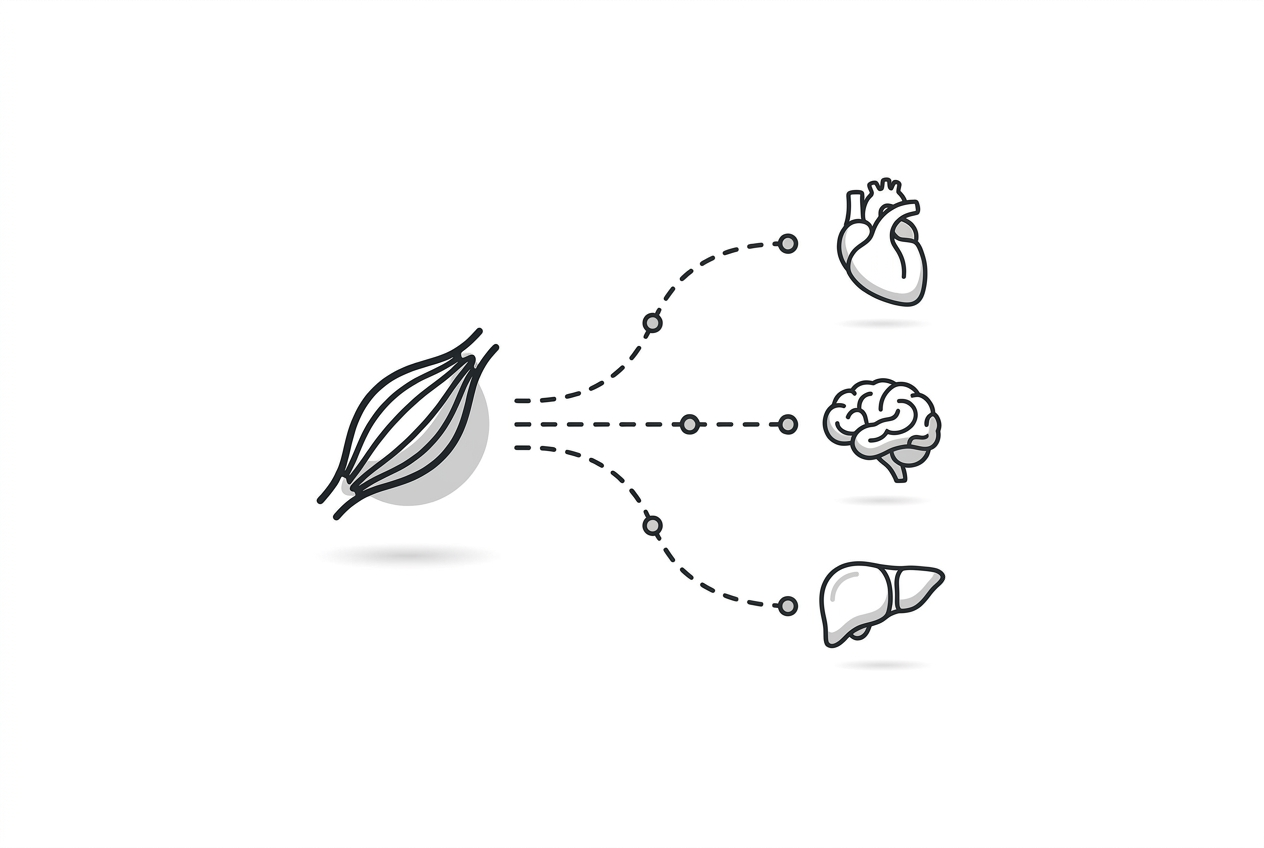
The moderate session reportedly produced almost the mirror image—seven proteins immediately, rising to 19 by three hours. Eight weeks of training didn't erase the difference; the sprint's acute molecular signature persisted even after participants got fitter.
These molecules, collectively called exerkines, are how exercising tissues talk to distant organs. The provisional interpretation is that hard efforts don't merely release more signal—they release a qualitatively richer, "healthier" one.
That is the mechanistic candidate for why converting moderate minutes into vigorous ones tracks with lower risk across so many organ systems at once.
The brain gets its own plausible pathway. A recent Trends in Neurosciences review argued that exercise supports the glymphatic system—the brain's waste-clearance network that runs mostly during sleep—by lowering blood pressure and vascular stiffness, reducing neuroinflammation, dropping resting norepinephrine, and improving deep-sleep slow-wave activity.
That build-up of metabolic junk becomes more damaging with age, precisely when good sleep gets harder to come by. So exercise—"especially the type that lifts your heart rate," as the lead author reportedly put it—offers a second route to clearing it.
If that mechanism holds, it links the vigorous-fraction dementia association from Biobank to something concrete happening inside the skull. Association, plus a candidate mechanism.
And that phrase is the whole caveat. Every strand here is observational cohort or mechanistic review—not a single randomized trial demonstrating that shifting a fixed volume toward intensity causes lower risk.
People who climb stairs, or sprint for the bus, may also eat better, smoke less, weigh less, or get better preventive care. The stair-climbing authors say so plainly: strong association, not proof of cause.
Measurement muddies the picture too. The Biobank intensity work found associations were consistently stronger with device-measured accelerometry than with self-report—likely because self-report blurs intensity, flattening real effects rather than inflating them. One person's "vigorous" is another's stroll.
The optimal dose is genuinely unsettled. The stair meta-analysis floated roughly six flights a day as a favorable balance while conceding the dose-response may not be linear; the bout analysis found vigorous efforts optimal in different patterns depending on whether they ran under or over five minutes.
There is even a warning flare in the data: one Biobank analysis reportedly found that in adults with hypertension, six to nine minutes a day of vigorous activity in bouts longer than two minutes was associated with more than doubled stroke risk. More is not monotonically better.
Nor is "go harder" a universal prescription. As Dr. William Li puts it, "High-intensity workouts create a short-term stress response in your body. If you're already overwhelmed, try Zone 2 walking or controlled strength training. Move, recover, then build from there."
That caveat matters because the same acute stress response that spikes 714 beneficial proteins is still, physiologically, a stressor—and an already-depleted body may not adapt to it well.
The honest synthesis, then, is narrower than the headline temptation. It is not that duration is worthless; low-volume people still benefit most from simply moving more.
It is that once you are moving, the composition of those minutes appears to matter—and the evidence, imperfect and non-randomized as it is, keeps pointing the same direction: a modest shift toward vigorous effort, embedded in the life you already live, tracks with a body that ages more slowly across more systems.
Not proof. But a consistent, mechanistically plausible signal—one worth acting on with your eyes open, and worth watching for the randomized trials that would either confirm it or complicate it further.