About 1 in 7,000 people carry a mutation that quietly disables one copy of a gene called FNIP1, and without doing anything at all — no diet, no drug — they run leaner livers, better blood sugar, and roughly 60% lower odds of cardiometabolic disease.
That figure comes from a Regeneron-led exome analysis of 1,032,116 people across America, Europe, and Asia, published in Nature. It is one of the strongest favorable metabolic signatures in the entire dataset.
The question for the other 6,999 of us is simple and unforgiving: can that natural gift be bottled?
Start with why the finding is so seductive. Human genetics has spent decades hunting for "longevity genes" or large-effect protective variants, and mostly it has come up with polygenic noise — thousands of tiny effects, the occasional APOE, a modest FOXO3.
FNIP1 is different. It is a single ultra-rare knock (allele frequency 0.01%) with a large, coherent effect: carriers had lower triglycerides and ApoB, less liver fat, better glycemic control, and a more favorable body-fat distribution.
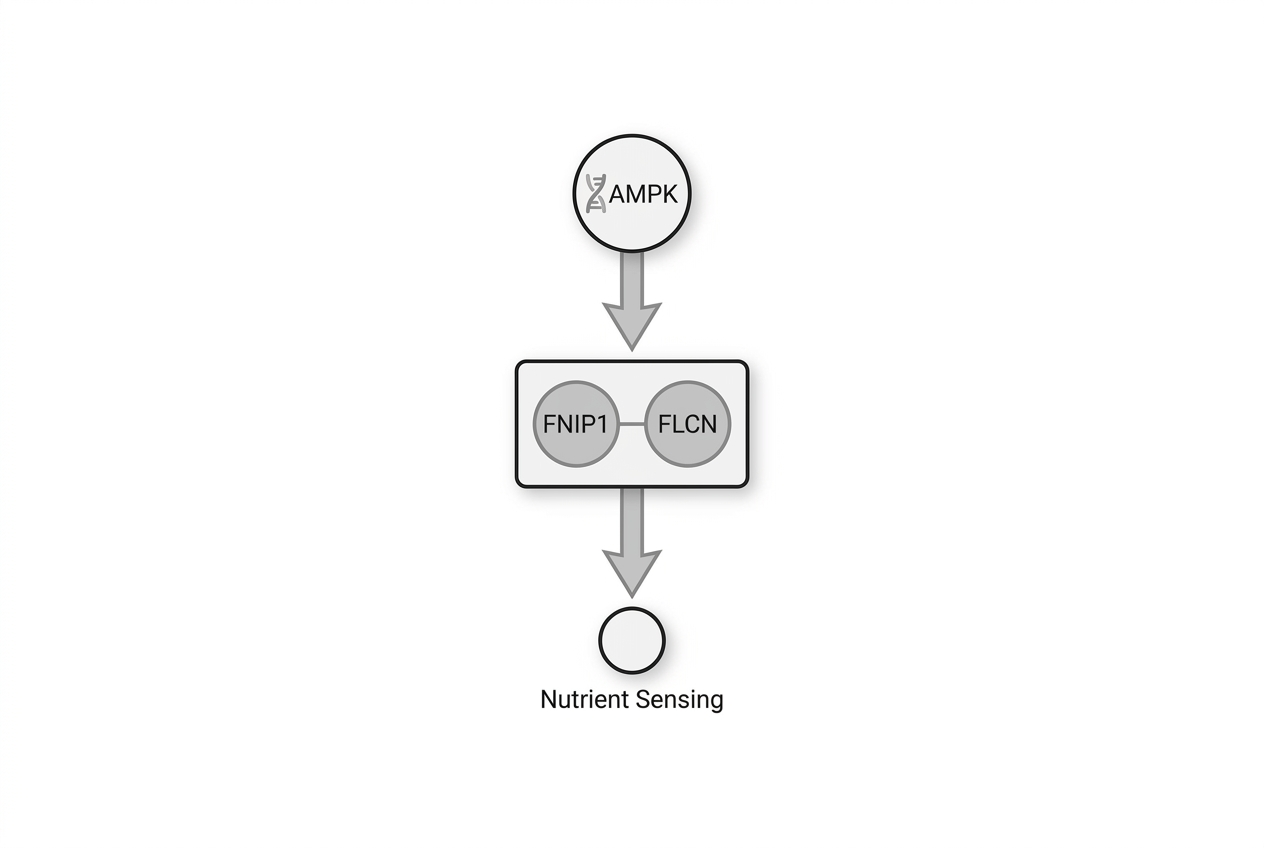
Better still, the association arrives with a mechanism attached. FNIP1 partners with folliculin (FLCN) in a nutrient-sensing pathway downstream of AMPK, the cell's central energy sensor.
Lotta, the study's corresponding author, frames it vividly: the FNIP1 pathway is "a 'metabolic brake,' curbing the consumption of energy so that calories can be saved for a 'rainy day' when we may undergo prolonged fasting/starvation." An asset over millennia of scarcity; a liability in a world of drive-throughs.
And the mechanism validated. Knocking down FNIP1 in primary human hepatocytes switched on a transcriptional program of lipid breakdown and lysosomal activity — exactly what the human carriers' lean livers would predict.
That alignment is rare. Genetic association and functional biology usually point in slightly different directions; here they agree. This is why the finding deserves the excitement it's getting, and why the fact that 23 of the study's 59 hit genes already have approved or clinical-stage drugs against them tells you the screen was catching real, druggable biology.
Genetic association and functional biology usually point in slightly different directions; here they agree. This is why the finding deserves the excitement it's getting.
Now turn the paper over and read the caveats printed on the same pages.
The headline 60% odds reduction is for a composite outcome — coronary artery disease, type 2 diabetes, MASLD, and cirrhosis lumped together. The composite reached significance. Two of its components, taken alone, did not: CAD and cirrhosis individually missed the bar.
The reason is arithmetic, not biology. At an allele frequency of 0.01%, you are working with relatively few carriers, and rare-variant effect estimates built on small numbers wobble. A striking composite can sit atop components that are each individually underpowered.
That is not a reason to dismiss the signal. It is a reason to hold the exact number — 60% — more loosely than a clean headline implies.
Then comes the detail that should give any drug developer pause. In human liver cells, silencing FNIP1 alone was enough to flip the lipid-breakdown program.
In mice, it was not. Protecting the animals against high-fat, high-fructose diets required knocking down FNIP1 together with its paralogue Fnip2 — or knocking down the interactor Flcn instead.
Read that again. The species you validate drugs in needs two brakes released; the species you want to treat apparently needs only one.
The authors attribute the gap to interspecies differences, and Lotta is candid about the cost: "Developing new medicines is always hard and this makes it more difficult to study this pathway in model organisms and preclinical models, so it adds a layer of complexity."
This is not a footnote. Preclinical efficacy in mice is the gate every cardiometabolic program has to pass. If mice only respond when you suppress a redundant paralogue that humans apparently don't require, then the mouse is telling you something uncomfortable about redundancy — and you'll be reproducing an artificial double-knockdown just to see any effect at all.
Widen the lens, because FNIP1 is a specific instance of a general problem.
A recent framework paper argues that the more complex an organism, the harder it is to move its physiology by perturbing one node. In C. elegans, a single daf-2 mutation can roughly double lifespan; in mice, even rapamycin buys 10–25%.
The mechanism is redundancy. As biological networks acquire cross-talk, feedback, and paralogues, switching off any one component produces less systemic change, because parallel pathways compensate. The mammalian response to an intervention is partly a response against it.
That robustness is a feature — a long-lived animal shouldn't reorganize its metabolism every time one protein flickers. But it is exactly what defeats single-target drugs.
FNIP1 and Fnip2 are the redundancy story made literal. A paralogue sitting in reserve is precisely the architecture that mammalian robustness predicts, and precisely what the mouse experiment surfaced.
So here is the honest read on the excitement.
The human carriers are real, and they prove the ceiling exists: turn this brake down and you get lean livers, good glucose, and — probably — substantially lower disease risk.
But those carriers are haploinsufficient by birth, dosed continuously from conception, in a single tolerated genotype. A drug has to reproduce that with a molecule, in adults, without tripping the pleiotropy that a nutrient-sensing pathway downstream of AMPK almost certainly carries.
FNIP1/FLCN sits in a pathway tied to mitochondrial activity and lysosomal function across tissues. A brake that useful is rarely a brake with only one downstream consequence.
This is the same translation gauntlet that longevity biology keeps running into from the mouse-and-cell end — the recurring gap between a clean mechanism and a working human intervention, the valine-and-mitochondrial-mimetic question in a different costume — only here we are seeing it from the human-genetics end, which is the more flattering angle and no less treacherous.
What makes FNIP1 genuinely credible, then, is not the 60% headline. It is that the finding names a mechanism — an AMPK-downstream metabolic brake — and comes pre-loaded with a human natural experiment showing what releasing it does.
That is more than most drug programs start with. It is the difference between a target and a hunch.
The proof that remains is specific and hard: show that pharmacologic inhibition of FNIP1 reproduces the heterozygous carriers' protection, in humans, without needing the paralogue suppression the mouse demanded and without the pleiotropy that mammalian robustness all but guarantees.
Evidence grade for the honest reader: a strong human genetic association, moderate functional validation in cells and mice, and a species discrepancy that is not a rounding error but a warning label.
The 1-in-7,000 got lucky. Turning that luck into a pill is a separate experiment, and it has not been run.