
Article — "Coupled Decline: Mapping the Shared Biology of Muscle, Bone, and Cognitive Aging": Article — "Coupled Decline: Mapping the Shared Biology of Muscle, Bone, and Cognitive Aging": Nearly a third of the proteins linked to either sarcopenia or osteoporosis turned out to be linked to both. And almost all of them pointed the same direction—up when up, down when down—converging on NF-κB signaling.
That is the number that keeps the coupling hypothesis alive. It comes from a proteomic analysis of UK Biobank data, and it does not read like coincidence.
Now widen the lens. Three research teams, three different tissues, three diseases we file in separate clinics: muscle wasting, bone loss, cognitive decline. Their biomarker lists keep colliding on the same inflammatory and mitochondrial pathways.
So the question this issue is built around: is this one disease wearing three masks, or three diseases sharing a neighborhood?
Is this one disease wearing three masks, or three diseases sharing a neighborhood? Their biomarker lists keep colliding on the same inflammatory and mitochondrial pathways.
Start with the collisions, because they are genuinely striking.
The muscle–bone proteomic work found that of every protein associated with sarcopenia or osteoporosis, nearly a third belonged to both—and the shared genetic architecture agreed. Per the study, a dozen genomic regions influenced both disorders; in ten of them, the correlation ran the same way. Genes tilting you toward muscle loss tilted you toward bone loss too.
The named culprits are almost too on-the-nose. COMMD7, tied to NF-κB. TFAM, which maintains mitochondrial DNA. Inflammation and energy production—the two hallmarks that recur everywhere in aging biology.
Muscle and brain rhyme just as loudly. A GeroScience plasma proteomic study reportedly identified protein signatures for the combined decline of cognition and physical performance—dual trajectories, not two separate stories. The muscle–brain axis review literature echoes it: mitochondrial dysfunction, inflammation, metabolic alterations, all reportedly associated with sarcopenia and cognitive impairment alike.
And the crosstalk has physical vectors. Skeletal muscle reportedly releases neurotrophic factors—BDNF among them—during contraction. Bone secretes osteocalcin, sclerostin, and FGF23, which can reportedly cross the blood–brain barrier. The Nature Reviews Endocrinology synthesis frames bone–muscle communication as an inherent process, carried by myokines, osteokines, adipokines, and extracellular-vesicle miRNA cargo.
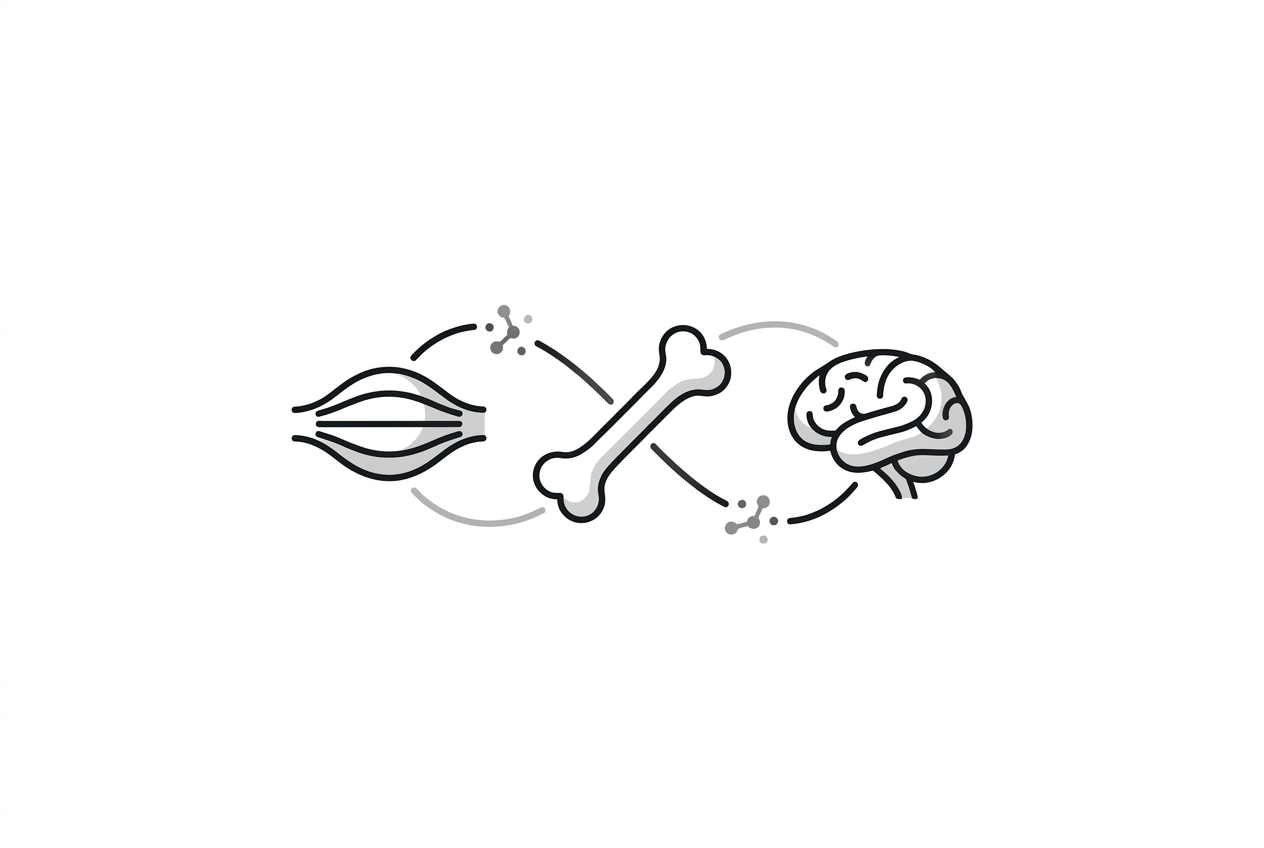
This is the tissue-level echo of the same inflammatory aging biology that the biological-age-clock literature reads systemically. The clocks measure it in the blood; here we see it wired into the specific organs.
So the temptation is obvious. If NF-κB and failing mitochondria show up in muscle, in bone, and in brain, maybe there is one upstream fire and three columns of smoke. Douse the fire, save three organs.
Here is where the discipline has to kick in.
Look hard at what the muscle–bone convergence actually rests on. The osteoporosis measure was heel thickness—not the established densitometry you would want. Sarcopenia was inferred from hand grip strength, not from muscle mass or biopsy. These are proxies, and everyone involved knows it.
More damaging: the study could not establish temporal order. The authors could not tell whether inflammatory metabolites preceded muscle loss or followed it. That is not a footnote. It is the whole ballgame.
Because "shared biology" and "shared upstream cause" are different claims, and the evidence supports only the first.
Consider the alternative reading, which the same dataset accommodates just as well. Ordinary mechanical loading—muscle pulling on bone—maintains bone mineral density. Lose muscle, and bone loses its stimulus. The inflammation could be downstream of that mechanical decoupling, not the primary driver of it.
The study's own U-shaped finding cuts the same way: too little muscle mass tracked with bone deterioration, but so did too much, attributed to overstressing bone. That is a mechanical story about load, not a proteomic story about a master switch.
So the shared NF-κB signature might be the common cause. Or it might be the common consequence. Cross-sectional data cannot referee that fight, and the muscle–brain literature is honest about the same gap—whether neuromuscular junction changes trigger or follow muscle decline is, in its own words, unsolved.
This is the recurring sin of the field: a convergence discovered in observational data gets narrated as a mechanism. The proteins really do overlap. The direction of effect really is concordant. But the arrow of time is missing, and without it, "one disease, three masks" remains a hypothesis wearing the costume of a finding.
None of this makes the coupling useless. It makes it a different kind of useful than the single-driver story promised.
The correlations are strong, replicated, and biologically coherent. People with more symptoms of sarcopenia were even more likely to have osteoporosis. Osteosarcopenia—both conditions together—carries greater fall and fracture risk than either alone. CT-derived muscle quality reportedly tracked with frailty, functional status, cognition, and quality of life all at once.
That is a screening opportunity, and it is available now.
If one system reliably flags the others, you measure the accessible one and check the rest. Grip strength is cheap; it is a legitimate reason to look harder at bone and cognition. A CT scan ordered for one purpose carries muscle-quality information about several. Dual-endpoint detection—cognition plus physical performance, muscle plus bone—is justified by exactly the correlational strength that fails to prove causation.
Multi-system biomarker panels are the honest deliverable. Not a root-cause drug. A wider net.
What we cannot yet do is claim we know what to target. Is it mechanical loading, arguing for resistance training as the lever? Or is it a shared proteomic pathway, arguing for anti-inflammatory or mitochondrial intervention? The observational resources cannot tell us, because they were never built to order events in time.
Which is why the most important entry in this literature is not a finding at all. It is a resource.
The Muscle Ageing and Sarcopenia Study Lifecourse spans adults from 18 to 85 and pairs actual muscle biopsies with clinical, functional, and lifestyle data. That is the deep phenotyping the biobank-scale studies structurally lack—tissue, not a heel-thickness proxy, and a lifespan range that at least permits the question of what comes first.
Longitudinal, deep-phenotyped data is the only thing that converts a shared signature into a shared cause. Until it arrives, the arrow stays undrawn.
So hold both positions at once, because both are earned.
The coupling is real. Inflammation, mitochondrial failure, and secretome crosstalk recur across muscle, bone, and brain in every dataset that looks, and they recur with the same sign. Treat that as a mandate to stop screening organs in isolation.
But the single upstream driver is a story, not yet a result. It is the most attractive interpretation of the data and the least tested. Measure one system, flag the others—and refuse, for now, to promise you can put out a fire you have only inferred from smoke.