The Foothills of the Singularity: Hassabis Declares AGI Near as Doudna Counsels Patience
In May 2026, closing the Google I/O keynote, Demis Hassabis told an audience in Mountain View that "we're at the foothills of the singularity." A few hours later, in an interview, he clarified his terms: the singularity "means the era that we're in," and In a Bloomberg interview a few months earlier, he had said, plainly, "we're nowhere near that," holding to a "50 percent chance of getting there by 2030."
Two months later, on July 14, he published an essay reportedly on Substack. Same phrase, different weather. AGI is now "probably only a few short years away," and the foothills line has been promoted from keynote flourish to thesis statement.
Ask yourself what changed between those two moments. Not the models. Not a benchmark. Not a published result. Only the volume.
Not the models. Not a benchmark. Not a published result. Only the volume. That gap between 'nowhere near' and 'a few short years away' is the whole subject.
That gap—between "nowhere near" and "a few short years away," with no new data point wedged in between—is the whole subject of this piece.
Last week, this column was arguing about whether machines think. This week the question shifts, because Hassabis has quietly moved it: the interesting problem is no longer cognition but credibility. When does the CEO of a frontier lab get to announce the arrival of a new age, and who is standing by to audit the confidence?
Start with the definition, because everything hangs on it. Hassabis defines AGI as "a system that exhibits all the cognitive capabilities the brain has." Every one of them. That is not a spec; it is a horizon.
And notice what the essay does not contain. Nowhere in the recoverable text does DeepMind attach a benchmark, an evaluation suite, or a checkable milestone to that definition. There is no line that reads: when a model does X, we will have crossed the threshold.
So "a few short years away" cannot be wrong on any particular Tuesday. It is a directional claim built to resist falsification—one that reasonable people could argue about for a decade while the influence it generates gets banked immediately.
Then comes the imagery, engineered for the same purpose. AGI, Hassabis writes, "is much more akin to the discovery of electricity or fire. If you stop to think about it, we've essentially found a way to make sand think. It's miraculous."
Electricity and fire are not benchmarks. You cannot run an eval against "fire." The comparison works precisely because it floats above measurement—it asks for awe, not verification.
The scale claim does the same work: "perhaps 10x of the Industrial Revolution at 10x the speed." A number that looks quantitative and measures nothing. No instrument returns a reading in units of Industrial Revolutions.
This is the genre error at the heart of the essay. It presents as a forecast—a claim about the future that could in principle be checked—while every load-bearing sentence is designed to escape the checking. A forecast you cannot lose is not a forecast. It is a mood, deployed at scale by an interested party.
And the party is interested. A near-AGI framing shapes DeepMind's fundraising, its recruiting, and above all its leverage in the rooms where the rules get written. None of that makes the timeline false. It does mean the timeline is doing a job.
Which brings us to the essay's actual payload, buried well below the sand-thinks poetry. The document is titled "A Framework for Frontier AI," and its real content is not a date—it's an institution.
Hassabis proposes a new Standards Body for frontier AI, modeled explicitly on FINRA, the Financial Industry Regulatory Authority: a federally overseen public-private partnership, a self-regulatory organization for labs. Its funding, he writes, would "likely mostly come from industry."
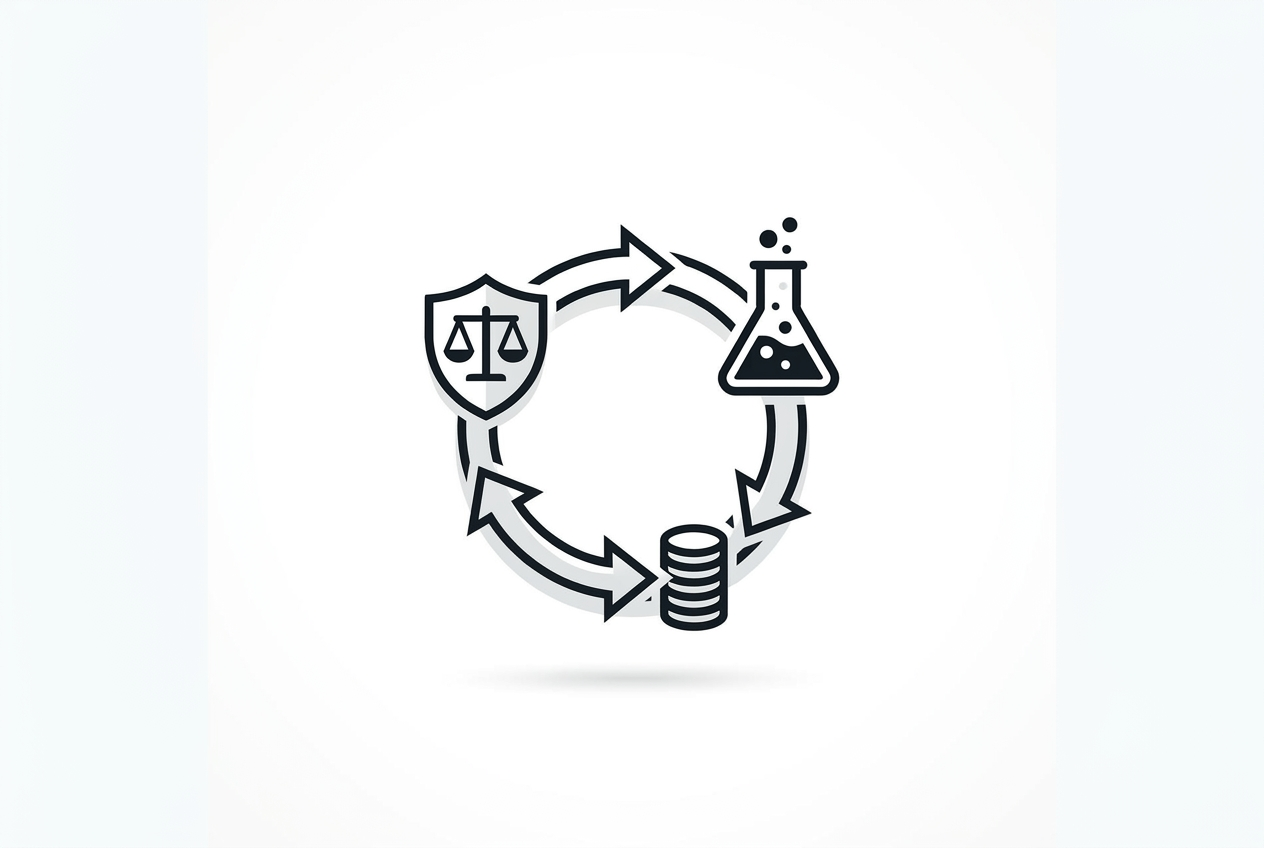
Under the proposal, a model becomes "Frontier-class" if it clears "a set of benchmarks determined by the Standards Body." The body decides what counts. And who helps the body decide, at least at first? The evaluations "would be developed in consultation with Frontier Labs."
Read that sequence slowly. The essay declines to give a benchmark for AGI, then proposes a body—industry-funded, industry-consulted—whose entire function is to set the benchmarks that will define who is regulated and how. The vagueness at the top and the specificity at the bottom are the same move.
This is the tell. The timeline is throat-clearing; the ask is the Standards Body. The urgency—"a few short years away," "urgent action is needed"—is the pressure that makes the governance proposal feel like a rescue rather than a bid for authorship.
For a policy audience, that reframes the entire document. A framework paper written by a lab CEO is lobbying input dressed as forecasting, and it should be weighed against independent evaluation, not adopted as the baseline everyone else has to argue against.
Now set a different figure beside Hassabis, someone with an actual shipped revolution behind her.
Jennifer Doudna won the 2020 Nobel Prize in chemistry for Crispr-Cas9, a gene-editing tool that genuinely rocked the scientific world in 2012. In June, per Bloomberg, she said she is skeptical about AI replacing human effort in scientific discovery, and questioned its role in medical innovation. In July, per a 3 Quarks Daily headline, the framing was blunter still: AI hasn't cured anything—yet.
The inversion is almost too clean to be accidental. The person who delivered a world-changing technology counsels patience. The person promising one counsels awe.
And the contrast sharpens when you notice Hassabis's own biotech venture, Isomorphic Labs, spun out of the AlphaFold work that earned him his Nobel. Its stated aim, he says, is to cure "hundreds of diseases." The aim. Doudna, who has actually moved from lab to therapy, is the one applying the brakes.
This is the real epistemic asymmetry: certainty is flowing in exactly the wrong direction. The delivered results come with hedges; the undelivered future comes with electricity metaphors.
Which is why the confidence itself, not the timeline, is the thing that needs auditing.
Here is the mechanism that makes an unfalsifiable claim dangerous rather than merely grandiose. An interested party issues a claim that cannot be checked for years. That claim sets the baseline for how capital is allocated and how regulation is scoped. By the time any independent evaluation could confirm or deny it, the money has moved and the framework has hardened. The influence is banked long before the forecast can be graded.
The confidence does its work in the window before anyone can push back. That is the entire value of saying it now.
So the correct response is procedural, not rhetorical. Do not argue with the essay; you cannot win an argument against a mood. Track the capability releases instead—the model cards, the actual evals, the shipped systems—because those can be checked, and the essay cannot.
DeepMind's public framing tends to precede its product gating by months, so the next ninety days offer a simple test: does "a few short years away" ever acquire a milestone you could hold it to? Until it does, treat the sentence as governance, not science.
The tell was there in May, if you were listening. "Nowhere near," to a reporter asking a checkable question. "Foothills of the singularity," to a room he wanted to move.
Same man, same technology, two months apart. The only variable was the audience—and what he needed each one to do.