Consider two sentences written by men who watched the same republic die.
The first is Ludwig Kaas, leader of the Catholic Center Party, on March 23, 1933, steadying himself before the Enabling Act: "We must preserve our soul, but a rejection of the Enabling Act will result in unpleasant consequences for our party." His party voted yes. The act passed, 444 to 94, and the path to dictatorship opened.
The second belongs to Richard Thoma, a legal scholar who lived through the whole arc and out the other side. In a short 1948 book he wrote, almost offhandedly: "We have had democracy in Germany until 1932; and we will perhaps have it again in the future."
Most readers, reaching for Weimar today, hear only Kaas—the fatal slide, the door swinging open, the terminus at 1933. Almost nobody hears Thoma, who looked at the identical wreckage and saw a practice that had stopped and might resume.
Weimar has become the West's default grammar for its own dread, and we have absorbed it in one tense only: the past perfect of doom.
That gap is the whole problem. Weimar has become the West's default grammar for its own dread, and we have absorbed it in one tense only: the past perfect of doom.
The image is everywhere now. Neal Ascherson reviews Berliners "dancing on a volcano." Katja Hoyer titles her book "Life on the Edge of Catastrophe" and calls it, per one reviewer, a clarion call. Robert Kaplan looks at China, Russia, and the United States and concludes "the entire world is one big Weimar now."
Kaplan, to his credit, is honest about what he is doing. "Analogies can be futile," he writes, "since no thing is exactly like another. Yet they are often the only way to communicate and explain." He raises Weimar, he says, "in the spirit of caution."
Caution is the right word for a metaphor. The trouble arrives when the metaphor stops calling itself a metaphor.
That is the turn of 2025 and 2026. Political scientists moved, as one account puts it, "from loose to precise"—formalizing the Weimar comparison not as historical warning but as analytical framework, extracting its failure mechanisms and scoring contemporary democracies against them using the V-Dem Institute's dataset.
The V-Dem numbers give the exercise its authority. The 2025 Democracy Report found that the level of democracy enjoyed by the average world citizen had returned to 1985 levels; the 2026 update newly classified six Western democracies as backsliding.
Out of this comes what the framework calls a legitimacy collapse sequence: economic disruption breeds institutional distrust, distrust breeds electoral extremism, extremism breeds legislative dysfunction, dysfunction justifies executive concentration, and concentration breeds further distrust. The sequence lets you assess, as its proponents say, "how far along the path a given democracy has traveled."
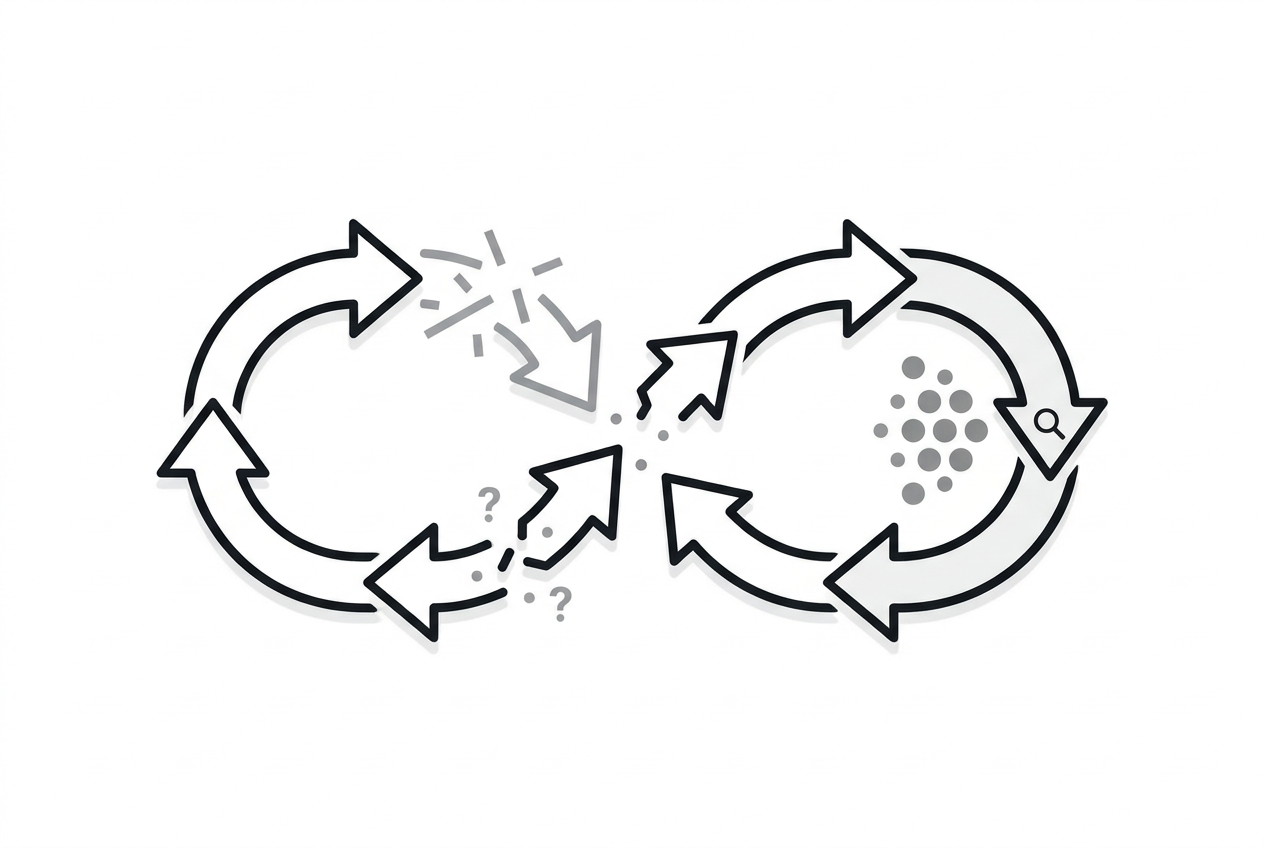
Notice the geometry of that sentence. There is a path. It has a direction. You are somewhere on it.
The framework's defenders insist the sequence "is not deterministic"—that it "can be interrupted at multiple points by institutional reform, elite coordination, or economic recovery." I believe they mean it. But the model's structure quietly overrides the disclaimer.
Here is why. The Weimar sequence is reverse-engineered from an outcome we already know: 1933. Every mechanism in it earns its place because it contributed to a collapse that actually happened.
A model built backward from a single ending cannot help treating that ending as the gravitational center. Movement toward collapse registers as signal. Movement away from it registers as noise—a "pause," a delay, an interruption in the real story.
This is the hazard. The Weimar analogy has become intellectually dangerous precisely as it has become methodologically respectable. In formalizing it, we smuggled in Weimar's foreordained ending and converted a warning into a prophecy.
And prophecy has a mood. Jeroen Bouterse names it exactly: reading Carl Schmitt in a Weimar frame, one feels the pull to "convince ourselves that his observations must be correct." The republic "was many things but clearly not a success." So the questions arrive on schedule: "Is there something untenable, something contradictory, something impossible about liberal democracy now? Has it had its time?"
That mood is not an accident of the analogy. It is what Schmitt wanted us to feel. He was, Bouterse writes, "not just the prophet of liberal failure; he wants to see it happen"—driving wedges between the popular will and democratic institutions, "slandering the latter because they stand in the way." A model that ends where Schmitt hoped it would end does his work for him, in the neutral voice of political science.
Now set a fact against the model.
On April 12, Hungarians went to the polls in record numbers—turnout nearly 80 percent, the highest ever recorded in a post-Communist Hungarian election. They were, in Gordon Sander's phrase, tired of Viktor Orbán. And Orbán lost.
Here was a democracy that had traveled a long way down the sequence—courts pressured, press bought, veto players eroded through legal means, the whole catalogue. The model would place Hungary deep along the path. And then the path bent the other way.
Watch what the fatalist frame does with this. It calls the loss a "pause." Sander himself is careful: it "remains to be seen whether Orbán's loss has reversed the right-wing European tide, but it certainly has paused it—by any measure a historic accomplishment."
Note the asymmetry. A step toward collapse would never be called a pause in the recovery. It would be called what it is: motion along the true trajectory. Only reversal gets demoted to a temporary interruption in a story we have already decided how to end.
That is the tell. When your framework can absorb an 80-percent-turnout electoral defeat of an entrenched autocrat only by reclassifying it as noise, your framework has stopped describing the world and started defending its ending.
This is exactly where Thoma's flat sentence does its work. "We have had democracy in Germany until 1932; and we will perhaps have it again in the future."
The sentence is anti-fatalist to its bones. Thoma had no obligation to be optimistic—he was writing in 1948, in the country that had produced the worst of it. His confidence comes from somewhere sturdier than hope.
It comes from what he thought democracy was. For Thoma, democracy was not a constitutional machine that runs until its emergency-decree clause seizes and it crashes. Its roots were social and historical, not philosophical—the "social-revolutionary" force of the economically disempowered, the tactical alliances of classes over centuries.
If democracy is a socially rooted practice rather than a doomed apparatus, then 1933 is not a proof about its nature. It is one interruption of one practice in one country—recoverable, as it was recovered. "We will perhaps have it again."
The perhaps is the whole ethic. Not the false comfort of "it can't happen here," and not the fatalism of a sequence that only runs one way. A live, contingent, un-guaranteed possibility that depends on what people do.
So where does this leave the analogy? Not in the trash. Weimar remains indispensable—but as a catalogue, not a narrative.
As a catalogue of specific institutional failure-points, it is precise and irreplaceable. The emergency-decree provision that let Hindenburg render the Reichstag largely irrelevant by 1930. The elite abdication captured in Kaas's self-justifying "unpleasant consequences." Alfred Hugenberg's fantasy that he could recruit Hitler to reinvigorate the conservative cause—not to stop him, but to use him. The systematic erosion of each veto player by legal means.
These are real mechanisms. They recur. Naming them lets you see them operating in a present that has not read the ending.
The corruption enters when the catalogue is welded into a story with a fixed terminus, so that spotting one mechanism seems to foretell all the rest, and 1933 arrives as the necessary last chapter.
Daniel Ziblatt draws the honest lesson from Kaas: that democracy "often erodes slowly at first, via the gradual surrender of those entrusted to defend it," and that "reversal becomes harder" with each concession. That is diagnosis. Harder is not impossible.
The discipline of the good analogist, then, is a kind of theft. Steal Weimar's diagnostics—every failure-point, every mechanism, every specific way a republic can be dismantled from within by people telling themselves they are being pragmatic.
Refuse Weimar's teleology. Do not import the ending along with the parts.
Kaas believed the outcome was foreordained and so helped foreordain it; his fatalism was itself one of the mechanisms of collapse. Thoma, surveying the ruin Kaas helped make, refused the same fatalism and was proved right—democracy did return to Germany.
The Weimar frame, in its formalized form, teaches us to think like Kaas: to read every tremor as a step down the one path there is. The 80 percent who turned out in Hungary on April 12 were, whether they knew it or not, thinking like Thoma.
The volcano is real. The dancing need not be a dance of the doomed.