You already know the script. Someone at the dinner table says something about the president, or immigration, or whatever this month's flashpoint is, and a small internal voice runs the math: no one's mind will change, and it'll only cost me the relationship. So you let it go. You change the subject. You feel, quietly, that you've been wise.
Here is the tension worth sitting with. That voice is not reporting a fact. It is making a prediction—a forecast about a conversation that hasn't happened yet—and when researchers finally measured that forecast against what actually happens in the room, it turned out to be wrong in a specific, repeatable direction.
The forecast says: nothing will move. The measurement says: both of you will move, and more than either of you expected.
The forecast says: nothing will move. The measurement says: both of you will move, and more than either of you expected.
The person who ran that measurement is Michael Kardas at the University of Wisconsin–Madison, with Loran Nordgren and Derek Rucker. Their 2025 paper in the Journal of Personality and Social Psychology carries a title that doubles as its thesis: "Unnecessarily Divided."
The design is simple enough to trust. Recruit adults in the U.S. and U.K. who hold opposing views on some issue. Before they talk, have them rate the strength of their views and predict how much—if at all—their own and their partner's attitudes will shift toward each other. Then give them ten minutes to actually talk, with prompts to share their reasoning and ask about the other person's. Then measure again.
Across every topic, people's views changed more than they'd anticipated. So did their partners'. The conversations depolarized both sides, and the participants had systematically failed to see it coming.
The topics matter here, because they rule out the easy objection. This wasn't only about Joe Biden's performance as president, or whether cancel culture is good or bad—the charged stuff where you might expect strong emotions to override calm forecasting.
It was also cats versus dogs.
Sit with that. People underestimated how much a conversation would soften their position on whether dogs or cats make better pets. As Kardas puts it, "even on a conversation about a topic related to personal preferences, like cats versus dogs, people became less extreme in their views to a greater extent than they themselves expected."
If the forecasting error shows up on pets, it isn't about politics. It's about a general misunderstanding of what conversation does.
And it wasn't a fluke that evaporated by the next morning. When the researchers followed up a week later, people's attitudes were still less polarized than they'd started—not as much as immediately after the conversation, but durably shifted.
More striking: the people whose attitudes moved most right after the conversation were the most likely to stay moved. The change didn't just linger; it stuck hardest in exactly the people who changed most.
So the forecast is wrong. The interesting question is why—and the answer is not that people are bad at debate. It's that they misdiagnose the disagreement itself.
Here is the mechanism, and it's the load-bearing insight of the whole paper. People infer that their attitudes differ because they fundamentally disagree. In reality, their attitudes differ because they are focused on different aspects of the same multifaceted issue.
Take cancel culture. One person thinks it's good, because when they hear the phrase, they picture Harvey Weinstein—a sexual predator held to account. Another thinks it's bad, because they picture Colin Kaepernick, punished for kneeling during the anthem to protest racial injustice.
These two people are not locked in fundamental opposition about a shared object. They are reasoning carefully about two different objects and calling both of them "cancel culture."
Kardas's framing is precise: "When people formulate their attitudes, they're often drawing on only a small subset, a small sliver of information that comes to mind when they think of the issue." A conversation surfaces the other person's sliver. Suddenly the disagreement looks less like a wall and more like a Venn diagram with an unexpected overlap.
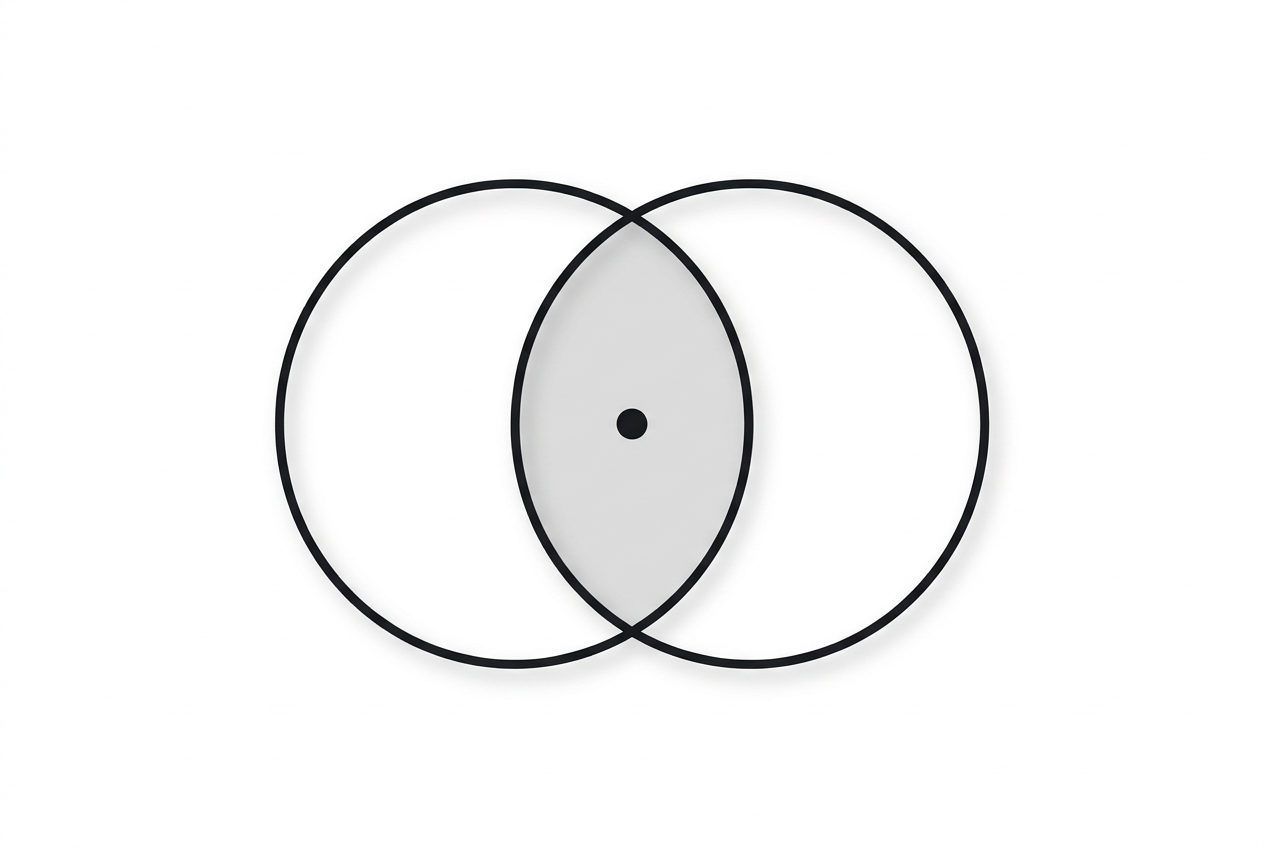
That's the engine of depolarization. Not persuasion, not winning—just the discovery that you were each answering a slightly different question.
But knowing all this changes nothing if people still won't come to the table. Which brings us to the study that turns a finding into a lever.
In one experiment, reportedly Study 6, the researchers didn't teach anyone a technique. They didn't coach empathy or model active listening. They simply told some participants what the earlier studies had found: that in a conversation like this, your partner's views might moderate, or your own might, or both might move closer together. Other participants were told nothing.
Then they measured willingness to discuss a genuinely charged topic—views of Biden's performance. The people who'd been told about the depolarization finding were more willing to have the conversation than those who hadn't.
Read that carefully, because it's the entire practical payload. The intervention was not a skill. It was a correction to a single prediction. Recalibrate the forecast, and people walk toward the conversation they were avoiding.
This is worth separating cleanly from a different reason people avoid political talk. Other work—Boland and Davidai's correlational research on zero-sum beliefs—reportedly finds that people who see politics as a game where one side's gain is another's loss tend to avoid cross-partisan conversation, through expected conflict and low receptiveness, though the authors caution their findings cannot directly determine causation. That's a structural belief about the nature of the fight.
The Kardas finding is a different animal. It's not about how you construe politics; it's a calibration error about what conversation does. The two explanations are complementary, not competing—one describes a reason to stay away, the other a mistaken forecast that keeps you away.
Now the honest limits, because the effect is real but bounded.
These were ten-minute online conversations, not Thanksgiving with your brother-in-law. A small share of participants dropped out after learning their partner's view and before talking—though the researchers found the gap between predicted and actual depolarization held even under conservative assumptions about those who left.
The follow-up ran one week, not one year; nobody measured whether these shifts survive a month of doomscrolling. And the samples were Western, drawn only from the U.S. and U.K.
That last point cuts in an interesting direction. The authors note that people from Eastern cultures tend toward more dialectical thinking—more comfort holding apparent contradictions at once. Such people might already grasp that a single issue can support opposite attitudes depending on which facet comes to mind, and so might not underestimate depolarization the way Western participants did.
In other words, the error this research documents may be partly a Western habit of mind, not a universal law. The fix may be needed most exactly where the mistake is largest.
But within those limits, the result is unusually clean. The barrier to talking across difference is not that you lack the skill to persuade. It's not even the disagreement.
It's a forecast—no one's mind will change—that you've been treating as settled knowledge when it's an untested prediction, and one that measurement keeps proving wrong.
You don't have to get better at arguing. You have to get better at guessing what a conversation will do. And the evidence suggests you've been guessing too low.