A mouse, lightly satiated, hears a sound. It ignores the sound sometimes and responds other times, and the researchers can prove why: it only bothers when it actually wants the water on offer. This is a goal-directed animal, weighing a choice. Then, at a specific moment, the same mouse begins responding to the sound every single time, whether it wants the water or not. Nothing changed in the experiment. The animal simply switched.
"The animals simply switched strategies from one trial to the next," said Sharlen Moore, lead author of the Johns Hopkins study published this year in Nature Communications. "Capturing that kind of rapid behavioral reorganization is rare."
That switch flipped from one trial to the next — call it an instant. Meanwhile, the most-cited human number for how long a habit takes to form is 66 days. And, per the 2024 Singh et al. systematic review and meta-analysis, median times to achieve habit formation were reported across studies at somewhere between 59 and 66 days.
Both findings arrived wearing the same headline: the old 21-day rule is dead. Which leaves a reader holding two numbers that cannot both be right. A habit snaps into place in a single trial, or it grinds into existence over two months. Pick one.
The trick is that they are not answering the same question.
The mouse study measures a control mode inside a brain. Neuroscientists distinguish between goal-directed behavior — acting because you want the outcome — and habitual behavior, where you act on the cue regardless of whether you still want the reward. The Hopkins team found that the flip between those two modes can happen abruptly, and that a particular brain region may house the switch.
For over a century, the field assumed that transition was gradual. Kuchibhotla, the senior author, argues that assumption was an artifact of method. Older studies could only test animals at two time points — early and late — and then inferred a smooth ramp between them. They never watched the moment itself.
When the Hopkins team stopped over-motivating their mice and watched in real time, the ramp turned out to be a cliff.
That is a claim about neural machinery: how quickly the brain can reassign control of a behavior it already knows how to perform. It says nothing about how long it takes a human to build the behavior in the first place.
The 66-day figure measures something else entirely — and it measures it with a questionnaire, not an electrode.
That number comes out of a lineage of self-report studies where people pick a behavior, repeat it daily in a stable context, and periodically rate how automatic it feels. The instrument is a scale like the Self-Report Behavioral Automaticity Index. What it tracks is a slowly rising curve of felt automaticity in an ordinary, distracted human life.
The 2024 systematic review from the University of South Australia pooled 20 studies and 2,601 participants doing exactly this — flossing, drinking water, exercising, microwaving dishcloths. Median times to achieve habit formation were reported across the included studies at between 59 and 66 days.
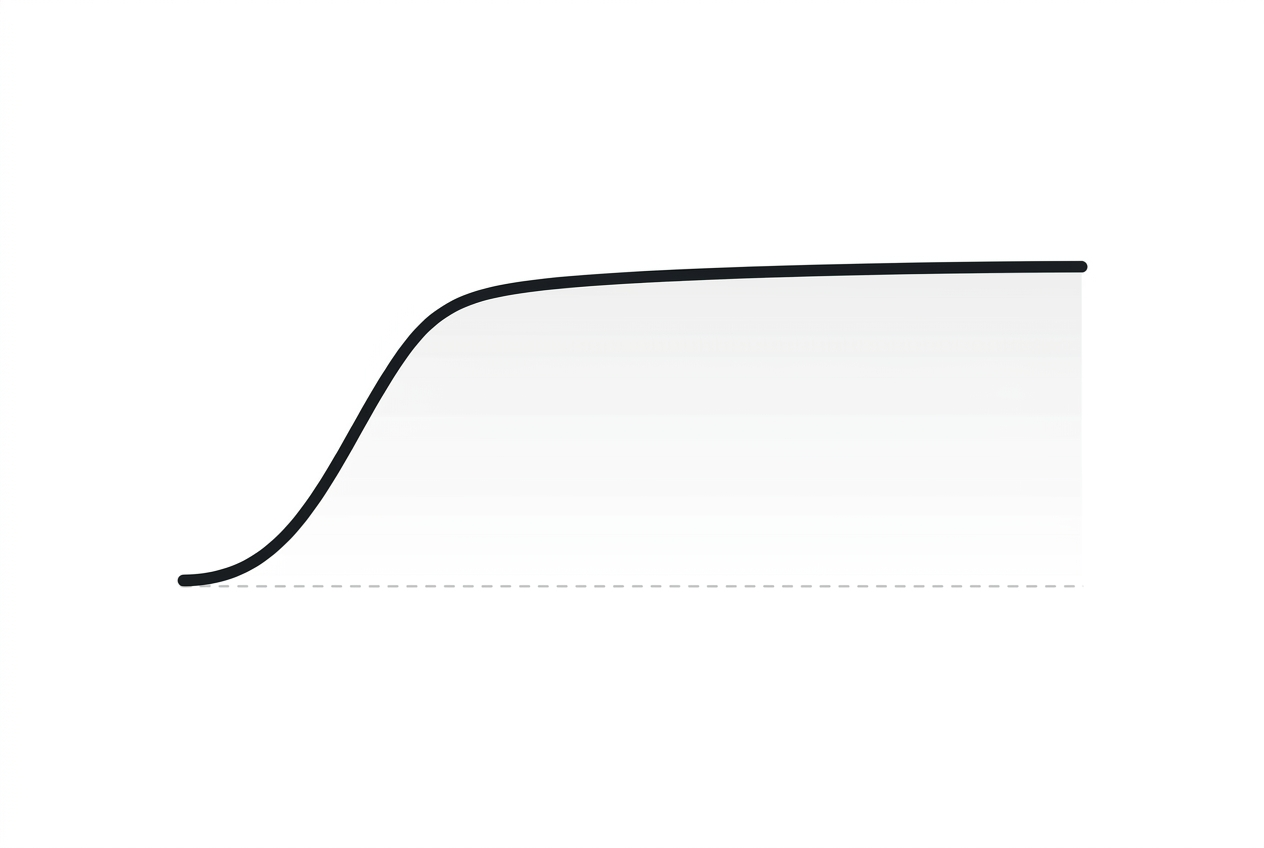
But the headline median buries the real finding. Individual estimates ranged from 4 days to 335 days. Some people consolidated a habit inside a week; others were still not automatic most of a year later.
So one study clocks a neural strategy-switch that can happen between two trials. The other clocks the accretion of subjective automaticity across weeks or months of messy behavior. A brain flipping a control mode and a person feeling like flossing has become effortless are different events, measured on different scales, in different species.
A brain flipping a control mode and a person feeling like flossing has become effortless are different events, measured on different scales, in different species.
They are no more in conflict than the speed of a light switch and the time it takes to wire a house.
Why does the distinction matter beyond tidiness? Because collapsing the two produces exactly the thinking that kills real habits.
If you believe habits "form in an instant," you expect the new behavior to feel automatic almost immediately — and when it still takes effort in week three, you conclude you failed. If you believe in a hard 66-day deadline, you treat the number as a test you can flunk. Either way, you are counting down to a verdict.
The evidence on when people actually quit is less settled here. According to one non-peer-reviewed practitioner guide, behavior tends to collapse somewhere between weeks three and six, precisely because motivation decays while automaticity has not yet stabilized. The felt effort is still high, the initial enthusiasm is gone, and any fixed deadline has started to feel like a rebuke.
A median is not a promise. In the human data, 66 sits within a range of estimates that runs from 4 to 335 — which means treating it as your personal finish line is close to a coin flip about whether it will lie to you.
The corrective is to stop counting days and start counting exposures. What the automaticity curve actually rewards is repetition of the same behavior in the same context, often enough that it gradually requires less deliberation than it did at the start.
This is why the useful levers are structural rather than motivational. Implementation intentions — specifying in advance when, where, and how you will act — and habit stacking, where a new behavior is tacked onto an existing routine, both work by the same mechanism: they engineer more reliable repetitions in a stable setting. They are not magic; they are just ways to get the reps in.
Note the shape of the target. The goal is not to reach day 66. The goal is to arrange your environment so the behavior happens again, and again, in a context stable enough that the automaticity can accrue on its own uneven schedule.
There is a final reason the fast-switch finding is worth keeping in view, and it cuts against the fatalism baked into most habit talk.
If the brain has a controller that can flip a behavior from goal-directed to habitual in a single trial, then that controller can presumably flip the other way. The Hopkins team saw exactly this: some mice reverted to goal-directed behavior after long stretches of acting purely on habit.
"The fact that it is so sudden implies that something is controlling it," Kuchibhotla said. "The fact that there may be a controller means maybe we can reverse maladaptive habits back to goal-directed behavior."
His conclusion is the one worth carrying: "Rather than thinking of habits as always being there no matter what, it's possible that bad habits need not be there forever."
That is the honest reconciliation of the two numbers. The neural mode can switch fast, in either direction, which means no habit is a permanent fixture — but the subjective sense of automaticity in a real human life accretes slowly and unpredictably, which means no calendar can tell you when you are done.
So drop the deadline. It was never the thing doing the work. The reps in a stable context are.