Article — "Vagus Nerve Stimulation Reduces Suicidal Ideation in Treatment-Resistant Depression": Eleven. That is, reportedly per the RECOVER trial report, the median number of antidepressant treatments a person had already failed before qualifying for the unipolar arm of the RECOVER trial. Seventy-seven percent arrived with active suicidal ideation. Forty percent had already attempted to kill themselves.
These are the patients for whom a surgeon threads a lead onto the left cervical vagus nerve and buries a pulse generator in the chest. This is the population where "next option" is often a euphemism for "no option."
Now hold two facts about the same regulator side by side.
The FDA requires a boxed warning that antidepressants may increase suicidal ideation in children and young adults. The same agency cleared vagus nerve stimulation, a device that a growing body of reports now credits with reducing it.
Two opposite relationships to the same outcome, stamped by the same authority. The uncomfortable question the gap opens is not which direction is real. It is how we could ever prove either one.
Two opposite relationships to the same outcome, stamped by the same authority. The uncomfortable question is not which direction is real, but how we could ever prove either one.
Start with what RECOVER actually was, because the headline version—"VNS reduces suicidal ideation"—smuggles past the part that failed.
RECOVER was, per RECOVER trial reports, a multicenter, triple-blind, sham-controlled trial of 493 adults with marked treatment-resistant depression. Everyone got the implant. Half had it switched on; half sat with a dormant device for twelve months. The design reportedly blinded patients, offsite raters, and the sponsor.
The primary outcome was precise: percent time in MADRS response across months three through twelve, response being a 50 percent drop from baseline. This was the endpoint the trial was built and powered to move.
It did not move. Percent time in MADRS response did not distinguish active from sham VNS. On the measure that mattered most, the switched-on device and the switched-off device looked the same.
Secondary measures told a warmer story—onsite clinicians, self-report, and offsite raters all favored active VNS on response or partial response. But secondary endpoints in a trial whose primary endpoint failed are hypotheses dressed as conclusions. They are where you go looking after the main bet loses.
So any claim about suicidal ideation does not ride on the depression result. It rides on something the investigators built themselves.
They constructed, in advance, a composite suicidal ideation score. It fuses the suicide item from the MADRS with the suicide items from two versions of the Quick Inventory of Depressive Symptomatology—one clinician-rated, one self-reported.
The rationale is defensible on its face: some patients disclose ideation to a rater, others only on a form they fill out alone. Combining perspectives is meant to make the measure more reliable than any single item.
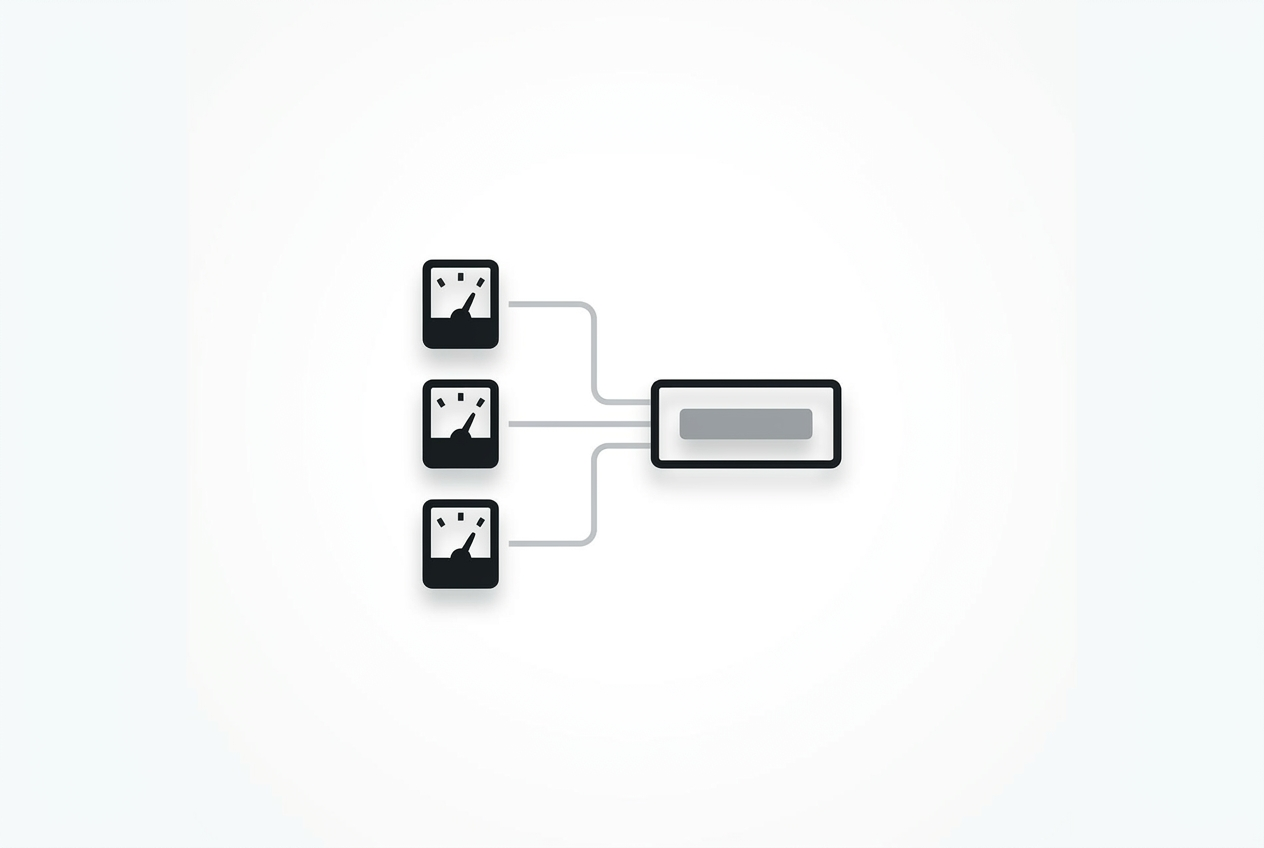
But notice what has happened. The MADRS, which failed to separate the groups as a full depression scale, contributes item 10—its suicide question—to a new composite that is then asked to separate them. You have disassembled a null result and reassembled one piece of it into a positive one.
That is not fraud. It may even be good measurement. But it is the kind of move that demands you ask why the composite had to be built at all.
Here is why. The outcomes we actually care about—suicide attempts, deaths by suicide—are, statistically, too rare to detect.
The trial's own framing concedes it: completed suicides and attempts are uncommon, and therefore "relatively insensitive metrics for detecting differential treatment effects." You cannot power a 493-person trial to find a difference in an event that happens to a handful of people.
So the field substitutes ideation. And it justifies the substitution with real evidence: in the McHugh meta-analysis, patients with suicidal ideation were reportedly 3.41 times more likely to die by suicide than those without, over an average of nine years of follow-up.
Ideation is common enough to measure and predictive enough to matter. That combination is exactly what makes it attractive as a surrogate—and exactly what should make us cautious.
Because a risk marker is not a mechanism. That ideation predicts death over nine years does not establish that lowering an ideation score over ten months lowers the thing the score stands in for. We are treating the number we can move as a proxy for the outcome we cannot, and calling the move validated because the correlation is strong.
The prior VNS literature runs on the same fuel. A five-year bipolar registry reportedly found significantly greater reduction in suicidality with VNS plus treatment-as-usual than treatment-as-usual alone—but it was open-label, non-randomized, with high attrition, and suicidality was a single MADRS item.
RECOVER was supposed to be the rigorous answer to those soft, observational hints. Its rigorous primary answer was null. The suicidal-ideation signal that survives is, once again, an ideation signal—now assembled from a purpose-built composite rather than resting on attempts or deaths.
And yet. Set the caveats down for a moment and look at what the inversion means.
Multiple psychotropics, antidepressants among them, carry labeling that they may increase suicidal ideation. Here is a treatment associated, across observational and now composite-endpoint data, with lowering it—in a population where 40 percent have already attempted suicide and eleven prior drugs have already failed.
For a patient with no ordinary options left, an intervention that pushes ideation down rather than warning it might push it up is not a rounding error. It is, plausibly, the most humane thing on the table.
That is the bind. The ideation signal is simultaneously the most compassionate finding in the trial and the thinnest evidentiary reed on which to justify a permanent surgical implant.
The access structure sharpens the point rather than softening it. In 2007, CMS reportedly judged VNS "not reasonable and necessary" for treatment-resistant depression and withheld coverage.
In 2019 it reportedly issued a coverage-with-evidence-development decision: patients could get the device, but essentially only inside a trial designed by the manufacturer, LivaNova, and approved by CMS. RECOVER is that trial. Coverage is tied to the very study meant to generate the evidence.
So the pathway to the implant runs through a manufacturer-run study, the study's headline efficacy endpoint failed, and the surviving reason to reach for the device is a surrogate the field has adopted precisely because the real outcome is unmeasurable at this scale.
None of this means VNS does not help these patients. It might. The secondary signals are consistent, the mechanism is plausible, and the population is genuinely out of alternatives.
It means we should be honest about what we are betting on. Not "VNS treats depression"—the primary endpoint says otherwise. Not "VNS prevents suicide"—no trial this size can show that.
What we have is a device that, in the hardest-to-treat depression there is, appears to lower a composite score standing in for an outcome too rare to observe. That is a real signal and a fragile one at the same time.
The right response to a fragile signal in a desperate population is not to dismiss it, and not to sell it as proof. It is to say plainly what the reed can bear—and to keep measuring the thing we actually fear, even knowing we may never see it move.