
Article — "SK Hynix's Record $26.5B US Debut Is the Market Betting Memory Demand Never Cools": Every SK Hynix employee is about to collect a bonus of roughly $574,500. That number — larger than most Silicon Valley base salaries, and reportedly enough to make Hynix engineers sought-after marriage partners in Korea — is the truest picture of what a memory supercycle looks like from the inside.
It is also the number that should make you nervous.
Because here is the anomaly buried in this week's celebration: SK Hynix didn't just set the record for the largest US debut by a foreign company, raising $26.5 billion by selling 177.9 million ADRs at $149 each. It priced those shares at a roughly 2.9 percent premium to its Seoul close, per the Korea Herald — and the company says it was the first US IPO of its kind ever priced above market.
Large equity offerings are supposed to be priced at a discount. You give investors a small gift to move a big block of stock. SK Hynix did the opposite and still drew orders for more than seven times the shares on offer.
Global long-only funds, sovereign wealth funds, tech-focused funds — Baillie Gifford, Coatue, and Situational Awareness Partners reportedly signaled interest in up to a combined $7 billion. That is not the tape of a company begging for capital. That is a feeding frenzy.
And a 7x-oversubscribed deal priced above market is what a top looks like, not a floor.
Here is why. If demand were about the durable, decade-long growth story everyone keeps narrating, you'd expect the valuation the market assigns to SK Hynix to expand as the stock climbs. It's doing the reverse.
The stock is reportedly up 680% over twelve months, per Reuters. Since the end of October, its 12-month forward price-to-earnings ratio has fallen to 5.5 times, down from 7.9 times.
Read that slowly. The multiple is compressing into the rally.
That is the signature of a market buying earnings it already assumes will normalize. Investors aren't paying up for future growth — they're paying for a mountain of current profit they expect to shrink, and demanding a lower and lower multiple to hold it as the cycle ages.
You don't price a company at under six times forward earnings when you believe demand never cools. You price it that way when you believe you're near the peak and want to be paid to take the risk of the descent.
You don't price a company at under six times forward earnings when you believe demand never cools. You price it that way when you believe you're near the peak.
Counterpoint Research forecasts that Samsung, SK Hynix, and Micron will post second-quarter operating margins averaging between 75 and 80 percent. Those are not the margins of a competitive commodity business. They are the margins of scarcity — of a product the world needs and cannot get enough of.
And scarcity, unlike growth, is a fragile thing. It survives exactly as long as supply can't catch demand. The entire 75-to-80-percent margin structure the stock is priced on is a bet that the shortage holds.
Which brings us to the gift that is actually a threat.
This same week, researchers at POSTECH reportedly announced they had stacked more than 10 ultrathin semiconductor chips to achieve memory density roughly four times higher than the best commercial chips available today — and did it under low heat, below 180 degrees Celsius, and low pressure, below 20 kilopascals.
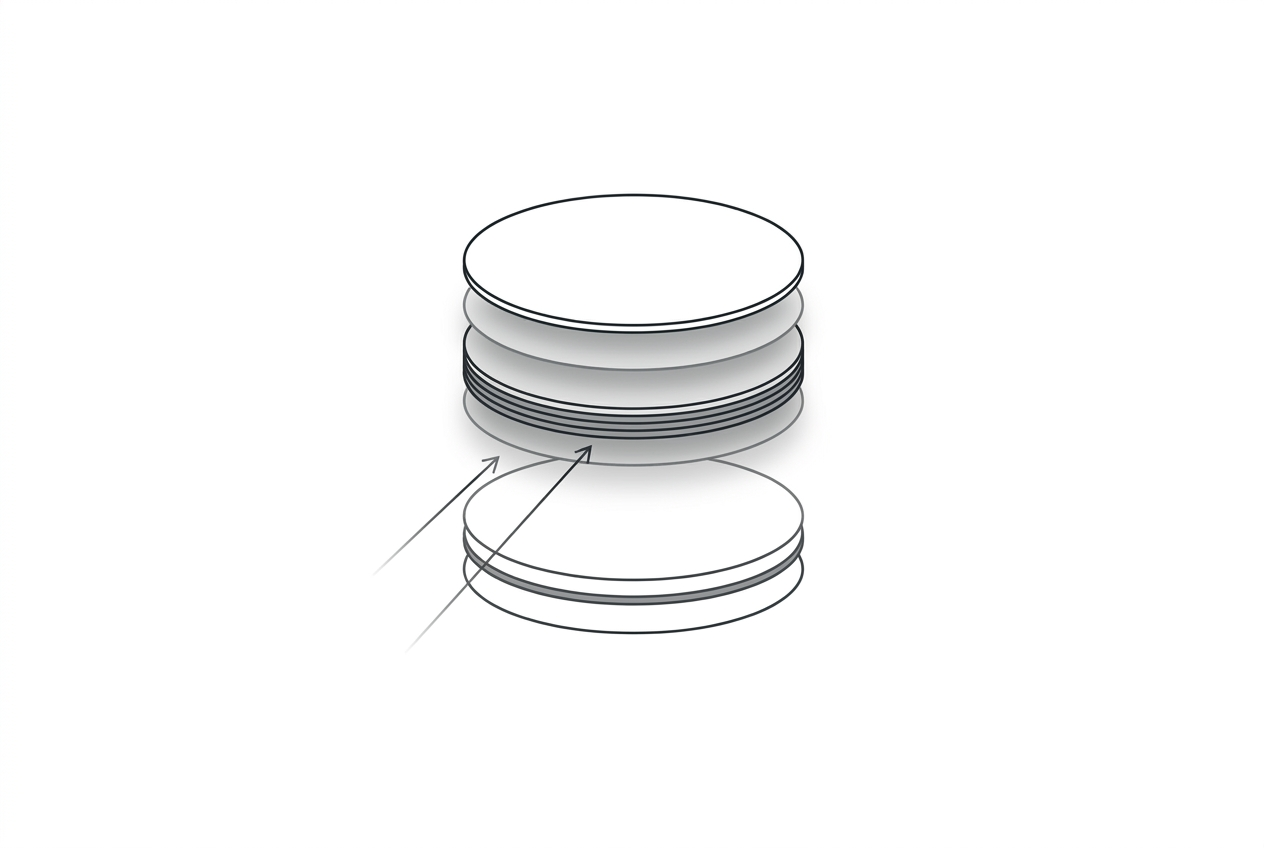
The press coverage framed this as HBM's future: the memory ceiling holding AI back, finally lifting. And for the technology, that's true.
For SK Hynix's margins, it's a loaded gun.
Think about what "four times the density in the same space" actually does to a business that prints money because chips are scarce. Density is the enemy of scarcity. Every doubling of what you can pack into a package is a halving of the physical constraint that lets you charge 80-percent margins.
Supercycles don't end because demand vanishes. They end because a density leap — a node shrink, a new stacking method, a yield breakthrough — collapses the bottleneck that made the product precious, and suddenly everyone can make enough.
A lab that can quadruple density is not a tailwind for a company whose entire earnings profile depends on the world not being able to make enough memory. It is the mechanism by which this cycle eventually breaks.
Now, timing matters, and the bulls have a genuine counter. The sibling case for this boom argues that if you can get four times the memory from the same stack, the wafer math that looked irreversible starts to bend. The investor question isn't whether the shortage is real today — it plainly is — but how many quarters of runway that claim actually has before a density breakthrough scales into production.
So what should you actually watch, if you're deciding whether this listing means anything for you?
Not the stock price. As eToro's Zavier Wong put it bluntly: "Hynix's stock going up isn't the same as the discount shrinking." The shares can rip and the underlying story can still be unchanged.
Watch the Korea discount instead. SK Hynix trades at a forward P/E 20 to 40 percent below Micron's (Korea Herald); Reuters cites 5.5 times versus Micron's 6.66, while LSEG separately pegs SK Hynix at 4.8 times, Micron at 6.6 times, and the industry median near 30 times. The whole official rationale for a Nasdaq listing is that direct access to the world's deepest capital pool should narrow that gap.
If the discount genuinely closes — if Hynix re-rates toward Micron and stays there — then the listing did structural work, and the bull case has a leg beyond the cycle.
But BNK's Lee Min-hee already warned he does not expect the US listing to meaningfully lift the local shares, because the governance concerns behind the Korea discount don't evaporate on a Nasdaq ticker. If he's right, then the multiple won't re-rate — it'll just track the memory cycle up and then down, like every memory boom before it.
That's the tell. A narrowing discount is a real story. A stock that merely rides the cycle is a liquidity event wearing a growth story's clothes.
And a liquidity event is exactly what this smells like. The proceeds fund fabs at Yongin, packaging at Cheongju, EUV equipment — capacity added despite industry concerns, as reported, that the memory-chip upcycle "may be approaching its peak."
Thomas Hayes of Great Hill Capital said it without flinching: "Global semiconductors is the most crowded trade in the world right now. The bankers and the issuer... are seeing excessive valuations, and they want to take advantage of it."
That's the whole thing in one sentence. When the smartest supplier in the industry chooses this exact moment to sell the largest block of foreign stock in US history — at a premium — the question isn't whether they know something.
It's whether the seven-times-oversubscribed crowd buying it does.