The Grunt-Work Truth: Designers Adopt AI for Drudgery, Not the Creativity We Were Promised
Michal Malewicz went to the beach and let Claude do his job. Not the fun part. The tedious part.
"Claude MCP → Sketch → Export all assets as SVG's and PNGs for the developers," he posted. "Then remove duplicates and give everything proper naming conventions. This saved me HOURS of manual work. It was working for me like an intern, while I enjoyed the beach."
And it is the exact inverse of the one they sold us on stage.
Put the two images side by side. On one screen, the conference-keynote promise: AI will handle the grunt work so you can ascend to higher-order creativity, strategy, the meaningful stuff. On the other, Malewicz's tweet: the grunt work is precisely what got automated, and the higher-order stuff is still all his — he just got to do it from a beach chair.
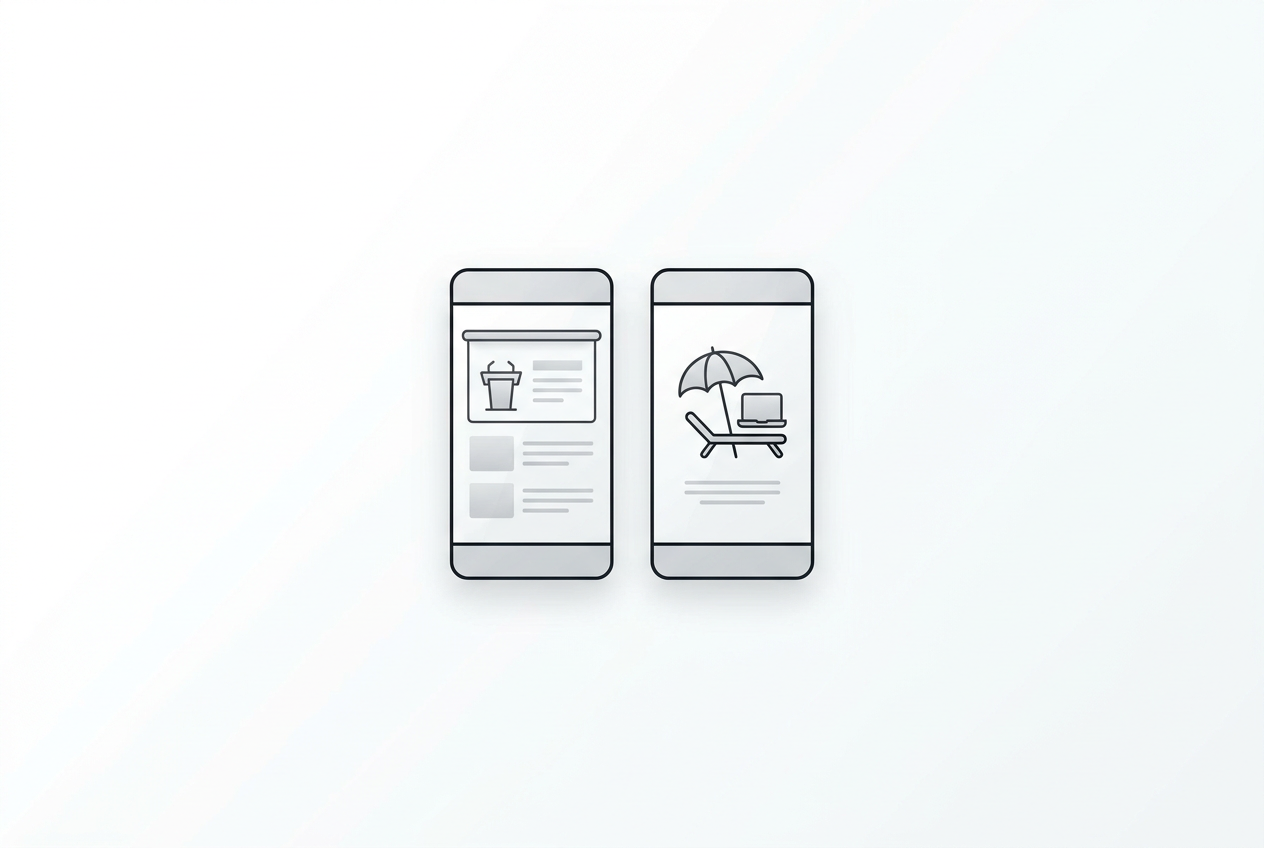
The keynote had the object of the sentence right and the subject wrong. AI did free him for higher creativity. It just did so by taking the drudgery, not by generating the design.
The evidence tells us why the slop keeps coming: adoption runs on drudgery, not creativity, and we keep pointing the tools at the wrong layer.
Start with what designers actually reach for when nobody is watching. Malewicz exporting and renaming assets. Erik Kennedy turning Greg Mushen's thread series (with links to 46 studies) into a readable Google doc — "OK, fine, Claude did it. I went for a walk instead." De-duping. Compiling. Renaming. The unglamorous connective tissue of the job.
None of that made a slide. Nobody demos asset renaming at a launch event. But it is the reliable daily win, and it is reliable precisely because it is bounded, verifiable, and boring.
Now look at the thing that did make every slide: generative creation. Type a prompt, get twelve UI variations, iterate to greatness. This is the "10x designer" pitch, and it is where the math quietly falls apart.
Pallavi Sharma names the scene exactly. Forty-five minutes crafting the perfect prompt, twelve variations generated, all reviewed, none quite right — and then you sit down and design the damn thing yourself in twenty minutes. It looks better. And a quiet, uncomfortable thought surfaces: was any of that necessary?
She calls it a new category of work disguised as automation. That phrase is doing enormous load-bearing work, so sit with it.
The pitch assumed design was an execution problem — that if you speed up the making-stuff layer, net output rises. But the real time sinks are upstream: understanding the actual problem, reconciling contradictory stakeholders, synthesizing research, making judgment calls that require context the model does not have.
AI sped up the parts that were already fast. It did nothing for the parts that were slow. Accelerate the fast steps of a process and you don't get a faster process — you get more visible bottlenecks, with a pile of generated assets waiting on the far side of every slow human decision.
Worse, generation multiplies choices. A tool that produces a hundred variations in the time you used to sketch five hasn't solved the choice problem. It has amplified it. Every option is a small tax on collective attention, and the tax compounds.
So we have two categories of tool doing two opposite things. The drudgery tools subtract work. The generation tools add a new layer of work and call it automation. And we sold both under the same banner.
The drudgery tools subtract work. The generation tools add a new layer of work and call it automation. And we sold both under the same banner.
Here is where the numbers land the point. Figma's data: 78% of designers say AI makes them more efficient, but only 32% say they can rely on its output.
Read that gap slowly. Nearly four in five feel faster. Barely one in three trust what comes out. That is not a contradiction — it is a map of which layer each figure measures.
The 78% is the drudgery win. Exporting, renaming, doc-compiling — efficiency you can feel because the task is bounded and the output is checkable at a glance.
The 32% is the generation problem. When the gatekeepers of brand, voice, and quality tell you they cannot trust the output two times out of three, they are not describing an intern who saved them an afternoon. They are describing a slot machine they still have to babysit.
The category error is the whole story. Ideation tools got sold — and bought — as production tools. And a tool used against its grain doesn't just underperform; it teaches its user to distrust it.
Note who admits this most clearly: Claude Design's own advocates. The UX Planet writer, defending the tool against "AI slop" complaints, doesn't argue it makes production-ready output. He argues the critics are using it wrong.
His actual claim: "Claude Design is a tool for quick ideation." Explore more directions faster, pressure-test assumptions, prototype an error state instead of another happy-path mockup. Every genuinely useful technique he lists is an ideation technique.
That is the confession hiding in the defense. The people closest to the tool describe an ideation aid. The marketing describes a production engine. The 32%, arguably, is the distance between those two descriptions.
And this is where it stops being a workflow argument and becomes a values argument. Because which layer you automate determines what the job feels like to do.
There is a version of this that is genuinely liberating. Andrew Shea puts it, per itsnicethat, plainly: eliminating rote work isn't inherently bad — so long as you compensate for the muscle it built. Malewicz on the beach is that version. The drudgery left; the design decisions stayed with him.
But automating ideation is a different operation on the soul of the work. As Shea notes, per itsnicethat, every prior tool upheaval — Adobe, QuarkXPress, the California job case in his studio — touched execution. AI is the first to reach into ideation itself.
That matters because, as Shea argues, creative labor is one of the main ways people find meaning in their working lives, and that meaning was never only in the finished product. It lived in the process of arriving at ideas.
So here is the trap. The tool that actually augments you — the boring exporter-intern — gets no keynote and quietly earns your trust. The tool that gets the keynote reaches for the exact layer where meaning lives, does it unreliably, and slowly teaches you that AI can't be trusted at all.
That is how we lose twice. We under-credit the drudgery win because it isn't sexy, and we over-deploy the ideation tool into a job it fails, poisoning trust for both.
There is a designer described in the UX Design piece — an SVP of Design, twenty years in — who, per the account, adopted AI without drama. The theory offered is that experience tempers idealism: once you've learned design is mostly solving problems under messy constraints, handing off the rote parts feels like relief, not intrusion.
Fine. But relocate the passion upstream — into strategy, concept, deciding what to build — and then point your AI at that upstream layer, and you've automated the exact thing you relocated your idealism into.
The honest position isn't pro-AI or anti-AI. It's layer-literacy. Know what you're outsourcing.
Outsource the export, the rename, the de-dupe, the research digest, and go to the beach with a clear conscience. That is the win nobody put on a slide, and it is real.
But when the ideation tool costs you forty-five minutes to save you none, stop calling it production. Call it what its own advocates call it — a place to think, not a place to ship — and stop grieving a trust you never should have extended.
The drudgery is not beneath us. It was never the meaning. The ideas were. Automate accordingly.