Article — "Banks and Networks Race Into Stablecoins as Circle, Visa-Dunamu and BankChain Reshape Rails": Article — "Banks and Networks Race Into Stablecoins as Circle, Visa-Dunamu and BankChain Reshape Rails": Thirty-nine state bankers associations, representing 3,283 banks with $21.8 trillion in combined assets, spent the last week of August building a blockchain of their own.
Circle spent the same week buying a spot on Chelsea's shirt.
Put those two moves side by side and you have the whole state of the stablecoin fight in one frame. One side is wiring the pipes that could make whose token you hold irrelevant. The other is paying to put its name where Premier League fans will see it.
One side is wiring the pipes that could make whose token you hold irrelevant. The other is paying to put its name where Premier League fans will see it.
This week the incumbents stopped buying and started building.
More than ten financial firms — Bank of America, Wells Fargo and Santander among them — are pursuing a jointly issued stablecoin, per the Wall Street Journal, starting dollar-pegged and eyeing G7 currencies. JPMorgan has reviewed issuing its own but says it has no formal plans.
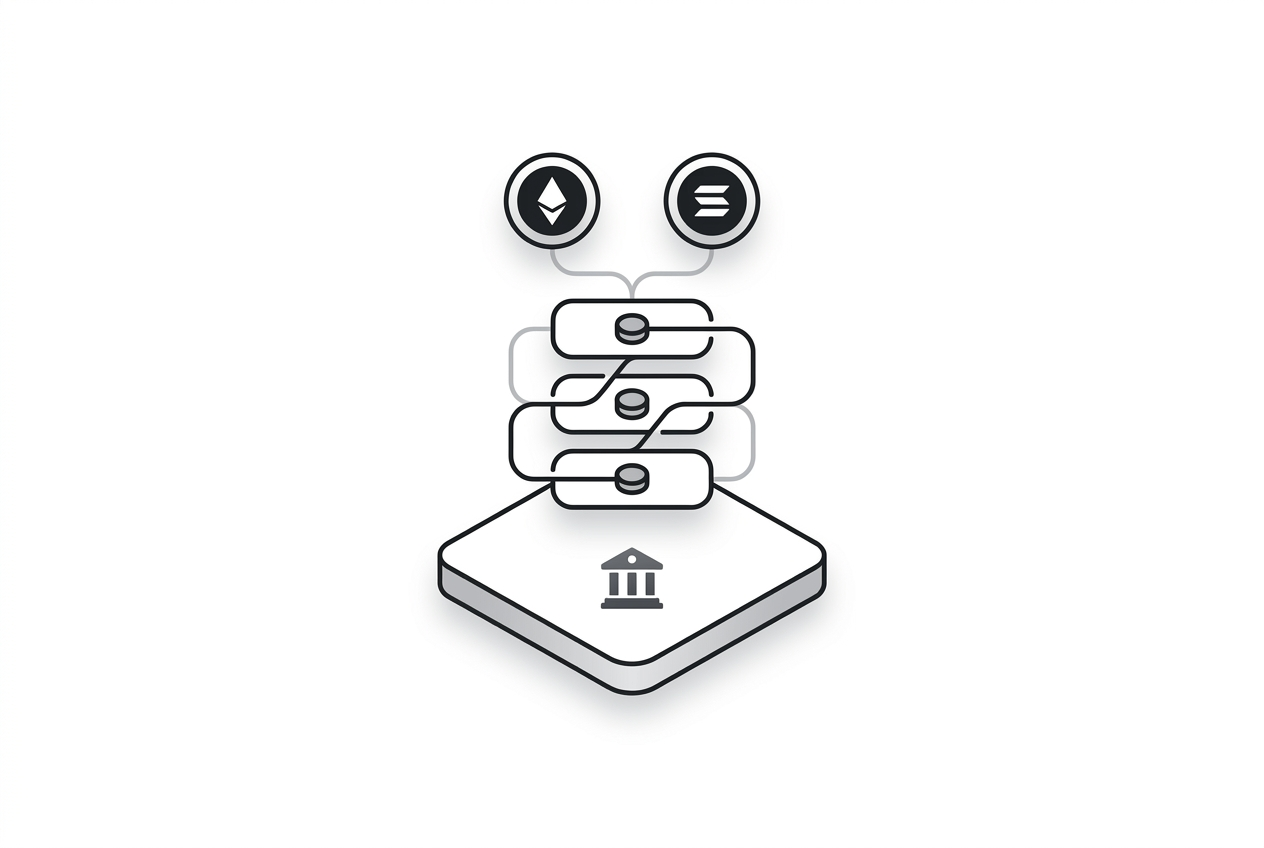
The BankChain Alliance is the wider move: a bank-owned, bank-governed network targeting a 2027 launch, built to carry deposit tokens, stablecoins, programmable payments and smart-contract settlement. It has not named a chain, a technology partner or a governance model. It doesn't need to yet. The point is the ownership structure, modeled on the Federal Home Loan Bank system.
This is the part that matters for Circle and Tether, and it's easy to miss inside the infrastructure jargon.
The stablecoin market has bifurcated into two competitive currencies. One is brand and mindshare — where the crypto-natives still lead. The other is embedded distribution and network interoperability — where the incumbents are consolidating fast.
USDC and USDT won the first game years ago. The name recognition, the exchange integrations, the reflexive trust of the on-chain trader — that's Circle and Tether territory, and no bank consortium is going to out-brand them to crypto Twitter.
But brand only prices in when the customer gets to choose the token. The whole thrust of this week's moves is to take that choice away from the customer and hand it to whoever owns the distribution surface.
Look at what a captive-distribution play actually does to issuer identity.
Revolut is withdrawing Tether's USDT from the EEA and Switzerland, and, per Revolut, said remaining balances would be converted into customers' base currencies after Aug. 31. In its place it is rolling out EURR, a MiCA-compliant euro token issued not by Revolut but by Bridge, the Stripe-owned infrastructure firm.
The initial rollout reportedly involves roughly 2 million customers across Denmark, Poland and Portugal, per Revolut. Those users didn't pick EURR over USDT on the merits. Revolut picked for them, swapped the token inside the app, and moved on.
That's the tell. To roughly 2 million people, the issuer became a back-end vendor overnight — swapped out the way a merchant swaps a payments processor. The end user's relationship is with Revolut, not with whoever mints the coin.
Now scale that logic. Visa and Dunamu, parent of Korean exchange Upbit, formed a strategic partnership to explore stablecoin payments, remittances and settlement — Visa's second major Korean deal that week.
Crucially, Dunamu has not committed to a specific token. Open Standard's proposed OUSD is one of several under review. And OUSD already claims more than 140 companies signed up to use it — Visa, Mastercard, Stripe, Coinbase and BlackRock among them.
Read that as a distribution primitive, not an issuance one. A 140-company consortium plus Visa's network plus Upbit's userbase is a machine for attaching some compliant dollar token to an enormous existing base of users and merchants. Which specific token gets attached is a procurement decision.
(The Visa-Dunamu deal also floats agentic commerce — AI agents buying on a user's behalf. Note it only as another distribution surface; the payments-infrastructure argument lives elsewhere.)
The pattern across all three moves is the same, and it is the argument.
When Revolut can swap the token behind 2 million wallets, when Visa and Dunamu can bolt any compliant coin onto Upbit's base, and when 140 firms can rally behind a shared OUSD, the issuer brand stops being a moat and becomes a commodity input. The token is fungible. The distribution is not.
BankChain sharpens this to a point. The associations behind it represent 3,283 banks with $21.8 trillion in assets — that is default customer distribution at national scale, the kind of embedded relationship no crypto-native can manufacture.
And they are explicit that this is defensive. Banks spent years fearing deposit flight — trade groups warned in January that up to $6.6 trillion in deposits could leave if stablecoin rewards spread. The answer this week is not to resist but to own the rails, so the deposits move on-chain without leaving the banking system.
BankChain isn't alone. The Clearing House has an on-chain money initiative backed by JPMorgan, Bank of America, Citi, BNY and Wells Fargo. Regional lenders are building Cari, which had attracted more than 30 participating banks by July, per Cointelegraph. Community banks formed the DTX Consortium, which IBAT said had passed 50 banks by June.
That is four overlapping bank-led networks, all aimed at the same thing: keeping the customer relationship and the settlement layer inside institutions that already own the customer.
Interoperability is the quiet accelerant here. BankChain says the network will be interoperable with other chains. So does everyone else. The BIS has warned about liquidity fragmentation and stressed interoperability as the fix.
But interoperability cuts against the issuer, not for it. If any compliant token can settle across any of these networks, then the token's identity matters even less — the network handles the routing, and the coin is just cargo. Settlement interoperability is exactly the thing Tether and Circle cannot manufacture on their own, because it requires other people's rails to agree to carry you.
Which brings us back to Chelsea.
Circle became, per CoinDesk, "the first crypto financial services firm to land a Premier League front-of-shirt deal." USDC will appear on the jerseys for the 2026/2027 season.
The deal landed about three months after the FCA warned Premier League clubs — potentially including Chelsea — about "questionable sponsorship deals with unauthorized financial firms," crypto companies among them. Circle's UK arm has been listed as authorized under the FCA to provide certain financial services since 2018, and USDC is legal to use in the country, though the stablecoin itself is "not issued or regulated under the laws of the United Kingdom."
The regulatory wrinkle is a sideshow. The competitive signal is the choice of venue.
A shirt front is a bid for mindshare. It reaches fans, not treasurers — not the procurement teams at Visa, not the technology committees at BankChain, not the product managers at Revolut deciding which token to embed. It is advertising aimed at the exact audience whose choice is being engineered away.
If Circle were winning the distribution fight, it would be announcing rail partnerships, not stadium logos. Its own feed shows it can do the former — congratulating a UAE bank for adding USDC, noting Korean institutions choosing settlement rails.
But those are single-bank integrations announced one at a time, while banks are forming 3,283-strong alliances and Visa is closing two Korea deals in a week.
That is the uncomfortable geometry. Competitiveness, as the Seoul Economic Daily framed it, will be decided less by issuance volume than by liquidity secured and connections made across networks. On that axis the incumbents own the two things Circle and Tether can't build: default customer distribution and settlement interoperability.
So Circle bought the shirt. It is competing on brand precisely because it is being outflanked on rails — and a jersey is what you buy when the pipes are being built to route around you.