
Two analysts looked at the same S-1, the same 11,000 satellites, the same $11 billion in Starlink revenue, and came away separated by a factor of three. Oppenheimer set a price target of $195. Morningstar put fair value at $63. That is not a disagreement about whether SpaceX is a good company. It is a disagreement about which SpaceX you are buying.
Last week, the open question was whether SpaceX could hold its roughly $1.8 trillion pre-IPO target through listing. This week we have the answer, and it is stranger than a clean yes or no. The stock jumped 19% on debut to $161, peaked at a $2.8 trillion valuation days later—more than a trillion above the target—and has since given 8% back, closing recent sessions near $143.
The infrastructure keeps arriving on schedule regardless. On Aug. 18, SpaceX flew its 100th mission of 2026, sending 24 more Starlink satellites up from Vandenberg, and pushed the constellation past 11,000 spacecraft in low Earth orbit.
Set that against the trading floor and you get the contradiction this whole equity story is built on. The rockets are countable. The valuation is not.
Set that against the trading floor and you get the contradiction this whole equity story is built on. The rockets are countable. The valuation is not.
Here is the tell. On IPO day, CNBC ran a live item titled, in effect, the "Dean of Valuation" calling SpaceX's $28.5 trillion total addressable market a "hallucination." That figure is not a rounding error—it is the entire bull case. Strip the AI TAM out of the S-1 and you are left with $370 billion for spacecraft and $870 billion for Starlink. Leave it in and the number balloons past $28 trillion.
So the argument is not really about Starlink. It is about whether the AI segment bolted onto SpaceX in February deserves to be modeled at all.
Now peel the S-1 apart, because the two halves tell opposite stories.
Starlink is the part that works, and it is not close. In 2025 the connectivity segment booked $11.39 billion in revenue and $4.42 billion in operating profit, at a 63% adjusted EBITDA margin. Subscribers went from 4.5 million to more than 10.3 million in a single year, across more than 160 countries.
That is a real, self-funding utility. Musk expects Starlink to carry most of the world's internet traffic within a decade, and for once the deployment curve backs the rhetoric.
The AI segment is the mirror image. On roughly $3.2 billion of revenue it posted a $6.36 billion operating loss in 2025—the largest loss of any division, on the smallest revenue base.
Then look at what it costs to feed. AI capital spending leapt to $15.83 billion in the second quarter from $749 million a year earlier. That is not a typo and not a trend line; it is a step change of more than twentyfold. In the first quarter alone, AI accounted for 76% of total group capex.
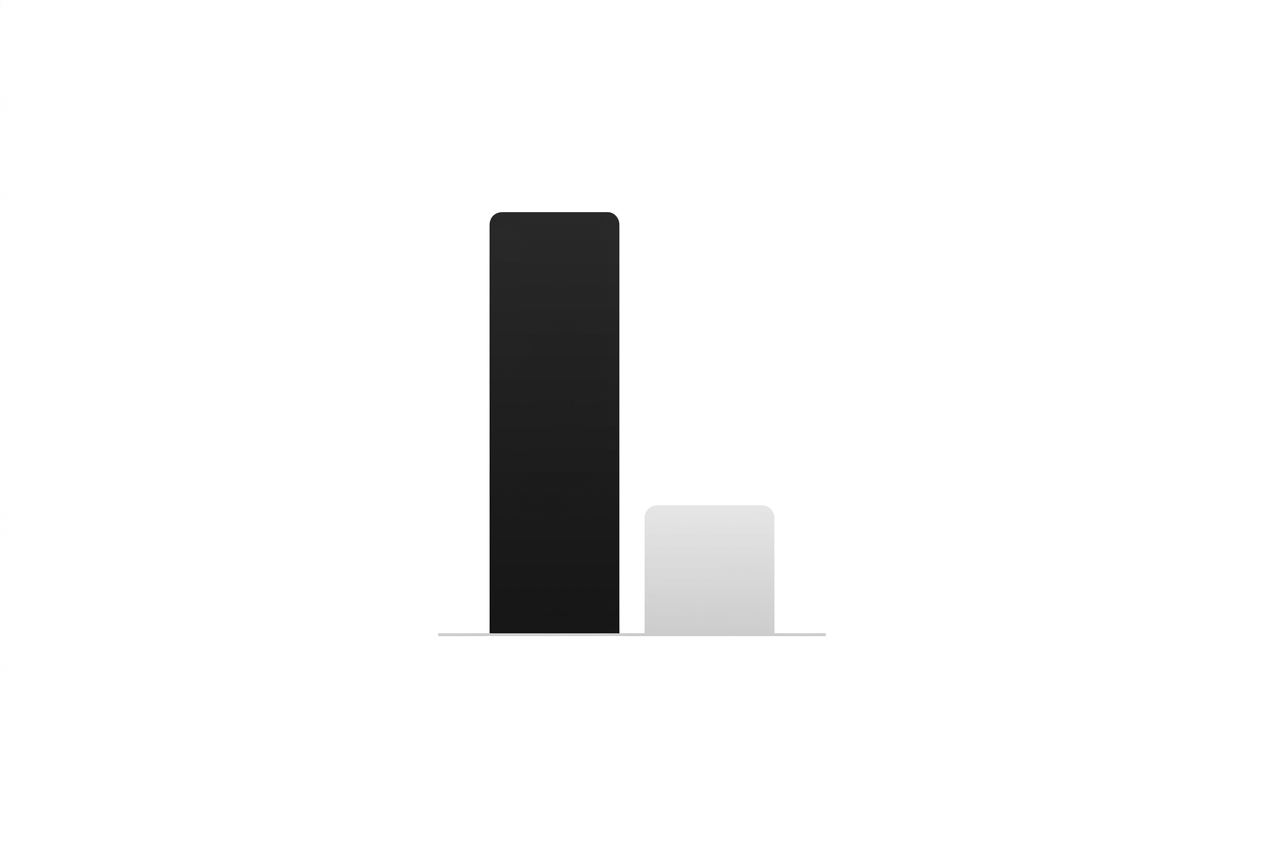
This is the mismatch in one sentence: the infrastructure is being deployed to Starlink's tune, but the valuation is being underwritten by xAI.
The deployment flywheel is genuine, and it is worth being precise about, because it is easy to mistake it for the thing the $2.8 trillion peak was pricing. It is not.
SpaceX has U.S. approval to launch between 15,000 and 19,000 Gen-1 and Gen-2 Starlink satellites by 2031. Direct-to-cell lets an ordinary phone reach the constellation, which turns agriculture, mining, robotics and emergency response into addressable markets. In Q2 2026 the connectivity segment already generated $4.3 billion in revenue, 55% of company total, growing 66% year over year.
All of that is measurable, and all of it flows from Starlink economics. None of it requires an orbital data center to exist. The bull case that justified a trillion dollars above target does—and that is the bet Morningstar's $63 refuses to underwrite while Oppenheimer's $195 embraces.
The company's own numbers show why both can be defended. Take the strong Starlink case seriously: if SpaceX captured half the combined $1.24 trillion TAM for spacecraft and Starlink, that is roughly $240 billion in operating profit. Put a modest 10-times multiple on it and you land near $2.4 trillion in enterprise value—close to where the stock peaked, on the boring segments alone.
But that is not how the underwriters modeled it. Goldman Sachs, the lead bank, projected total revenue reaching $474 billion by 2030, with AI revenue growing nearly a hundredfold—from $3.2 billion in 2025 to $322 billion in five years. That is the steepest ramp of any division, and it is doing the heaviest lifting in the valuation.
So the stock is fighting a war between two internally consistent futures. In one, Starlink cash compounds and AI is optional upside. In the other, AI is the whole point and Starlink is the collateral that funds the burn.
What changed this month is that the fight now has a referee. As a private company, SpaceX never had to reconcile these two stories on a clock. As a public one, it does.
The first earnings report, on Aug. 4, gave a preview. Revenue nearly doubled to $7.8 billion, total operating losses narrowed to $143 million from $970 million, and management guided to a $100 billion revenue run-rate by December while promising less than a one-year payback on new AI compute. That is the bull thesis stated as a target—and now it is a public promise that can be measured.
The float mechanics sharpen the pressure. The debut squeeze was partly structural: a 4% float, a 2x-oversubscribed book, forced buying from index inclusion. On Aug. 20, SpaceX unlocked up to 319 million restricted shares—about 2.4% of the company, enough to lift the tradable float by roughly a fifth—and the stock slid 3%. The bigger 180-day insider lockup expires in December.
Every one of those events pulls the price back toward fundamentals and away from scarcity. Which means the question the private company never had to answer becomes unavoidable: can Starlink cash outrun AI burn, on a quarterly cadence, in front of everyone?
That is a harder question than "is this a good company." But it is a healthier one. For years SpaceX's valuation was a private negotiation between believers, priced on a vision that no earnings release could contradict.
Now the 11,000 satellites are on one side of the ledger and the $6.36 billion loss is on the other, and the market gets to watch which line moves faster. Oppenheimer and Morningstar are not really arguing about SpaceX. They are arguing about how much of the future you are allowed to book today—and starting this quarter, the tape will start settling it for them.