
Article — "Juno maps Io's hidden subsurface heat, challenging tidal-dissipation models": Here is the thing most people will get wrong about Juno's new look at Io: they'll read "first temperature map beneath the surface of the most volcanic world in the solar system" and assume the map settles something. It does the opposite.
Start with the instrument, because the instrument is half the story. Juno's Microwave Radiometer was designed by principal investigator Scott Bolton to peer beneath Jupiter's cloud tops and read the composition of the gas giant's deep atmosphere. Reading the temperature of solid volcanic rock a few meters underground on a moon was not on the spec sheet.
"At Ganymede and Europa, we explored tens of miles below the surface, assuming their ice shells were mostly pure water, but the ability to probe into the volcanic rock at Io was an unexpected discovery," Bolton said.
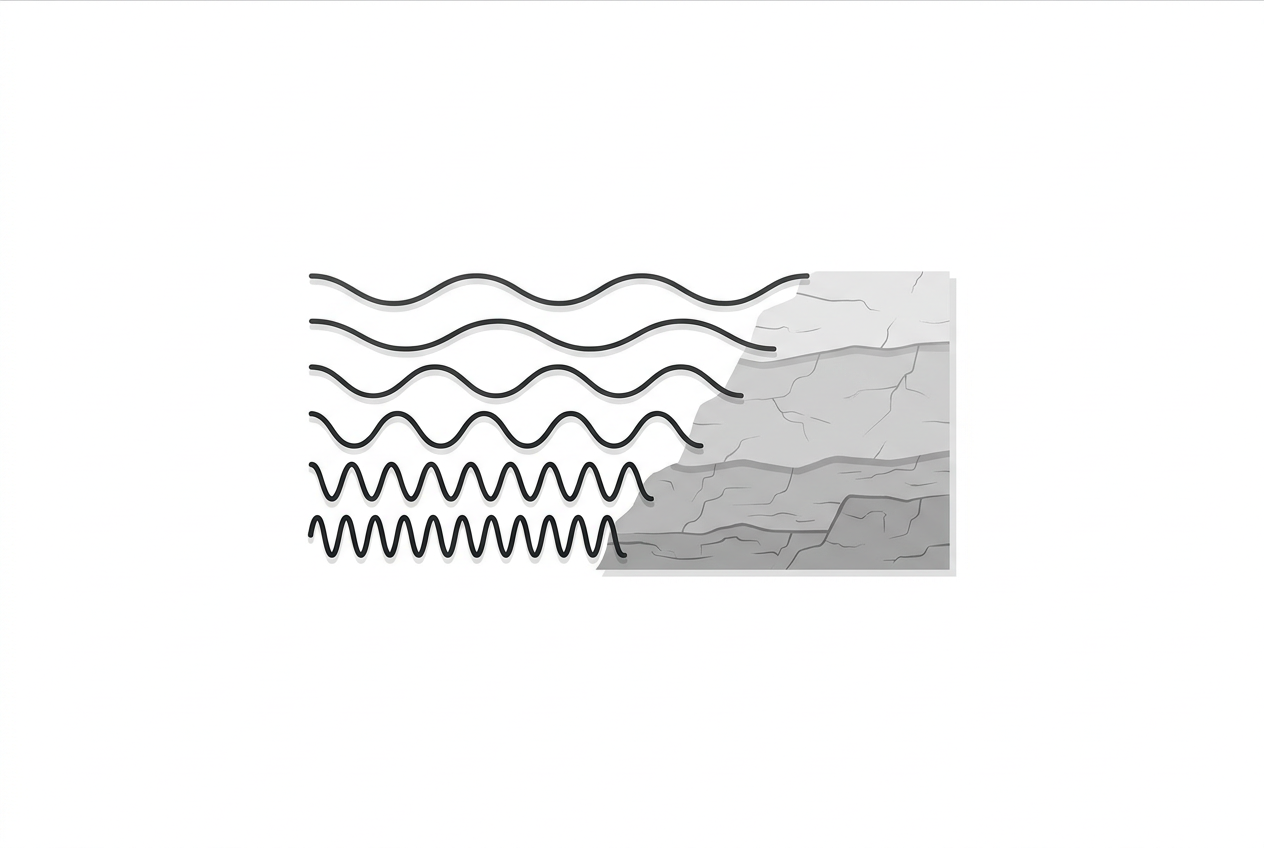
The trick is that the MWR's six antennas span wavelengths from about half an inch to 20 inches, and each wavelength probes a different depth. The highest-frequency channels sense the top few centimeters; the lowest, at 0.6 gigahertz, reach several meters down. Stack them, and you get a vertical temperature profile through the upper tens of meters of crust.
During two close flybys — December 30, 2023, and February 3, 2024 — Juno swept within about 930 miles of the surface, spinning at two revolutions per minute so the footprints laced across the Jupiter-facing hemisphere.
Now the finding. It is genuinely surprising and worth stating plainly.
"Everywhere we looked, we found the temperature rising by more than 40 degrees Fahrenheit just several feet into the surface — a gradient far steeper than solar heating alone can explain," said Shannon Brown, the paper's lead author at JPL.
Everywhere we looked, we found the temperature rising by more than 40 degrees Fahrenheit just several feet into the surface — a gradient far steeper than solar heating alone can explain.
Everywhere. Not just over the famous hot spots. The team reports a spectral slope of more than 20 kelvin in the lowest-frequency channels at all latitudes, and that slope reportedly steepens toward the north pole — the coldest place on the surface. Sunlight cannot do that. Something inside Io is pushing heat up toward the crust essentially planet-wide.
The most dramatic feature sits between 60 and 120 degrees west longitude, where subsurface temperatures run 10 to 20 kelvin above their surroundings. That anomaly coincides with the Zal Montes Patera complex, where Juno's Stellar Reference Unit caught an active lava flow. A second heat source stretches near the equator from 0 to 50 degrees west. These are real, localized, and hot.
So far, so clean. Here is where it fractures.
The same MWR spectra fit two physically opposite stories, and the team is honest that it cannot yet choose between them.
Story one is gentle and global: heat conducting steadily up through a solid crust, at 1 to 3 watts per square meter. On a local patch that's about the glow of a nightlight under every square yard — trivial. Summed across the whole moon, it's a release of energy up to 30 times Earth's average heat flow.
Story two is violent and patchy: not conduction at all, but sheets of cooling lava buried under a cold, highly insulating lid of solidified crust roughly 9 to 11 meters thick, covering about 10 percent of the surface at any moment. The buried lava radiates; the cold cap flattens the surface signal; the low-frequency channels see the heat underneath.
One picture is a warm moon breathing evenly. The other is a moon that's mostly cold on top with fire stashed a few meters down over a tenth of its area. Both reportedly fit the microwave signature Juno recorded within measurement uncertainty.
That is not a footnote. It is the whole interpretive game, and, per the team's own conference abstracts, model assumptions about the microwave loss tangent of the crust material and the temperature of the magma impact the results. Pinning those down might, per the article's reading, narrow the ambiguity toward one story. Until then it stands wide open.
You can watch the numbers themselves wobble as those assumptions get tuned. An earlier version of the lava-flow model put the insulating crust at 2 to 5 meters over 5 to 20 percent of the surface; a later abstract lists 3 to 8 meters; the JPL news release about the published work reportedly quotes 9 to 11 meters over about 10 percent. Same instrument, same flybys — different inputs, different crust. That spread is a fair measure of how unsettled the interpretation is.
Which is exactly why this matters, and why the map is a bigger deal for what it cannot yet decide than for what it found.
Io's volcanism is powered by tidal heating: Jupiter's gravity kneads the moon along its eccentric orbit, and the friction reportedly dumps something like 100 terawatts into the interior. The open question for decades has been where that energy is dissipated, because different depths predict different surface patterns.
The candidate models are specific. If dissipation concentrates in a soft asthenosphere, heat flow should peak at the equator and mid-latitudes. If it happens in the deep, stiff mantle, the peaks migrate toward the poles in a distinctive degree-2 pattern. A global magma ocean would smear the connection between interior heating and surface volcanism altogether.
Note that one option is already off the table. Last year, Juno's gravity measurements reportedly pegged Io's tidal Love number k2 at 0.125 ± 0.047 and its dissipation parameter Q around 11.4 ± 3.6, which is too rigid for a shallow global magma ocean — the interior is mostly solid. So the near-surface gradient isn't a magma-ocean signature by default; it is genuinely unexplained.
And here is the sharp point: none of the surviving dissipation models appears to have predicted a more-than-20-kelvin near-surface gradient that shows up at every latitude and grows toward the pole. That ubiquity is a new constraint that arrived unforeseen. It doesn't confirm the asthenosphere model or the deep-mantle model — it sits in front of all of them as a fact each will now have to reproduce.
But it cannot yet adjudicate between them, because the conduction-versus-lava fork controls what the gradient even means. If it's conduction, the >20 K slope is a direct readout of heat marching up from the interior, and the poleward steepening is a clue about where dissipation lives. If it's buried lava, the slope is mostly about how well a cold crust insulates fresh flows, and it says far more about Io's surface plumbing than its deep engine. Those lead to different verdicts on the same models.
What's actually new, then, is the capability. As Bolton put it, until now "we could only observe the heat escaping at the surface or through eruptions. Now we can characterize how the heat is moving from the interior toward the surface."
That reach extends beyond Io. Tidal heating is the same process that keeps liquid oceans under the ice of Europa and Ganymede, and MWR-style sounding is the first tool that can watch heat in transit through a crust rather than only at the moment it escapes. Bolton even suggests the technique could read the subsurface thermal signature of volcanoes on Earth.
So the map is best understood as a well-posed problem rather than an answer. Juno has handed planetary science its first direct measurement of heat moving upward through a rocky moon — and a fork in the road it cannot yet take. The next real advance won't come from another flyby. It will come from someone finally pinning down the loss tangent of Io's crust and the temperature of the lava underneath, and forcing the two stories to stop agreeing.