The fastest winds off the supermassive black hole in NGC 4151 don't blow when you'd expect. Xin "Cindy" Xiang and her team, working with the XRISM X-ray telescope, found that the strongest outflows arrived not during the black hole's brightest X-ray flares but about 10,000 seconds later—just under three hours—providing the first direct timing link to the outflows.
And when those winds do arrive, they carry away more than the black hole is eating. Every type of disk wind the team resolved had an outflow rate equal to or greater than the mass accretion rate. The black hole isn't just feeding. It's actively throwing out the gas its host galaxy would otherwise use to build stars.
There, in cosmic voids so vast that light takes tens of millions of years to cross them, the CAVITY survey went looking for galaxies that should have drained away long ago—pulled by gravity toward the walls and filaments that ring these deserts. Instead, they found company.
Running a friends-of-friends algorithm on void galaxies within a redshift of 0.08, the team picked out 1,367 bound groups totaling 3,040 galaxies. Little huddles, clinging together where almost nothing should be.
These are two surprises of exactly the same kind. In both cases, astronomers keep being startled by what's missing—and by what stubbornly refuses to go missing.
These are two surprises of exactly the same kind. Astronomers keep being startled by what's missing—and by what stubbornly refuses to go missing.
Start with the missing stars. Using JWST's PRIMER survey, a team led by Tiancheng Yang built a mass-complete census of quiescent galaxies—galaxies that have simply stopped forming new stars—spanning redshifts from 0.5 all the way to 8.
What they found breaks along mass. The massive quiescent galaxies fall off a cliff: their number density drops from about 1.32×10⁻⁵ per cubic megaparsec at redshift 3–4 to roughly 1×10⁻⁶ by redshift 6, and becomes negligible beyond that.
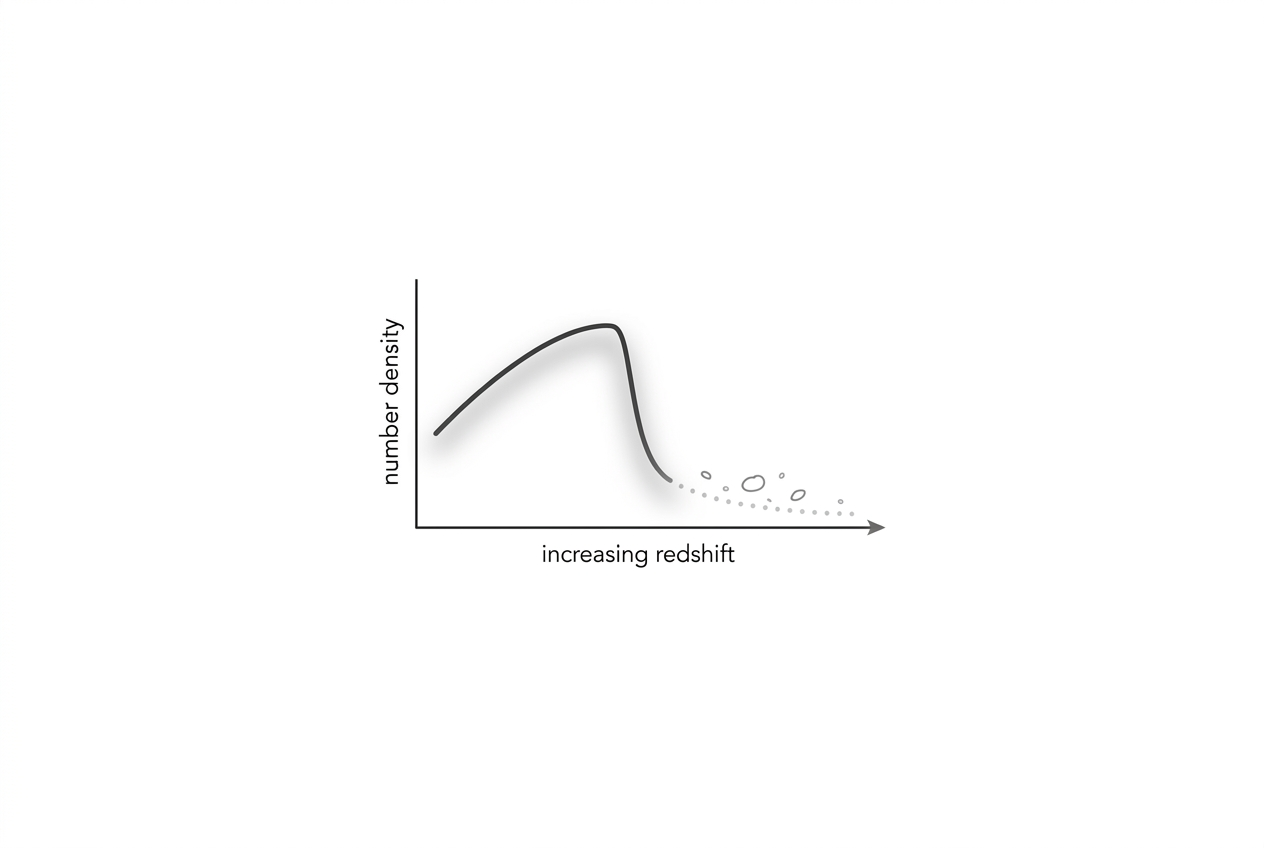
The low-mass quenched galaxies do the opposite. They hold flat—a steady plateau of around 2×10⁻⁶ per cubic megaparsec across the entire span from redshift 4 to 8.
Neither is what the models predict. Most leading galaxy-formation simulations underestimate how many massive quiescent galaxies exist at redshifts above 4, and they fail outright to reproduce the flat density of the low-mass population.
The tension is sharpest for the massive systems. Some of these galaxies appear to have built the bulk of their stellar mass at redshift 6 or even 10, then gone dark—which demands progenitors with furious star-formation rates that we mostly don't see in the early universe. The starbursts that should have made these galaxies are missing too.
The low-mass "miniquenched" galaxies hint at a gentler story. Their flat number density suggests they're not permanently dead but caught in temporary lulls—galaxies that ran out of gas, went quiet, and will likely reignite when fresh gas falls back in.
So one population quenches early, hard, and forever. The other quenches briefly and recovers. Both revolve around a single variable: the gas.
That's the through-line. Star formation is gas physics. A galaxy makes stars for exactly as long as it has cold gas to collapse—and it stops, permanently or temporarily, when that gas is removed, heated, or withheld.
Which is why NGC 4151 matters so much. XRISM caught, in real time, one of the mechanisms that could do the removing.
The winds streaming off that accretion disk can blow gas clean out of star-forming regions, disperse it so thinly that it can never collapse, or shred the molecules outright. As it is reportedly framed, the black hole's effect on nearby star-birth is catastrophic.
"With XRISM, we have the greatest resolution observing the brightest AGN, and we're getting the richest information on outflows that we have observed so far for an accretion disk," Xiang said. That resolution is the point—earlier instruments could only see the broad shape of these winds, not their structure, timing, or geometry.
Xiang even built a metric to predict when the fast winds fire, correlating X-ray hardness and brightness into what she calls the "color intensity index," or "cindicity"—"partly because my name is Cindy." The fast winds, it turns out, come when the X-rays are hard but faint, hours after the flares fade.
If black holes like this one are common, they offer a candidate answer to the quenching puzzle: a mechanism energetic enough to strip a massive galaxy of its fuel and keep it stripped. Feedback that outpaces feeding.
But notice what NGC 4151 doesn't settle. A separate Webb study also finds merger evidence—a separate Webb study of galaxies that quenched around nine billion years ago read the merger scars written into their structure, reportedly pointing to violent collisions rather than black-hole winds as the trigger.
So which is it? Do galaxies die because their central black hole exhales their gas away, or because a merger disrupts and consumes it? The honest answer is that we don't yet know, and both may be true for different galaxies at different times.
That's the state of the field: the models are visibly cracking. They can't produce enough early massive dead galaxies, can't hold the low-mass population flat, and can't yet tell us whether quenching is a black-hole story, a merger story, or both stitched together.
And then there are the voids, which keep embarrassing the recipe from the other direction.
The CAVITY numbers tell a subtle story. Alongside those 1,367 groups sat 14,672 lone galaxies with no close neighbors at all. Fifty-nine percent of void galaxies are solitary singlets—almost a mirror image of the control sample, where 60% belong to a group.
Voids genuinely discourage company. But they don't forbid it.
Where groups do form in the void, they stay small and unsettled. The densest void groups top out at just six galaxies—modest beside the crowded clusters elsewhere—and they tend to be loose, dynamically young, still finding their footing rather than relaxed into mature systems.
Strangely, the emptiness of the surrounding void doesn't seem to matter. A deep void hosts groups just as readily as a shallow one, which is not obviously what a gravity-only picture would predict.
The void is the control experiment. It's the place where structure assembles slowly, gently, with almost nothing to interfere—no dense environment, no relentless mergers, no crowd of neighbors stripping gas away.
And that is exactly why it's diagnostic. In the crowded universe, gas gets removed by every mechanism at once: winds, mergers, tidal stripping, shock heating. In the void, most of those switches are off.
So if we can explain how gas gets held, collapsed, and regulated in a place where structure forms this quietly, we have a cleaner test of the same physics that governs the quenched giants at the other extreme.
That's the real shape of this week's haul. Two absences—the stars that vanished too early, the galaxies that shouldn't cluster but do—converge on one unsolved question about when and how gas is removed or withheld.
The next generation of surveys will have to decide the mechanism. XRISM is timing the winds. JWST is counting the dead. And the voids sit quietly in the background, running the control, waiting to see whether our recipe for cosmic structure can survive being tested where almost nothing is there to hide behind.