Nvidia wrote a $3.5 billion check to the company whose entire job is to help Amazon, Google, and Microsoft build chips that aren't Nvidia's.
Then it structured the check so that whether those chips win or lose, the money and the traffic flow back through Santa Clara.
That is not a hedge. It is a tollbooth.
Last week the story was Nvidia guaranteeing OpenAI's Ohio data-center lease and folding AWS into NVLink Fusion without spending a dollar. This week Nvidia operationalizes the same thread it opened on August 25 — selling the factory to its rivals — by financing the factory's primary broker.
The mechanics deserve to be read slowly, because the mechanics are the whole argument.
Nvidia bought roughly $3.5 billion of a zero-coupon convertible bond MediaTek is issuing, part of a record $3.9 billion offering. Alphabet quietly took the remainder.
Zero-coupon convertible means this: if MediaTek's custom-chip business stalls, Nvidia sits as a creditor and gets its money back. If the business succeeds and hyperscalers rush to MediaTek for custom silicon, the bond converts to equity and Nvidia captures the upside.
Read that again. Nvidia profits from the defection it is enabling. Forbes named it exactly: "If the deal works, every escape from Nvidia's margins gets built on Nvidia's plumbing."
If the deal works, every escape from Nvidia's margins gets built on Nvidia's plumbing. Nvidia profits from the defection it is enabling.
But the bond is the smaller half of the deal. The load-bearing half is the terms bolted to it.
As part of the partnership, MediaTek adopts NVLink Fusion. Every custom accelerator it designs for a hyperscaler — no matter whose logo is on the compute die — terminates inside Nvidia's rack-scale system.
This is where the industry, and the regulators watching it, are looking at the wrong layer.
The public conversation about custom silicon is a conversation about the die. Amazon has deployed over a million Trainium chips. Microsoft's Maia 200 runs GPT-5.2 in production today. Custom AI chip shipments are growing 44.6% year over year in 2026, nearly triple the 16.1% growth of merchant GPUs. Marvell alone projects $11 billion in AI ASIC revenue this year.
The die, in other words, is contestable. That contest is real, and Nvidia is losing it at the margin — which is precisely why the die is the wrong thing to defend.
So Nvidia stopped defending it. It moved the moat one layer down.
Look at what NVLink Fusion actually surrounds a custom XPU with. An NVLink Fusion chiplet connecting the die to Nvidia's scale-up fabric. NVLink-C2C linking it to Nvidia's Rosa CPUs. NVHBM supplying the memory. All of it sitting inside the MGX rack-scale architecture, running Nvidia's system software.
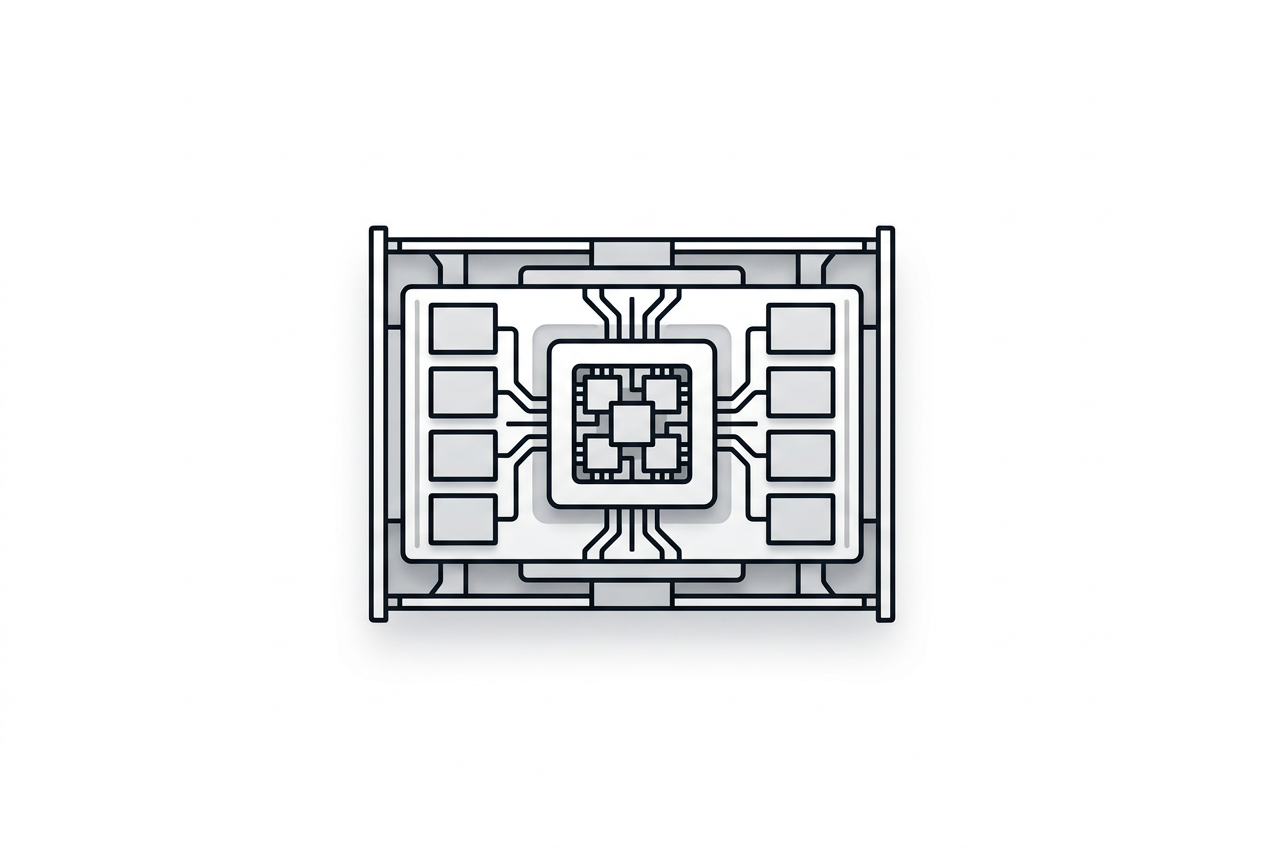
Nvidia's own framing is disarmingly honest about the division of spoils: customers "can focus resources on the differentiated compute that defines their platforms" while "relying on NVIDIA and MediaTek for the NVLink connectivity, memory architecture, packaging, manufacturing and rack-scale technologies."
Translation: you get the die. Nvidia rents you everything else.
Dion Harris, Nvidia's senior director of hyperscaler infrastructure, said the quiet part into a reporter's phone: "Basically, every cloud, every model builder is deploying our platform in some shape, form, or fashion."
Every one. Including the ones that think they're leaving.
This is the die-to-rack thesis executed not with a product but with capital and a contractual interconnect commitment. The NVLink Fusion ecosystem already names Marvell, Alchip, Samsung, Astera Labs, and now MediaTek — the entire custom-silicon supply chain lining up to terminate its output inside one company's fabric before most hyperscalers have finished reading the contract.
Which is why the antitrust question, as currently posed, measures the wrong thing.
Regulators count GPU market share: 90-plus percent of training, 60-75 percent of inference, still climbing. That number is real. It is also increasingly beside the point.
The tollbooth being built here does not depend on Nvidia winning the GPU. It depends on Nvidia owning the scale-up interconnect standard — the plumbing between the chips. You can switch to a cloud running MediaTek-designed accelerators and your infrastructure bill still routes through Santa Clara. The chip logo is starting to matter less. What runs between the chips is starting to matter more.
Auditing GPU share while the interconnect standard consolidates is like measuring the price of railcars while one company quietly buys every mile of track.
So the deal looks airtight. It probably isn't — and the reason is written into Nvidia's own income statement.
There is a precedent for a proprietary, low-latency, technically superior Nvidia fabric that dominated for a generation. It is called InfiniBand.
InfiniBand was the undisputed low-latency leader for two and a half decades. In the trailing twelve months to July, Nvidia made roughly $25.74 billion on it — almost exactly the $25.67 billion it made on Ethernet and NVSwitch combined.
But that $25.74 billion is, in one careful reading, "probably peak InfiniBand." Hyperscalers and model builders are standardizing on Ultra Ethernet. Even Meta, which gave InfiniBand its moment on earlier clusters, is moving.
The old adage in networking is that Ethernet always wins. It wins because it steals every good idea from any specialized fabric — the low latency, the adaptive routing, the quality of service — and folds them into a standard that already runs across every campus, edge, and datacenter on earth. InfiniBand doesn't get killed. It gets corralled into a niche.
That corralling is now forming for scale-up.
UALink fired the first salvo in May 2024, backed by AMD, Broadcom, Cisco, Google, HPE, Intel, Meta, and Microsoft. AMD's Helios racks already run the UALink protocol over Broadcom's Tomahawk 6 Ethernet switches. Then came ESUN, backed by Meta, Microsoft, AMD, Arista, Arm, Cisco, HPE, Marvell, OpenAI, Oracle — and, tellingly, Nvidia itself.
Both are memory-sharing protocols riding on commodity Ethernet. Both are the Ethernet moment arriving for exactly the layer Nvidia just spent $3.5 billion to lock.
Here is the tension that makes this deal more fragile than its brazenness suggests. The same companies bankrolling NVLink Fusion's rivals are the hyperscalers Nvidia most needs to route through NVLink Fusion. Google took part in the very MediaTek bond that finances NVLink Fusion — and sits on the UALink board.
That is not a contradiction. It is a hedge, played by the people with the most reason, and the most Ethernet expertise, to break the lock.
The Intel x86 analogy that bulls reach for cuts both ways. Yes, rival silicon kept plugging into Intel's bus standards for thirty years. But the buses that endured were the open ones — PCI, PCI-Express — not proprietary interconnects. When the industry wanted a standard, it built one it collectively owned.
Nvidia knows this. Its presence inside ESUN is the tell: it is quietly buying a seat in the Ethernet future it publicly insists it doesn't need.
So the frame regulators should adopt is not "how much of the GPU market does Nvidia hold." It is narrower and more urgent: who controls the scale-up interconnect standard, and is that control being financed into place before an open alternative can form?
Because the honest answer to whether NVLink Fusion becomes the permanent tollbooth is the same answer networking has given for thirty years. Proprietary fabrics win for a decade. Then Ethernet steals every good idea and corrals them.
Nvidia is betting $3.5 billion that this time is different. History, and its own InfiniBand revenue line, suggest it is buying a decade — not forever.
The regulators just have to decide whether they are auditing the die, or the track.