In a research zone in Hefei, mid-price-dispute, CXMT expelled a group of Huawei-linked engineers. That is not the behavior of a company undercutting rivals to win a market. That is the behavior of a company that already owns one.
Reuters reported this summer that CXMT charged some customers more for memory than Samsung. Read those two facts together — higher-than-Samsung pricing, engineers thrown out over a fight about that pricing — and the standard story about Chinese memory inverts. This is not a discount weapon. It is a supplier with pricing power in a captive home market.
Hold that thought, because it sits in direct contradiction to how CXMT describes itself to a U.S. court.
In its lawsuit against the Pentagon, CXMT insists its DRAM is unremarkable: standard JEDEC commercial spec, no military temperature or packaging or testing requirements, no licenses to build for military use. It argues that if the exact same chips were made in the United States, they would be classified as "purely civilian." The whole complaint is an argument that CXMT makes boring memory.
And CXMT is right. Its chips are boring, JEDEC-standard, civilian silicon.
It is also the exact company the December 2024 HBM export controls were written to strangle. Both claims are true at once, and that tension is the entire story.
Its chips are boring, JEDEC-standard, civilian silicon. It is also the exact company the December 2024 HBM export controls were written to strangle.
The Pentagon's original case for blacklisting was thin to the point of embarrassment. Per CXMT's complaint, the Defense Department's 2024 report cited an advertisement calling CXMT products "military grade" — an ad that came from an unauthorized distributor, which later admitted the characterization was erroneous. The company spent more than a year submitting information, saw a February delisting notice published and then withdrawn the same day without explanation, and got re-designated in June as "indirectly affiliated" with two state ownership bodies.
The legal fight is about a label. The strategic fight is about something the label misdescribes.
Because the export controls were engineered around a specific theory: choke China at the leading edge, where the chokepoints are real and few. EUV lithography. Through-silicon-via etching. Bonding and test tools. The December 2024 Commerce rules barred advanced HBM sales to China and restricted the machinery that makes and stacks it. The bet was that memory advanced enough to feed AI accelerators required tools China could not get.
The metrics still seem to vindicate that bet. CXMT is one product generation behind on HBM — shipping HBM3E in small batches while Samsung, SK Hynix, and Micron mass-produce HBM4. The technical gap is estimated at three to five years. SemiAnalysis pegged CXMT's HBM yield near 25 percent in June. And the tool stockpile CXMT built before the controls tightened runs out, by analyst estimates, somewhere in 2026–27, after which the calendar itself becomes the restriction.
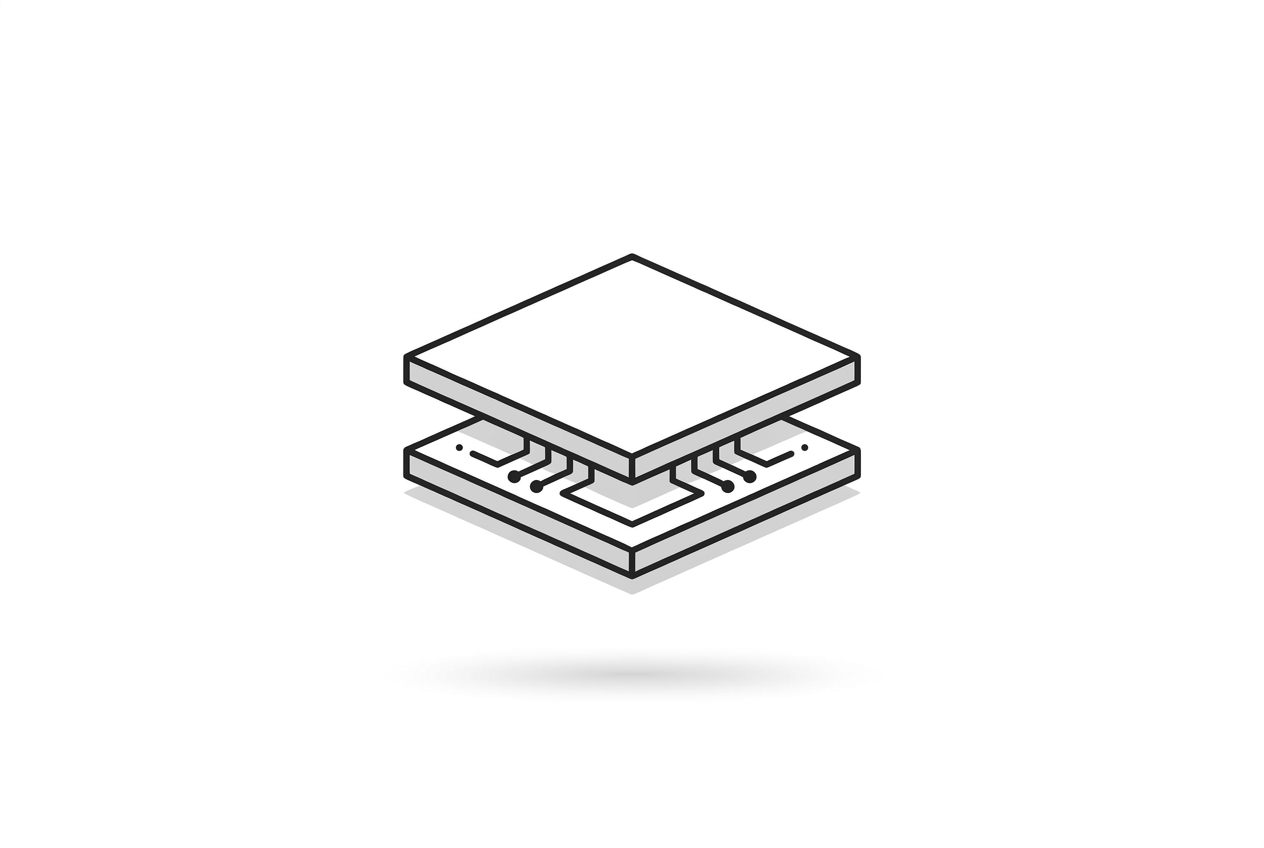
There is even a physics problem underneath. HBM3E starts from the densest DRAM cells made, which in practice lean on EUV — which CXMT cannot buy. Its reported workaround is architectural: "bonded DRAM," building the cell array and control logic on separate wafers and joining them via hybrid bonding, using DUV multi-patterning to reach density that would otherwise demand EUV. Clever, and possibly the only open door. It also adds a wafer, a bonding step, and a fresh yield to prove — all on tools inside the same export net.
Every one of those numbers is damning if you assume CXMT is trying to beat SK Hynix on the open market. It is not.
CXMT's HBM3E has nowhere to go but China. Western customers will not touch it; policy and fear see to that. The buyers are domestic accelerator makers — Huawei's Ascend most prominently, plus Cambricon and Alibaba's T-Head, both already testing CXMT HBM with their processors, with products slated for 2027.
This is where the export-control logic quietly breaks. The controls were designed to keep CXMT from mattering globally. But CXMT doesn't need to matter globally. It needs to feed Ascend and Cambricon at home.
And "at home," 25 percent yield means something different than it does on a spec sheet. In a global commodity market, 25 percent yield is a death sentence — you cannot compete on cost. In a captive market where the only alternative is a banned import you legally cannot get, 25 percent yield is a functioning supplier. The scarcity that would kill a merchant memory maker is precisely what gives CXMT pricing power.
That is what the above-Samsung pricing proves. A single HBM3E stack runs near $300 this cycle, and Micron has said its 2026 HBM supply is sold out under contract. In that shortage, a Chinese accelerator maker cannot buy Korean or American HBM at any price — the ban forecloses it. So it buys CXMT's, and CXMT charges accordingly, and throws out the engineers who argue.
The export-control lawyers who drew the HBM line in December 2024 made one assumption that is now visibly wrong: that a market couldn't form behind the wall faster than the stockpiled tools deplete. But the market formed first. The buyers exist, the products ship in 2027, and the scarcity the ban created is doing the pricing work.
Note that CXMT's LPDDR6 tells the same story without the yield caveat. CXMT announced mass production of LPDDR6 — the new mobile standard, PAM3 signaling, 43.2 GT/s — for a Xiaomi phone, roughly on the same timeline as the established DRAM leaders. Not years behind. On time, arguably first to announce.
The gap that used to be measured in generations has, on standard DRAM, collapsed to zero, and on HBM, to one step.
Now set that against Chinese logic, which has done nothing of the kind. In August 2026, TechInsights tore down Huawei's Kirin 9030 Pro and confirmed it still runs on SMIC's N+3 process — a DUV-based 7nm node, visibly behind TSMC and Samsung 5nm. No EUV, and the report frames it as evidence of the ceiling DUV imposes on advanced logic.
So the picture is asymmetric in a way the export regime did not plan for. Chinese logic is frozen a couple of nodes back, gated by EUV it cannot get. Chinese memory has caught up to one generation back, or dead level on mobile.
Which means the binding constraint on Chinese AI is migrating. It used to be memory — the thing the December 2024 controls targeted. Increasingly it is compute: the accelerator die that Kirin's frozen node illustrates, not the HBM stack bolted next to it.
The export controls were not wrong about where the leading-edge chokepoints are. They were wrong about which chokepoint mattered for this particular bottleneck. Memory never needed the leading edge to be useful — it needed to be good enough for a domestic accelerator and available when the imports weren't.
CXMT built exactly that. One generation behind, 25 percent yield, EUV-free, tool inventory ticking down toward 2027 — and none of it breaks the strategy, because the strategy was never to win the world. It was to feed a captive market at a scarcity price.
The company suing the Pentagon to prove its memory is boring is telling the truth. Boring, JEDEC-standard, civilian memory — made at home, priced above Samsung, and pointed straight at China's accelerators — is precisely the thing the controls could not stop.