"OpenAI achieving a satisfactory credit rating." Four words buried in an SEC filing, item three in a list of termination triggers, are the most revealing thing in the largest data center deal ever announced.
Nvidia's obligation under its residual value guarantees dissolves the moment OpenAI becomes creditworthy enough to borrow on its own name. The guarantee is designed to self-destruct on the customer's success.
Start with the mechanism, because the mechanism is the story, not the headline number.
Strip the zeros and a residual value guarantee is a car lease. Someone builds the thing. Someone else rents it. A third party promises the thing itself will still be worth a set amount if the renter walks.
Here, SB Energy builds and owns the PORTS-Pike campus in Pike County, Ohio. OpenAI signs a 20-year lease as tenant. Nvidia is the third party promising the buildings hold their value.
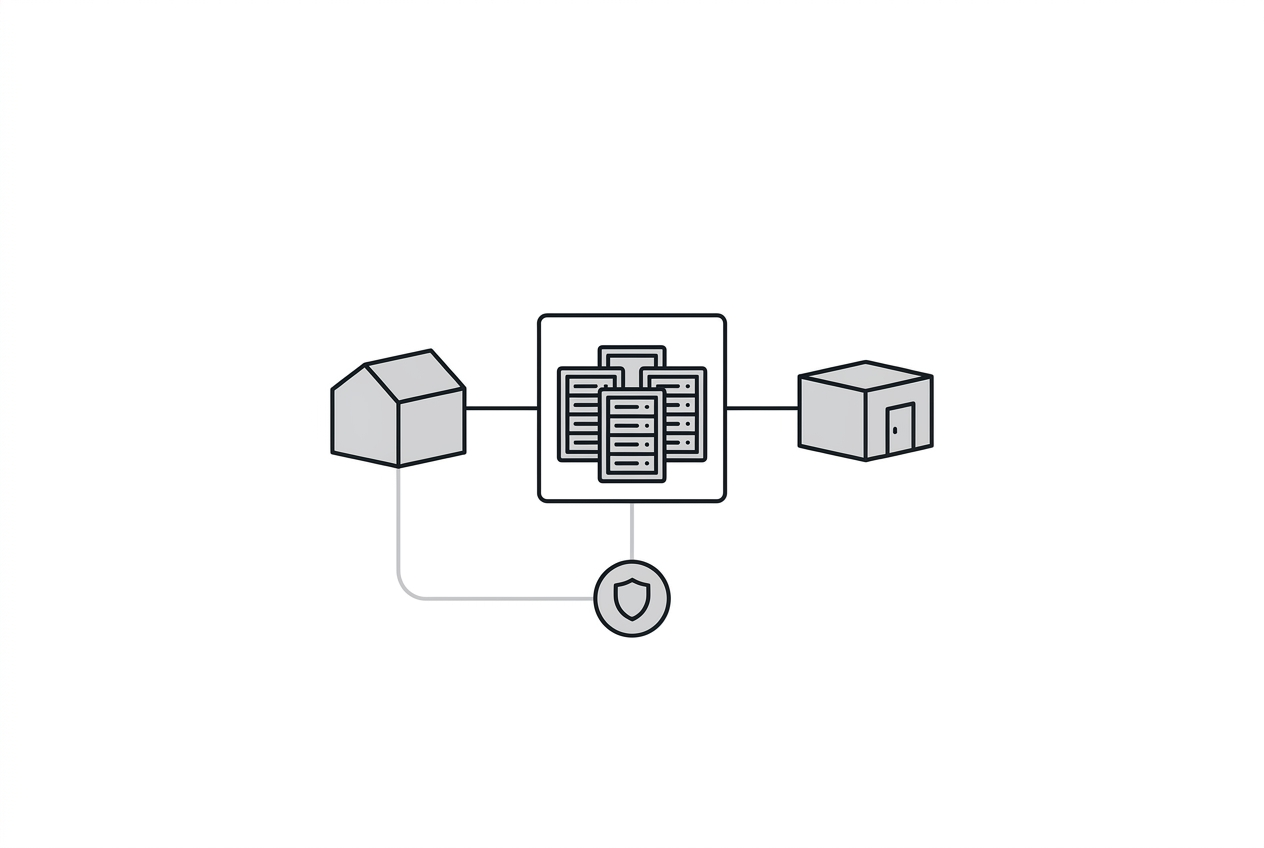
Last week, the guarantor was unnamed and the number was moving: the Wall Street Journal reported Nvidia would cut a backstop once discussed at $250 billion to under $120 billion. This week the SEC filing pins it. The instrument is a residual value guaranty, the guarantor is Nvidia, and the cumulative cap is $105 billion.
Note what falls out of the mechanism: $105 billion is a ceiling almost no one models hitting, because a waterfall sits between the trigger and Nvidia's checkbook.
Payment fires only on a Trigger Event — OpenAI's insolvency or a missed lease payment. Then SB Energy must try to relet the site at the same price. Failing that, it must try to sell. Only the remaining shortfall is Nvidia's.
Nvidia even picks the remedy. Per the filing, it can assume the lease, force a reletting, start a sale, allow termination, or defer for a year while covering project costs. The $105 billion is the number you reach only after every recovery path fails.
So the headline overstates the exposure by design. Which raises the question of what the structure is actually for.
Nvidia's own blog answers it, more candidly than the company probably intended. The world's largest cloud providers and investment-grade enterprises, it writes, "have balance sheets, infrastructure expertise, and long-term contracts to secure LPS independently."
"But frontier AI labs are different." They have "extraordinary demand" and "rapidly growing revenue" yet, in Nvidia's words, are "growing faster than their balance sheets and long-term credit profiles can support."
That is a confession dressed as a value proposition. OpenAI cannot finance its own leases, so Nvidia rents out its balance sheet until OpenAI can. This is a bridge loan wearing the costume of infrastructure discipline.
The indemnity clause proves it. OpenAI has agreed to reimburse and indemnify Nvidia for any amount Nvidia actually pays the lessor.
Read that slowly. The company being backstopped has promised to repay the backstop.
As TheNextWeb frames it: "That is worth less than it sounds, because a claim against an insolvent OpenAI would not be worth much." The only scenario that triggers Nvidia's payout is the exact scenario in which OpenAI cannot honor its promise to pay Nvidia back.
The only scenario that triggers Nvidia's payout is the exact scenario in which OpenAI cannot honor its promise to pay Nvidia back.
The indemnity, in other words, is not a financial protection. It is a tell. It exists to document that everyone understands this is temporary — a bridge, not a subsidy — even as it would evaporate at the precise moment it matters.
Which brings us to the load-bearing assumption underneath every reassurance Nvidia offers: fungibility.
Ask what happens to PORTS-Pike if OpenAI walks away, and Nvidia's blog has a clean answer. The capacity "can be resold to another qualified tenant across NVIDIA's global ecosystem of cloud service providers, enterprises, AI labs and startups."
The reasoning chain is worth quoting in full: "CUDA makes NVIDIA compute versatile. Versatility makes it fungible. Fungibility drives utilization and durability — making NVIDIA compute a productive asset: rentable and financeable."
Today, this is simply true. There is a line out the door for Nvidia GPUs, and a relet at PORTS-Pike would clear easily.
But a residual value guarantee is not a claim about today. It runs 20 years, phasing in as capacity comes online between 2028 and 2030. Fungibility has to hold not on signing day but on the worst day.
And the worst day is specific. It is a demand air-pocket somewhere mid-decade, when a Trigger Event fires precisely because AI compute demand has softened — and Nvidia is contractually asked to relet obsolete silicon into a market where every other tenant is trying to do the same.
Fungibility is a property of a market with excess demand. It is the first thing to disappear when demand cracks. The clause that reassures relies on the condition that would never coincide with the clause being invoked.
That is the single point of failure the whole edifice rests on. Not the $105 billion — the assumption that a resale market exists in the one state of the world where Nvidia needs it to.
None of this is running yet, which matters for the timeline. The first 800 megawatts are expected in 2028, largely on existing AEP infrastructure. Everything beyond needs new power plants, new transmission, permits, and financing.
The guarantee attaches only once buildings finish and leases commence — so the power and siting questions, real as they are, sit upstream of Nvidia's exposure. Nvidia's clock does not even start until concrete is poured.
Which is why the expiration clause is the true center of the deal.
The obligation terminates at the earliest of four events: the 20th anniversary of each lease, OpenAI ending a lease on its own terms, "OpenAI achieving a satisfactory credit rating," or other customary events.
The nominal term is 20 years. The real term is however long it takes OpenAI to become investment-grade.
That reframes the entire commitment. Nvidia is not underwriting OpenAI for two decades. It is functioning as a temporary balance-sheet prosthesis — carrying a customer's credit until the customer can carry itself.
And the test has a date on it. OpenAI reportedly told investors this month that its enterprise revenue has overtaken its consumer business, and says rent will come from that growth plus capital it raises. If the first 800 megawatts energize in 2028 and OpenAI is paying without a claim landing, the prosthesis comes off.
This is separate from the $500 billion third-party financing platforms Nvidia launched last week with six asset managers — a different structure for a different problem. PORTS-Pike is narrower and stranger: a supplier temporarily becoming its own customer's underwriter.
That is the conflict the whole thing turns on. Nvidia will sell hundreds of billions of dollars of chips into this site, then stand behind the value of the buildings those chips fill. Its credit-default swaps hit a record last month on exactly these circular-financing worries.
Huang insists it is not circular financing — "OpenAI will pay the lease," the blog says flatly. Perhaps. But the guarantee is structured as a bet that Huang is right before the bill comes due.
The tell is that Nvidia wrote its own exit into the contract. It did not commit for 20 years. It committed until OpenAI graduates — and priced the whole arrangement on the wager that graduation arrives first.