
Jensen Huang wants two things to be true at once. He wants OpenAI's Ohio buildout to generate up to $200 billion in Nvidia revenue on the first 4.25 gigawatts, and, by Huang's own estimate, as much as $600 billion by 2030 across 16 gigawatts of chips spanning OpenAI's total compute. And he wants you to believe, in his own words, that this is "not circular financing."
Both statements come from the same day, the same deal, the same man. The first describes Nvidia selling chips to a customer whose purchases Nvidia is underwriting. The second denies that this arrangement is what it plainly is.
Start with the document, not the press release. The 8-K Nvidia filed on August 17 does not describe a loan or a backstop in the ordinary sense. It describes "residual value guaranties" — a specific, narrow instrument that reveals far more than the "$105 billion backstop" headlines let on.
Last issue, we tracked Nvidia's move into power generation through its stake in Lancium — a chip-adjacent bet on solving the grid bottleneck. This week closes that thread: Nvidia has committed directly, at a named site near Cincinnati with an initial 4.25 gigawatts and an option for more, to captive power and shell capacity it will control for two decades.
Here is what the guaranty actually does. OpenAI signs a 20-year lease with SB Energy for roughly 4.25 gigawatts of IT load at the PORTS Technology Campus in Pike County, Ohio. OpenAI pays the rent. If OpenAI goes insolvent or simply fails to pay, Nvidia covers the gap between a guaranteed minimum lease value and whatever SB Energy can recover by re-leasing or selling the site. Nvidia's obligation is capped at $105 billion.
So Nvidia only pays if OpenAI defaults. This is not vendor financing where cash goes out the door up front. It is Nvidia's investment-grade balance sheet standing behind a tenant that lenders won't otherwise trust.
The tell is buried in the termination triggers. Nvidia's obligation ends at the earliest of four events: the 20th anniversary of the lease, OpenAI terminating the lease, "other customary termination events," and — read this one slowly — "OpenAI achieving a satisfactory credit rating."
That clause is the whole deal in miniature. The guaranty exists because OpenAI cannot borrow on its own. The moment OpenAI can — the moment it earns a credit rating good enough to convince lenders directly — Nvidia walks away. Nvidia is not providing capital. It is lending OpenAI its creditworthiness, because OpenAI has none to offer.
Nvidia is not providing capital. It is lending OpenAI its creditworthiness, because OpenAI has none to offer — and walks away the moment OpenAI earns a rating.
The Information put it plainly: "OpenAI doesn't have the credit to be able to kind of lease that on its own and convince lenders to back it. So it would need kind of an investment grade company with a strong balance sheet such as Nvidia to back it."
Now hold that against Huang's revenue math. The site OpenAI cannot finance on its own will deploy Nvidia's full-stack DSX platform "subject to limited exceptions" — meaning Nvidia is the exclusive chip supplier. Nvidia's guarantee is what makes the lease bankable. The lease is what houses the chips. The chips are what generate the $200 billion.
That is the circle Huang denies. Nvidia is underwriting the purchase of Nvidia chips, then counting the resulting purchases as demand that validates the AI trade. Some meaningful share of the "demand" for Nvidia silicon here is demand Nvidia financed into existence.
Even a sympathetic reading concedes the point. AJ Bell's Danni Hewson called it "a never-ending loop of AI deals" and noted "there was always going to be a degree of circular financing." The only open question, she said, is whether the investments "ultimately generate decent returns" — something knowable only "further down the line."
Which brings us to why the guaranty has to be load-bearing in the first place. The physical constraints on this buildout are severe, and they are what OpenAI's balance sheet cannot absorb alone.
Power is the binding constraint. SoftBank and SB Energy plan to build at least 10 gigawatts of new generation to feed the site, plus $4.2 billion in regional grid upgrades through AEP Ohio. At the center of that, per BloombergNEF reporting, is a 9.2-gigawatt natural gas plant expected to cost $33 billion.
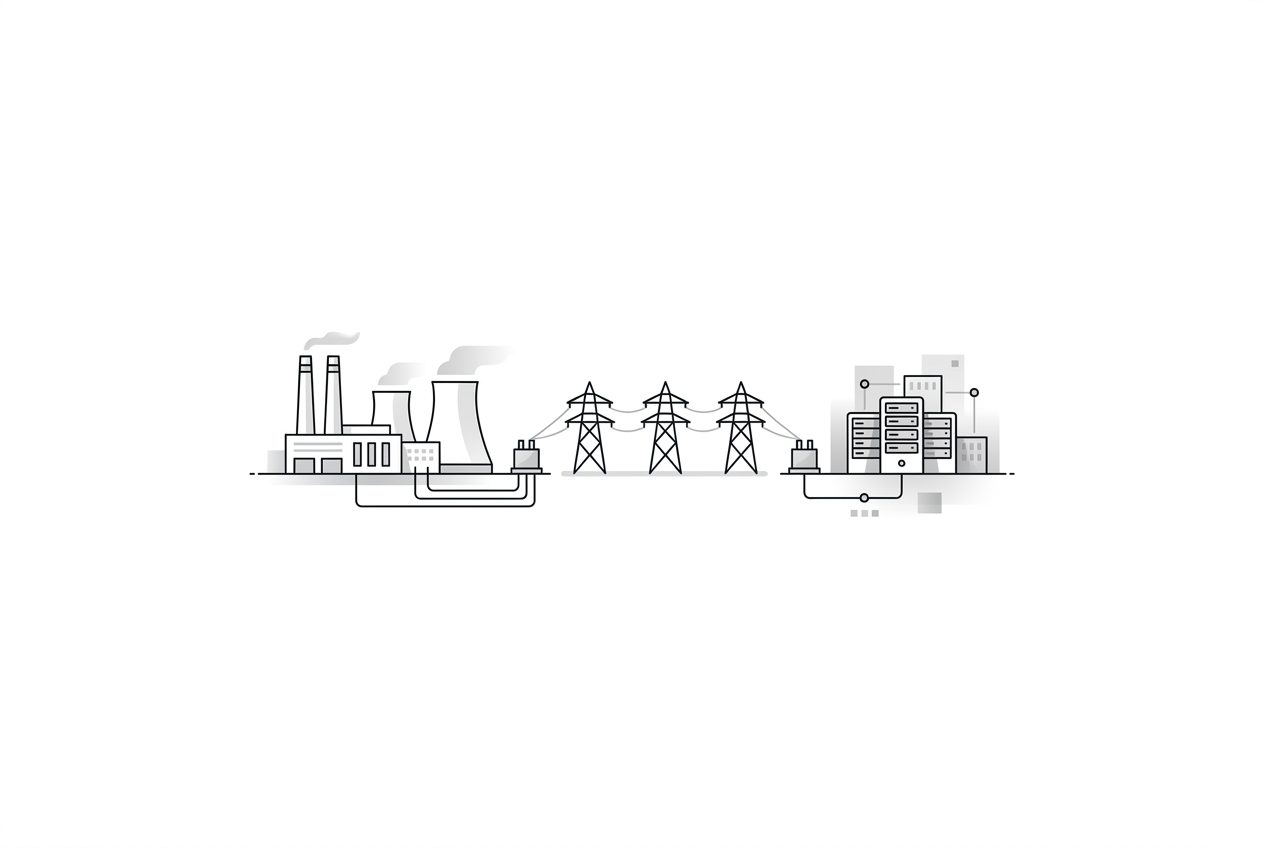
That $33 billion figure is not a rounding artifact. Gas plant construction costs have risen 66% in the last two years, per BloombergNEF. And once this plant and others like it come online, they'll be competing for gas with export markets — a squeeze that could triple natural gas prices in parts of the country.
Then there's the land itself. The Midwest and South now host more than 400 active data center restrictions, complicating expansion for OpenAI, Anthropic, and Google alike. States can't block demand for compute, but they can absolutely block where it lands.
Nvidia and SB Energy route around all of it by building on federal ground. The Portsmouth site is Department of Energy land — property that once enriched uranium for the U.S. nuclear arsenal and Navy submarines. Federal involvement, with both Commerce and Energy in the mix, sidesteps the local veto that has stalled projects elsewhere.
The state is bought in accordingly. Sources describe a low risk of construction delay from local opposition, thanks to 35,000 construction jobs through 2032, 2,500 permanent positions, and an $80 million OpenAI-SoftBank commitment to community projects. That is the price of consent.
Notice how much risk this stacks into structures no one can cleanly price. The financing itself isn't even defined yet — equity possibly from an SB Energy IPO and direct SoftBank investment, then a debt tranche of project-finance loans and maybe bonds, all to be assembled later. The gas plant faces cost inflation and a looming fuel-price squeeze. The grid work depends on a strained, aging system.
Morgan Stanley flagged exactly this problem: much of the AI buildout's debt sits off hyperscalers' balance sheets, in credit arrangements growing "increasingly difficult for investors to assess." Nvidia's own 8-K files the guaranty under "Off-Balance Sheet Arrangement." Even the ECB has warned a US tech correction looks likely, with knock-on risk to Eurozone stability.
So consider the asymmetry Nvidia has engineered. If AI capex holds, Nvidia captures the chip margin, the exclusive supply relationship, and a prime site it can run for multiple hardware generations — Huang says the firm intends to "selectively lock up prime sites" exactly like this.
If capex cools, the picture inverts. OpenAI defaults, its credit rating never arrives, and Nvidia is left holding 20-year residual-value obligations on gigawatts of purpose-built data center shells outside Cincinnati — plus a $33 billion gas plant's worth of stranded power in a region already saturated with restrictions on the only tenants who'd want it.
That's the wager underneath the denial. Huang says Nvidia is simply using "its scale and long-term visibility" to secure "long-lived infrastructure." Strip the language and it reads differently: Nvidia is manufacturing its own demand, capping its downside at $105 billion, and pushing the unpriceable risk — grid, gas, land, opposition — into off-balance-sheet vehicles that become the market's problem if the loop ever breaks.
Greg Brockman told CNBC that compute is "the new oil, the new limited resource of the AI age." Maybe. But oil companies don't usually have to guarantee their customers' ability to pay for the barrels — and then insist it isn't circular.