"Delays or cost increases related to design, engineering, permitting, construction, utility interconnection, equipment delivery and contractor performance."
That sentence is buried in the risk factors of an Oracle regulatory filing from late June, and it is the most honest thing the company has said about the AI buildout all year.
It reads like boilerplate. It is not. It is a list of every reason a data center that has already broken ground can keep getting more expensive — and Oracle is now telling shareholders, in writing, that all of it applies to the campuses it is building for OpenAI.
Start with the paradox, because the numbers refuse to line up with the price.
Oracle sits on a backlog north of $450 billion in signed contracts not yet booked as revenue. Data center leasing across the industry hit a record 16.4GW in 2025, with hyperscalers including Oracle leading the tables. Its stock had its best day since 1992 — a 36% single-day jump on September 10 after it disclosed that backlog.
Then the market took all of it back. Oracle has erased the entire pop, its five-year credit default swaps have shot to record highs, and the stock closed its worst month since 2011.
Record demand. Record backlog. Record CDS. The fundamentals are enormous and the market is treating them as a liability.
Last week, in "Power, Debt, and Orbit," we argued the buildout was running into hard physical and financial ceilings — power, capital, grid. Those were still abstractions, ceilings in theory.
This week the ceiling has a name and an address: the OpenAI campus Oracle is building, where per The Information the project is "becoming far more expensive than planned as permitting fights, power changes and new regulatory demands pile up."
Here is the distinction the market has finally internalized, and it is the whole story: committed capex is not monetizable capex.
Committed capex is not monetizable capex. A backlog tells you what customers promised to buy — nothing about what it will cost to deliver.
A backlog tells you what customers have promised to buy. It tells you nothing about what it will cost to deliver — and Oracle's own filing now concedes that the delivery cost is open-ended.
The tell is timing. Costs on the OpenAI build keep climbing long after construction begins. The meter does not stop when the ground breaks; permitting, utility interconnection, and equipment delivery keep running the number up while the concrete is already poured.
And the power line in the filing is worse than the construction line. Oracle warns that reliable power "may be unavailable on commercially reasonable terms or at all," and that price volatility can crush margins "particularly where customer pricing is fixed or committed."
Read that carefully. Oracle has locked in what it will charge OpenAI, but it has not locked in what it will pay for power. That is an uncapped input feeding a capped output — a structurally short position on its own cost base.
Now follow the money, because the financing has already started to reprice the risk the equity market is only now waking up to.
Per TD Cowen, Oracle has raised roughly $58 billion in debt for OpenAI-linked projects — $38 billion for Texas and Wisconsin, $20 billion for New Mexico — and needs to procure around three million GPUs to honor its existing agreements.
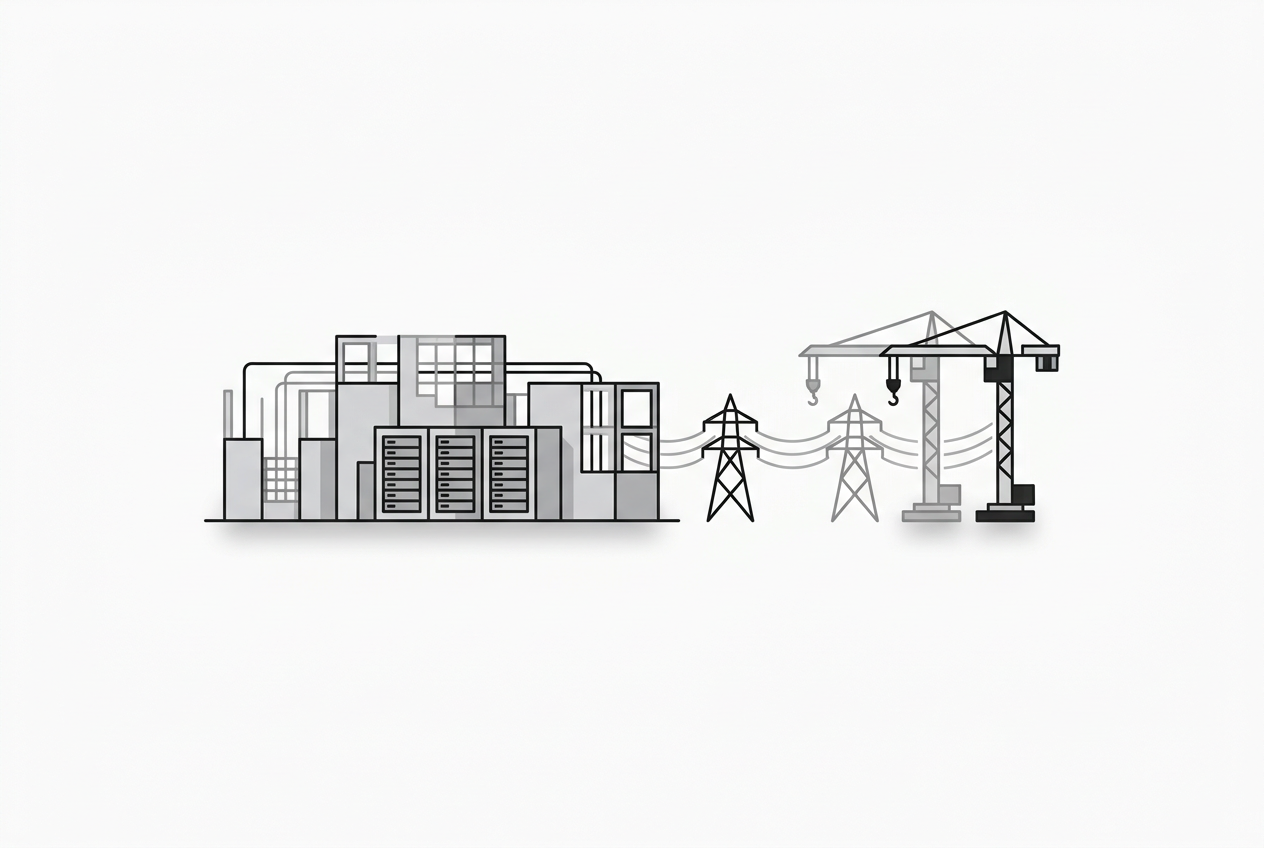
The bank's math on the customer is the number that should stop you: OpenAI carries an implied $156 billion capex requirement at a conservative $30 million per megawatt of fit-out cost, sitting on top of $1.4 trillion in outstanding multi-year commitments.
That is the exposure lenders are now staring at. And they are flinching.
TD Cowen reports US banks are retreating from Oracle-linked deals, and where they still lend, borrowing costs have risen. Some leases under negotiation have failed to secure financing at all.
The gap is being filled by Asian banks looking to buy AI exposure — which is another way of saying the overrun risk is migrating to more exotic, more expensive capital precisely as the projects get riskier.
The single most telling detail: Oracle now requires 40 percent upfront deposits to mitigate the incremental capex requirement for revenue growth. Vendors demand a 40% deposit when they no longer trust the schedule or the counterparty to hold. That is a distressed-project term, not a market-leader term.
D.A. Davidson's Gil Luria called Oracle the "bad behavior in the AI buildout," contrasting it with Microsoft, Amazon and Google — companies with the cash and demand to self-fund. Oracle's problem is an overreliance on OpenAI, a cash-burning startup whose ability to pay depends entirely on its ability to keep raising.
Luria's other line captures the binary perfectly. If OpenAI fails, Oracle writes off contracts and works down debt. If "OpenAI achieves super-intelligence, spends $1.4 trillion, none of us have to ever work again, and Oracle is fine."
There is no comfortable middle in that sentence. The market has noticed there is no comfortable middle.
Which brings us to the verdict — because private capital can paper over an uncapped budget, but public buyers just refused to.
Two IPOs tested the AI infrastructure trade this week. Both stumbled, and how they stumbled is the signal.
Data center operator Csquare priced below its range, at a steep discount to peers, and still fell 2% on debut — its rollup drawing scrutiny for high leverage and ongoing losses while its closest peers pay a dividend.
Early-stage nuclear fuel maker Standard Nuclear slashed its offering by more than half, then plunged 18% anyway. Cutting the deal in half was supposed to clear it. It didn't.
The broader tape confirms this was not idiosyncratic. The Renaissance IPO Index fell 8.3% on the week against the S&P's 1.6%, and the losers were almost all AI names.
Astera Labs landed at the bottom at -26.5%. CoreWeave fell 17.6%, Cerebras 19.6%, Arm 17.4%. Money rotating out of AI went into software — SailPoint up 14.4%, Figma up 13.5%.
That rotation is the thesis in miniature. Investors are not fleeing technology. They are fleeing capital-intensive AI infrastructure whose budgets no one can cap, and moving toward software whose costs they can actually see the bottom of.
The sentiment shift shows up upstream too. TSMC posted record Q2 revenue above $40 billion and raised 2026 capex guidance to $60–64 billion — and the stock fell roughly 4%. Good news reads as ambiguous news now, because raised capex is precisely what a wary market no longer wants to hear.
So here is where it lands.
The AI infra trade is being repriced not because demand is falling — the leasing pipeline is real, the backlog is real, OpenAI's targets are real. It is being repriced because the market has learned to separate the promise to buy from the cost to deliver, and Oracle's post-groundbreaking cost creep is the proof that the delivery number has no ceiling.
Private markets can still fund an open-ended budget, at a price — a 40% deposit here, an Asian lender there, off-balance-sheet vehicles and vendor financing to follow.
Public buyers won't. Csquare and Standard Nuclear are the two most recent companies to learn that an IPO is a request to underwrite a budget, and that public capital declines to underwrite a number nobody will cap.
The construction schedules on these campuses run years. The exit window for the companies building them is closing a good deal faster.