Three million dollars. That's what a single rack of Nvidia GPUs costs, and last Monday six of the most powerful men in finance stood next to Jensen Huang on a CNBC set and reclassified that rack from a depreciating device into what Huang called a "long lived, fungible, revenue generating asset."
The panel was a who's who of private credit: the CEOs of Goldman Sachs, BlackRock, Blackstone, KKR, Apollo and Brookfield. Together they said they'd raise $500 billion, and potentially more, to build AI factories.
Then Larry Fink reached for a comparison that was supposed to reassure. "This is the very beginning, like what it was when I started in the mortgage-backed securities market in the 1970s," he said. "I look upon this as a next future for financial engineering."
"This is the very beginning, like what it was when I started in the mortgage-backed securities market in the 1970s. I look upon this as a next future for financial engineering."
He meant it as an invitation. Read it as a warning.
Last week, we tracked Anthropic's chip-lease debt as an isolated feat of structuring — $71 billion assembled in roughly 60 days and kept entirely off its books. This week the frame changed: Blackstone is leading early investor discussions on a second Anthropic package, structured the same way.
Start with the physical absurdity, because everything rests on it. A GPU rack is a box of silicon that gets superseded on Nvidia's own release cadence. Huang wants Wall Street to treat it like a toll road.
His argument for durability is a single piece of software. The compute, he says, is "continuously improved through CUDA software — extending its useful life and improving its economics over time."
That sentence is the load-bearing beam of the entire $500 billion structure. If GPUs are long-lived, they're good collateral. If they decay on the schedule the bears describe, the collateral rots faster than the bonds it secures.
Now the mechanics, because the innovation here isn't the money — it's the invisibility.
Anthropic's structure works like this. A special purpose vehicle buys the chips, in this case Google TPUs. The SPV leases them to Anthropic. Broadcom reportedly backstops the senior tranches of the debt that financed the purchase.
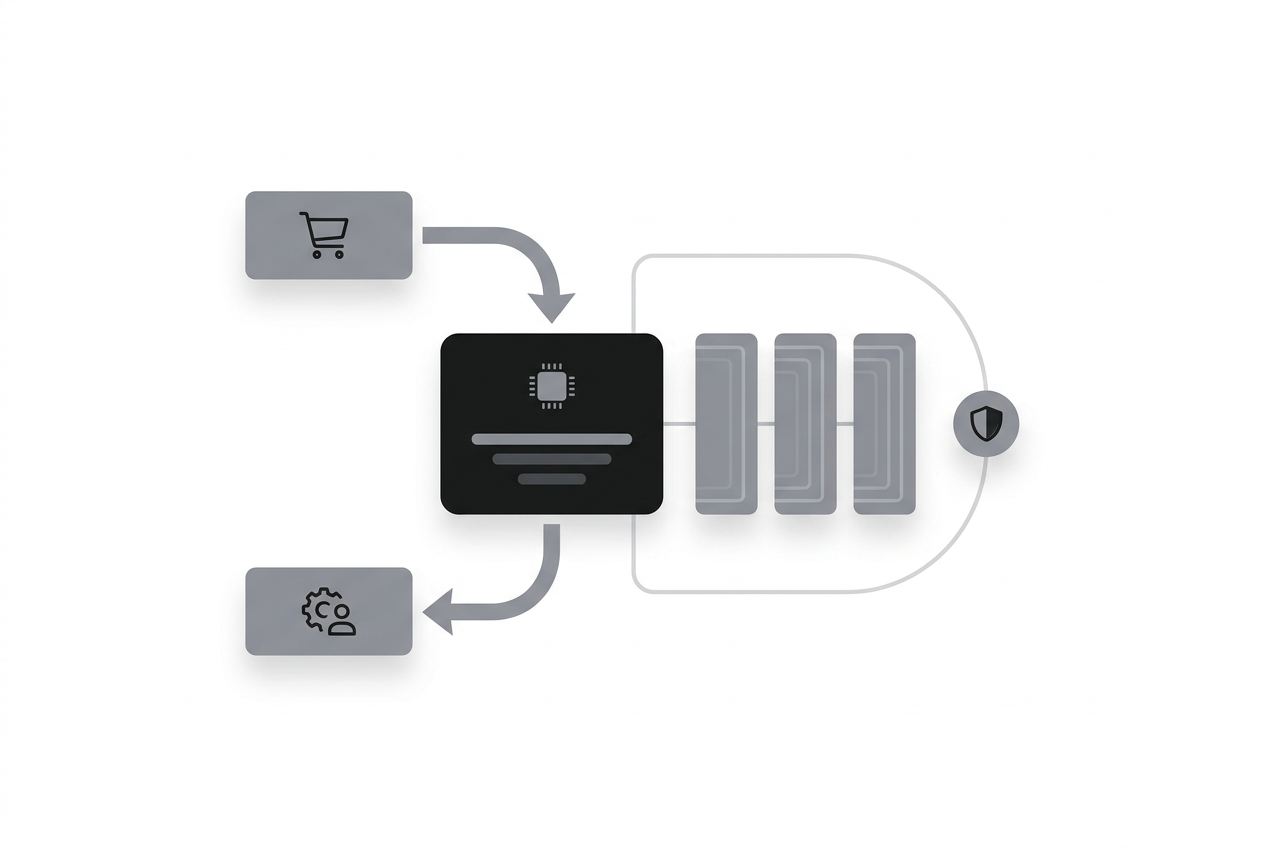
The effect, per the reporting: "no multi-billion-dollar asset depreciating on its books and no corresponding borrowing against its own credit." What appears on Anthropic's accounts instead is a lease expense.
The chips exist. The debt exists — north of $71 billion tied to Google hardware alone, among the largest private-credit arrangements ever assembled in any industry. But on Anthropic's balance sheet, almost none of it is visible. That is the point.
Huang's plan takes that architecture and industrializes it. KKR's Waldemar Szlezak described the mechanism plainly: "You can think about it as a revenue stream, and you can securitize it or effectively divide that risk and sell it to investors who want to participate anywhere in that stack."
Nvidia's contribution is a sweetener that also spreads the risk. It will have the option, case by case, of backstopping 25% of every loan — a guarantee that should win borrowers better rates than their own credit could.
There's a catch buried in that generosity. Borrowers must use Nvidia's specified system architecture, so that if a borrower fails, another operator can take the infrastructure over. The structure quietly concedes that borrowers may fail.
So follow the chain. The SPV holds the depreciating asset. The lessee shows only an expense. Broadcom or Nvidia backstops the senior debt. Investors buy the securities.
Every actor in that chain is betting the collateral holds its value. And nearly every credible data point says it won't.
Michael Burry — the man who shorted subprime — argued late last year that Meta, Oracle, Microsoft, Google and Amazon were overstating the useful life of their AI chips and understating depreciation. That is a direct challenge to Huang's CUDA premise.
S&P has already downgraded Oracle, whose bond spreads are reportedly trading near junk levels. Morgan Stanley reportedly clocked hyperscaler gross leverage jumping from 0.9x to 1.8x in two quarters — now above the energy sector — as capex outruns revenue and free cash flow.
The depreciation debate isn't a fringe short thesis. It's the single assumption the whole securitization edifice depends on, and it's the one under the most sustained attack.
Here's the part that makes it dangerous rather than merely aggressive: the accounting is built so the obligations don't show up until it's too late to reprice them cleanly.
Under GAAP ASC 842, lease payment obligations only hit the balance sheet once the lease actually commences. Until then they live in the footnotes.
Goldman Sachs reportedly combed those footnotes and found roughly $1 trillion in "not yet commenced" lease commitments — up from about $200 billion five years ago, and up from Goldman's own $750 billion estimate just a month earlier.
Then the ratings agencies wave most of it through. Fitch and Moody's don't include uncommenced leases in their metrics at all. Only S&P takes a more conservative line, counting those with "substantive debt characteristics."
Stack it up. Goldman's reportedly ~$1 trillion in off-report leases plus Morgan Stanley's reportedly ~$982 billion in procurement commitments approaches $2 trillion in potential hidden obligations. Goldman's analysts concede the current treatment "may understate corporate leverage and future liquidity needs."
That is the environment Huang wants to pour another $500 billion into — a market where two trillion dollars of obligations already sit where the standard credit lens can't see them.
And the buyers aren't looking closely. JPMorgan's own strategists, led by Erica Spear, just raised their tech bond issuance forecast to $540 billion while admitting record supply has left investors "fatigued and increasingly focused on the prospect of an extended supply cycle rather than underlying credit quality."
Sit with that phrasing. The people buying the paper are worried about how much is coming, not whether the collateral behind it holds. The scrutiny is aimed at volume, not value.
That is precisely where leverage compounds — in the gap between where the risk is and where anyone is looking. The SPV hides it from the issuer's balance sheet. ASC 842 hides it until commencement. Fitch and Moody's exclude it. And the marginal buyer is too supply-fatigued to ask about the chips underneath.
JPMorgan calls chip-backed financing "the next major frontier," a market that could stretch "into the trillions by the end of the decade." Fink's 1970s comparison points at the same trajectory — from a single new instrument to a sprawling asset class, exactly as MBS spread from mortgages into auto loans, student loans and everything else.
He stopped his analogy in the 1970s. He didn't mention what the same instrument did in 2008, when everyone assumed the collateral couldn't fall.
Even the panel knew. Apollo's Jim Zelter allowed that "there will be excesses, there will be pullbacks." Solomon said there'll be "big companies that turn out to be not what people expected."
For equity investors, the takeaway is narrower and sharper than the applause suggests. Huang's plan doesn't create new funding so much as a new way to make existing leverage invisible — and it rests entirely on the one claim, GPU durability, that the depreciation bears are betting is a lie.
The $71 billion already vanished once. The plan, reportedly, is to raise capital at $500 billion, and potentially into the trillions, on collateral that gets cheaper every time Nvidia ships a better chip.