Microsoft's Best Day Since 2008 vs Meta's Cash-Flow Collapse: The Market Picks AI Winners
Here is the thing most people got backwards this week. Microsoft and Meta walked onto the same stage, on the same night, and made nearly the same confession: we are going to spend an obscene amount of money on AI, and we are not going to stop.
One of them got its best trading day since 2008. The other extended a record losing streak.
On Wednesday night, Microsoft reportedly reiterated a capital expenditure plan of roughly $175 billion for calendar 2026 (down from an earlier ~$190 billion figure due to an accounting change), and hinted at further expansion into fiscal 2027. Meta narrowed its own capex guidance for the year to between $130 billion and $145 billion. Two megacaps, two nine-figure conviction bets on compute.
By Thursday's close, Microsoft had reportedly added nearly $450 billion in market value and closed up more than 15% — the single biggest one-day market-cap gain from a stock, per one account. Meta sank for an 11th consecutive session, down more than 20% over that streak.
Same ambition. Opposite verdict. So what actually changed the scoring rule?
Last week in this space, we left an open thread: do these names get graded on revenue growth, or on cash conversion — do investors reward the story or the receipts? This week the market answered, and it wasn't subtle.
Start with what Microsoft could actually show. Azure grew 43% year over year, accelerating from 40% the prior quarter and beating the roughly 40% analysts expected. Full-year Azure revenue crossed $100 billion for the first time.
Then the monetization line that mattered most: Microsoft 365 Copilot paid seats reportedly grew from over 20 million to over 30 million.
That is not a slide about what AI could become. That is a paid-seat count, a number with a price tag attached, moving up and to the right in one quarter.
The subtler tell was buried in the backlog. Microsoft said commercial remaining performance obligations rose 8% sequentially to $678 billion — and specified that the sequential growth came from customers other than large AI model developers.
Read that carefully. The demand wasn't just OpenAI recycling Microsoft's own money back through Azure. It was ordinary enterprises signing commitments. That distinction is what lets you argue the spending is buying real, diversified demand rather than one circular relationship.
Analysts said the quiet part out loud. Zacks' Bryan Hayes: "for the first time in three quarters, the market appears willing to grant that the spending is buying something real." Forrester's Tracy Woo: the results signal Microsoft's "$190 billion data-center buildout is beginning to deliver returns."
The key word in both is returns. Not vision, not ambition — returns.
Because make no mistake, Microsoft's own cash statement took a hit too. Capital expenditures and finance leases hit $41 billion for the quarter, up 69%, and free cash flow fell 23% to $19.64 billion.
Nobody cared. A 23% free-cash-flow decline read as the cost of building a machine that is visibly printing revenue — $100 billion of Azure, 30 million paid Copilot seats, an 8% backlog bump from real customers. The spend had receipts stapled to it.
Now walk across to Meta, where the spend arrived with a story stapled to it instead.
Meta's free cash flow plunged 91% year on year — to $784 million from $8.55 billion. That is not a dip. That is a cash-generation engine that nearly stalled in a single year while capex climbed toward $145 billion.
The forward number didn't help. Meta guided current-quarter revenue to a $61 billion–$64 billion range, midpoint $62.5 billion, against the roughly $63.15 billion analysts wanted. A miss on top of a cash-flow collapse.
And here is where the framing gap becomes the whole story. Unlike Microsoft, Meta does not have a thriving cloud business to point to. So when investors asked the obvious question — what is all this compute going to earn — Zuckerberg reached for a business that doesn't exist yet.
"We're getting a lot of offers for compute at a significant premium over what we paid for it," he said, floating the idea that Meta could lease out excess capacity to third parties.
Notice the structure of that sentence. It is present-tense demand ("we're getting offers") describing a future-tense business (leasing that Meta doesn't currently run). There is no revenue line, no seat count, no backlog figure. There is an anecdote about inbound interest.
Quilter Cheviot's Ben Barringer named it precisely: "the narrative from Mark Zuckerberg is a little light on detail and relying on what could be done in the future." He added that Meta "is still finding its way somewhat."
That is the exact same failure mode as Reality Labs — a unit that reportedly generated $431 million in sales against $4.6 billion in operating losses this quarter. The "trust me, the market is enormous" pitch. It worked, sort of, for years. It does not clear the bar in a jittery AI-capex market.
Because the contrast isn't spending magnitude. Meta's capex range tops out near Microsoft's, and both companies are pouring money into concrete and silicon — Meta alone has the $50 billion-plus Hyperion project in Louisiana, a $14 billion BlackRock venture in El Paso, and a $9 billion Alberta build.
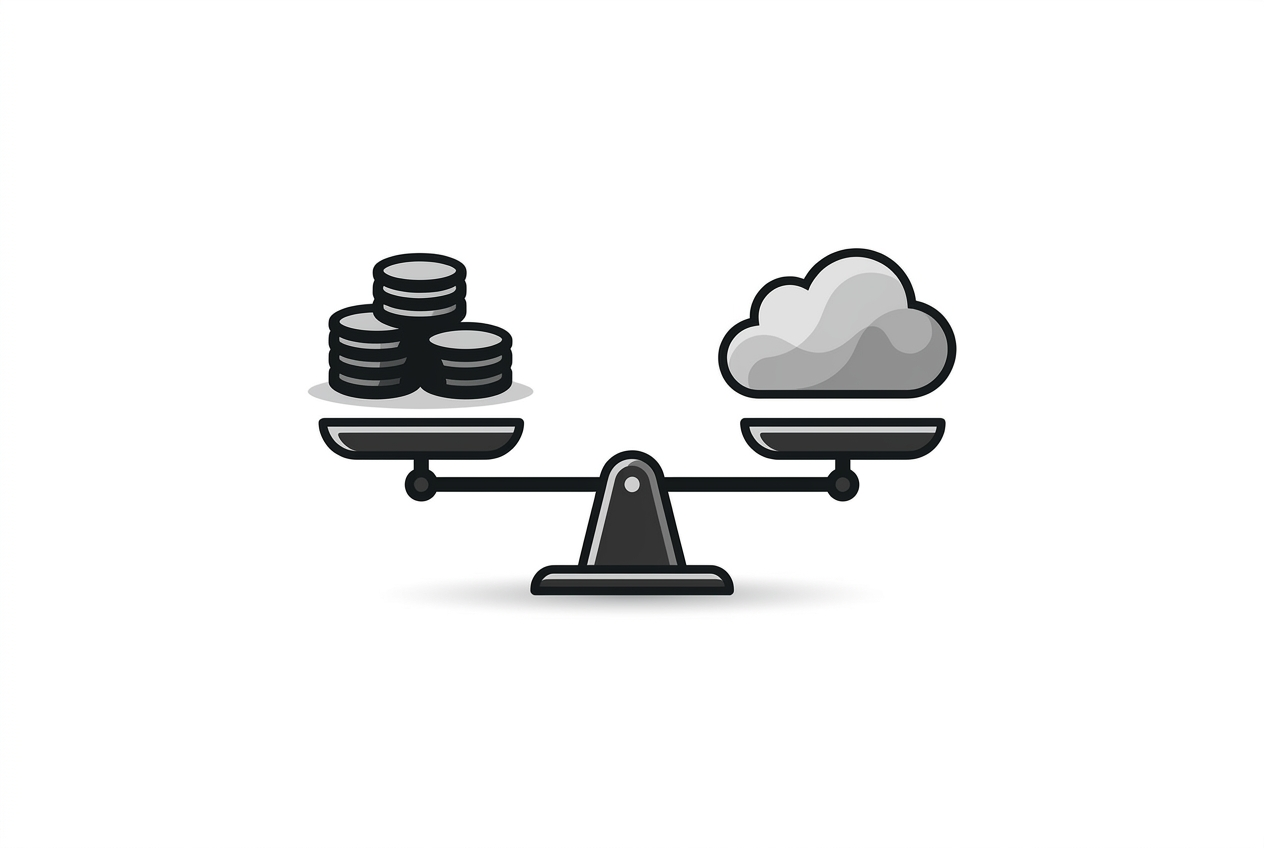
The contrast is evidence of conversion. Microsoft answered "where's the return?" with a P&L. Meta answered it with a pitch deck.
The contrast isn't spending magnitude. It's evidence of conversion. Microsoft answered 'where's the return?' with a P&L. Meta answered it with a pitch deck.
This is the new two-tier regime, and it's worth stating plainly because it reorganizes how you should read every megacap AI print from here.
Tier one: companies that have shown ROI have earned the right to keep spending. Microsoft reiterated $190 billion, signaled more in 2027, watched free cash flow fall 23% — and the stock ripped 15% because the monetization receipts bought forgiveness for the capex.
Tier two: companies still selling the story get punished for the identical ambition. Meta's 91% cash-flow crater plus a hand-wavy compute-leasing concept equaled an 11th straight down day.
The scoring rule quietly flipped from "how big is the vision" to "show me the line item." Proof of monetization now purchases the license to spend. A vision without a P&L line purchases a losing streak.
Two footnotes worth holding in mind, because Thursday was noisier than the clean split-screen suggests.
First, part of Microsoft's headline strength was cosmetic: net income of $35.77 billion included a $3.2 billion gain from its Anthropic stake and lower-than-expected voluntary-retirement costs. Adjusted EPS was $4.74; reported was $4.81. The operating story was genuinely strong, but not every dollar was operational.
Second, Thursday's broader AI rally had a separate accelerant. The hedge fund Situational Awareness faced margin calls and dumped more than $10 billion in holdings to Ken Griffin's Citadel, removing a forced seller and sparking a relief rally across chips and AI names. Some of Microsoft's tape-topping day rode that wave. Sentiment and fundamentals got tangled.
But strip out the noise and the core verdict holds. Two companies made the same bet. The one that showed cash conversion — or at least a credible, quantified path to it — got rewarded for spending. The one that showed a narrative got sold.
For anyone holding these names, the lesson is durable past this week: bring receipts, or bring a losing streak. The market has stopped grading ambition on a curve.