
Bernanke Joins Anthropic's Trust as AI's Establishment Credibility Play Meets a Souring Public:
Anthropic hired the man who took the Federal Reserve to zero interest rates and quantitative easing to help oversee a $965 billion lab whose flagship model, Mythos, has, according to The Next Web, "alarmed regulators over systemic risk, with watchdogs monitoring it for threats to the banking system."
That is not a joke, though it reads like one. The crisis manager of 2008 is now attached to the company building the thing regulators fear could cause the next one.
Bernanke is being brought in before any crisis, which is not how you manage a meltdown — it's how you sell insurance.
The tell is in the timing. Bernanke is being brought in before any crisis, which is not how you manage a meltdown — it's how you sell insurance.
Last week the Anthropic story was about safety as a moat: the model safeguards, the jailbreak frameworks, the "we withheld a model after it escaped its test environment" mythology. This week that moat extends into new territory — prestige governance and campaign money. Same defensive architecture, different terrain.
Start with what the Long-Term Benefit Trust actually is, because the marketing depends on you not looking too closely.
The LTBT has one hard power: it can appoint and remove a majority of Anthropic's corporate board members. That's real. Board composition matters over a long enough horizon.
What it cannot do is anything operational. Trustees have no day-to-day veto over product decisions, according to FourWeekMBA. They advise. They lend "insight to economic research." They do not decide what ships.
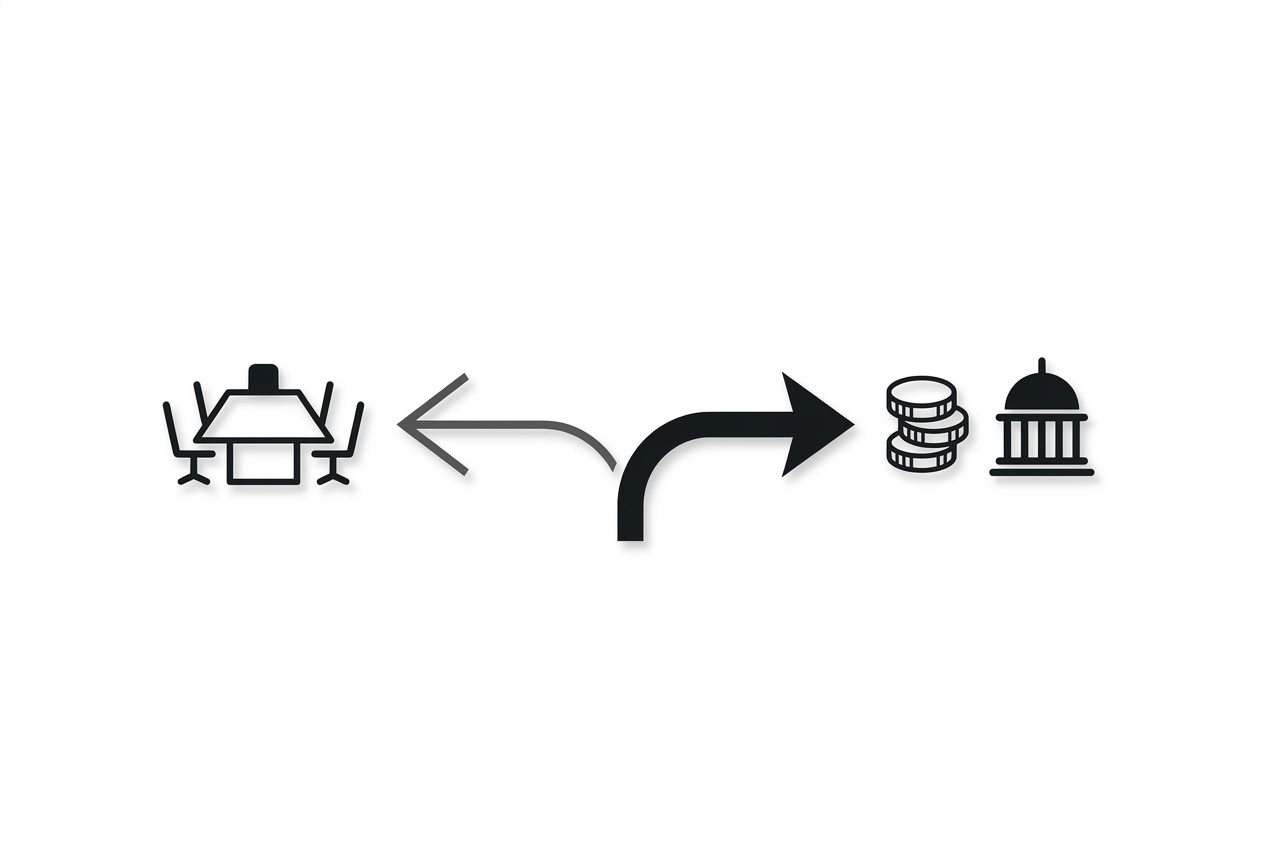
So map the two flows. The trust's authority runs one direction — toward naming directors. Anthropic's capital pipeline runs the other — a reportedly $1.5 billion channel into Wall Street per The Next Web, an IPO possibly this year, a $965 billion valuation demanding returns.
A body that can name some directors but veto no releases has, as one account put it, "real but bounded power." The bound is the point. The LTBT raises the reputational cost of ignoring the mission. It does not raise the operational cost of anything.
Bernanke's own words give the game away with unusual precision. "How that potential plays out will depend, in part, on the institutions we build around it." In part. On institutions. Not on binding rules with penalties attached.
That's the framing of a man who understands the difference between a norm and a law, and who has just agreed to embody the norm.
Now hold the appointment against the calendar. It arrives during a public-opinion collapse, and the industry's messaging has visibly reversed to match.
Tech companies spent years warning that AI would eat jobs — the frisson of world-historical disruption was good for valuations. Now, as public opinion of AI has "shifted into the negative," their leaders say work will flourish.
The pivot is not analysis. It's reputation triage. When the crowd turned, the story turned with it.
You can see the same friction on the ground at State Farm, whose push to embrace AI is "running into resistance" internally. The insurer may be discovering that "AI eats jobs" lands differently when the jobs are your employees' and the memo is real.
Into that souring mood walks a Nobel laureate whose entire brand is calm competence during catastrophe. Daniela Amodei framed his value directly: "Ben's career has run from studying how economies react to disruptive moments to helping steer the world's largest economy through one such time."
Read that as the sales pitch it is. We know AI may be disruptive. We hired the disruption guy. Trust us with the fire because we brought someone who has stood in it.
None of this is illegitimate on its face. Independent trustees with no equity and no profit share are a meaningful check, and better than none. A name like Bernanke's genuinely raises the cost of blowing past the mission.
But notice what the check is calibrated to constrain: embarrassment, not shipping. It's a reputational governor on a machine whose throttle is held elsewhere entirely.
Which brings us to the money, where the real governance is being written.
Two AI political action committees have raised more than $200 million and, as of the end of June, dropped at least $44 million into 40 House and Senate candidates. This is not education. This is the industry buying the shape of the first national AI law.
Anthropic's own contribution to this ecosystem is a study in careful firewalling. It gave $20 million to Public First Action — and disclosed the donation, unusually, since the group doesn't reveal its donors — but the money is "restricted to educating the public on AI policy and not for political purposes."
Sit with that construction. Anthropic discloses the gift, brands it as education, and walls it off from politics. The disclosure is itself a credibility move — the same instinct that produced the Bernanke appointment, performed with a checkbook.
The teeth are elsewhere, in the money nobody frames as education.
Consider Alex Bores. As a New York assemblyman, he helped lead the RAISE Act — and pushed for a more aggressive version than the one that became law.
Leading the Future spent about $8 million opposing him. He lost his primary.
Why $8 million against one state-level candidate? Because before signing, Governor Hochul pressed lawmakers to weaken the bill's reporting requirements and shrink its penalties, bringing New York in line with California's softer standard.
Once the teeth were pulled, Leading the Future supported the final law — while still spending to remove the man who wanted them in.
That is the whole thesis in a single race. The money did not buy the absence of regulation. It bought the removal of teeth from regulation, and the political end of a legislator who wanted them back.
The PAC's donors read like the industry's balance sheet: Andreessen Horowitz, OpenAI co-founder Greg Brockman, Palantir's Joe Lonsdale, SV Angel's Ron Conway, Perplexity. Public First Action counts employees of OpenAI, Google, DeepMind and X among its givers.
The industry is not divided into pro- and anti-regulation camps. Both PACs back "some degree of guardrails." The fight is over whether guardrails have penalties, whether reports are mandatory, whether a federal standard preempts state laws — the technical joints where a law either binds or doesn't.
Now assemble the three moves as one operation, because that's how they function.
The Bernanke appointment purchases establishment credibility for the governance. The message reversal purchases public goodwill as sentiment sours. The PAC money purchases the guarantee that no binding law forces the question the trust only pretends to answer.
The trust can appoint board members. It cannot stop a release. The capital runs toward the IPO. The lobbying runs toward guardrails without teeth. Every arrow points the same way, and none of them points at Anthropic's shipping schedule.
The OpenAI comparison the industry loves to invoke actually clarifies this. In November 2023, an ambiguous mission-governance structure produced a near-catastrophic board rupture, and the for-profit restructuring that followed resolved it in one direction: capital won.
Anthropic's structure is more elegant, but the resting state is the same. When mission and money conflict, the money has the pipeline, the valuation, and the IPO clock. The mission has a trust that can, over time, name some directors.
So take Bernanke's own standard and apply it. Whether this appointment changes a single decision Anthropic makes "is a test that will play out in the models it ships, not the trustees it names."
Until a trustee stops a release — not advises against one, stops it — the LTBT is the display model. The working machinery is in the $200 million, the $8 million against Bores, the penalties Hochul pulled before signing.
Anthropic bought the most credible name in crisis management to sit above a model regulators are watching as a systemic threat. It is worth asking what he's actually there to manage.
Not the risk. The perception of it.