Here is a contradiction worth sitting with.
XPeng calls IRON the world's first advanced general-purpose humanoid robot to walk off a production line, capable of a "broad range of applications." Then it tells you the applications.
Customer reception. Vehicle introductions. Visitor guidance. Inspections. Small-item handling.
That is the entire year-one job description for a 76-degree-of-freedom machine with 2,250 TOPS of onboard compute — greeting people and carrying light objects inside XPeng's own showrooms and industrial parks.
Last week we looked at the raw volume story: China accounting for more than 97 percent of the roughly 19,100 humanoids shipped worldwide in the first half of 2026. This week the question sharpens. Not how many China can build, but what it has built the machines to do.
Start with the scene, because it is genuinely novel. On the morning of September 8 in Guangzhou, IRON completed automated final assembly and walked off the production line by itself — per CleanTechnica, without human assistance or remote control.
He Xiaopeng then clipped a staff badge onto it, marking it, in the company's words, an official member of the XPeng team.
The badge is the tell. It is a greeter's badge.
But the line it walked off is real, and it matters. Humanoid manufacturing has run, until now, on small-batch production and what Xinhua bluntly calls "labor-intensive semi-manual assembly" — engineers hand-building units in ones and tens.
XPeng did something different. It took automotive-grade quality systems and pointed them at a robot: more than 80 percent of core processes automated, and, per CleanTechnica, over 85 percent of IRON's supply chain shared with its EV business.
That 85 percent overlap, per CleanTechnica, is the quiet engineering fact of this whole story. The motors, the sensors, the batteries, the manufacturing discipline — a carmaker, reportedly, already has them.
Which is why He Xiaopeng can say the line "was created from scratch with no precedent to follow" and be right about the robot while understating how much of the automotive playbook carried over. The novelty is the product category. The competence is borrowed.
The novelty is the product category. The competence is borrowed. A carmaker, reportedly, already has the motors, the sensors, the batteries, the manufacturing discipline.
Now widen the lens, because XPeng is not building this alone. Behind the private factory sits a state apparatus.
In Beijing's Shijingshan district there is a facility that looks like a vocational school where every student is a robot. Dozens of humanoids, remotely operated by human trainers, pick up bottled water, slide meal trays into microwaves, scan parcels, fold clothes, clear tables — over and over.
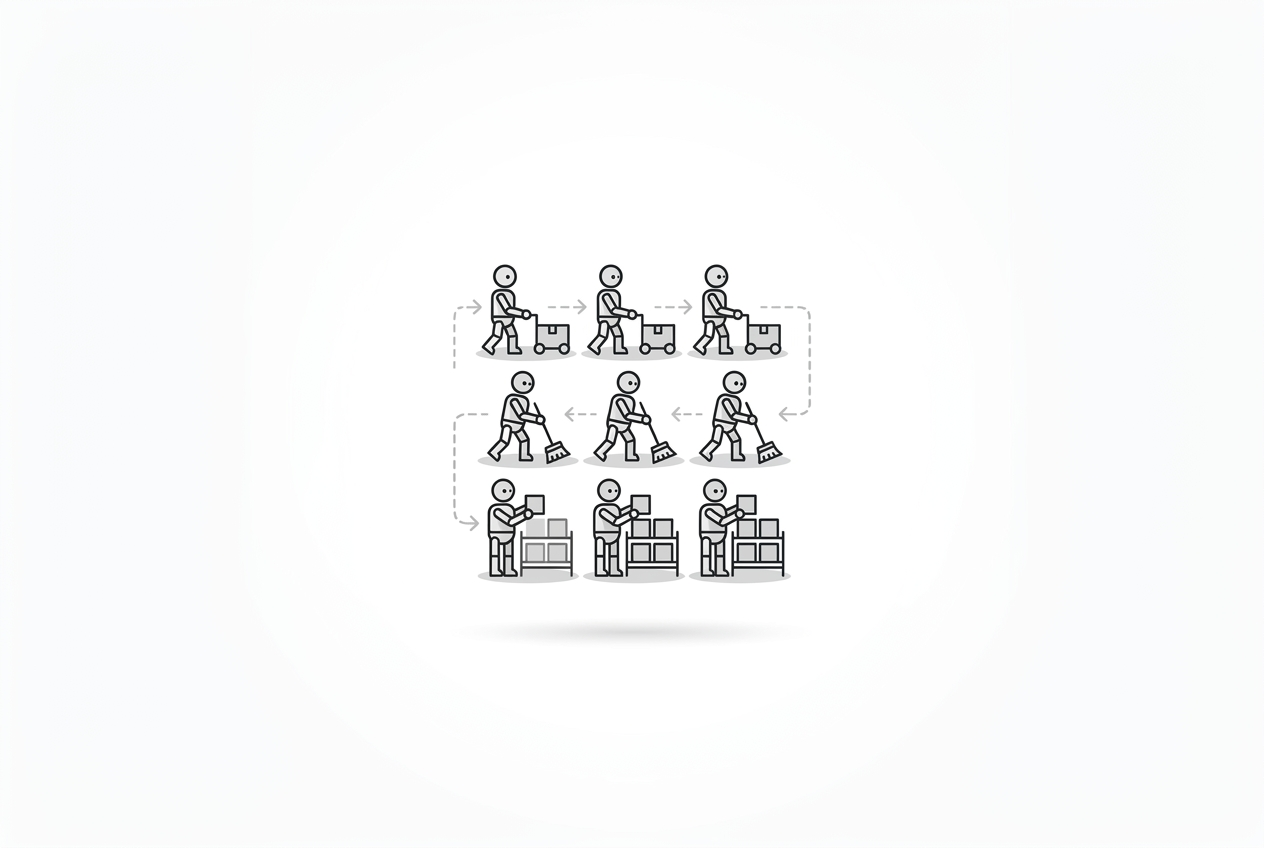
The center runs 100 robots and produces 29,000 hours of training data a year across nearly 700 scenarios, at a 99 percent pass rate on individual collection tasks. It is majority owned by a state-owned innovation group, with a robotics firm holding the rest.
And it is not one center. Per Interact Analysis, at least 90 such data collection and training centers were operating, planned, or under construction across China as of the end of April 2026 — 64 already running, clustered thickest in Zhejiang, Guangdong, and Jiangsu.
The general manager at Shijingshan, Zhu Kai, gave the framing that explains everything: "Like infrastructure construction back then, this is a new form of infrastructure, and much of it is being undertaken by state-owned capital."
Read that carefully. China is treating humanoid training data the way it treated highways and high-speed rail — as public works, built ahead of demand, financed by the state, on the theory that if you build the capacity the traffic will come.
Embodied intelligence now sits in China's government work reports for 2025 and 2026, and in the outline of the 15th Five-Year Plan as a key future industry. This is industrial policy, not a market clearing.
So here is the shape of what China has actually assembled: an automotive-grade body that can be manufactured at scale, and a state-funded pipeline generating physical-interaction data at scale. The supply side of a humanoid industry, built out with real capital and real steel.
What it has not assembled is the order book.
Go back to what IRON will actually do when mass production starts by year-end. It will be deployed at XPeng's own stores and campuses first — the company explicitly frames this as a way to refine algorithms through real-world use before a broader rollout in 2027.
That is a polite way of saying the customer is XPeng. The first buyer of the general-purpose humanoid is the company that makes it, deploying it into its own lobbies to do work that a receptionist and a hand truck already do.
And look again at what the state centers are training for: folding clothes, microwaving meal trays, scanning parcels, clearing tableware. These are the canonical low-stakes, high-repetition tasks — chosen precisely because they are tractable, not because anyone has placed an order for a clothes-folding fleet.
The tell runs through the whole edifice. Even China's most vertically integrated player — the one company, per its own claim, with a fully in-house stack from AI model to body to manufacturing line — can name only greeter and parcel-handler as launch roles.
If the firm that controls every layer of the stack can't articulate a paying job beyond reception, the gap between capacity and purpose is structural, not a XPeng problem.
The Business Times piece states the underlying question without flinching: how does China's vast production capacity secure orders on a corresponding scale? The honest answer is that it doesn't yet. The robots need to work like humans in factories, logistics parks, and eldercare facilities — and whether they can is unproven.
A research note from Agricultural Bank of China's fund arm names the condition precisely: "strong expectation, weak reality" — 强预期,弱现实. The long-term growth story is widely accepted, the note says, but the industry remains early-stage, and very few firms achieve scaled revenue or profit.
Its advice to investors is the advice for reading this entire moment: watch real orders, watch customer validation, watch mass-production cadence. Not factory tours, not walk-off ceremonies.
Because a walk-off ceremony is a supply-side event. It proves you can build the thing. It says nothing about whether anyone outside your own showroom needs it built.
XPeng did raise real money against this — over $900 million at a valuation above $6.3 billion, the largest single private round in China's embodied-AI industry to date. That funds the factory. It does not, by itself, create the demand the factory exists to serve.
Which leaves the genuinely open question, and it is the interesting one. China has industrialized the body and nationalized the data pipeline, both as state-backed infrastructure, on the explicit bet that supply built ahead of demand will summon the demand.
Highways did summon traffic. The 15th Five-Year Plan is wagering that robot schools and automotive-grade lines will do the same for embodied labor.
But a highway serves a task that already exists — people already needed to get from one city to another. The humanoid's task does not yet exist in any priced, contracted, at-scale form. The infrastructure is being built for work no one has yet proven the robots can do or will pay for.
97 percent of global shipments is a dominance of supply. It is not, yet, a dominance of solved work. The badge is on. The job is still being invented.