Article — "Nevada Green-Lights Thousands of Robotaxi Permits—But Tesla Gets Only 10 Cybercabs": Article — "Nevada Green-Lights Thousands of Robotaxi Permits—But Tesla Gets Only 10 Cybercabs": Tesla asked the Nevada Transportation Authority to run up to 5,000 robotaxis in Southern Nevada. The state handed back a permit for exactly 10.
Then, reportedly on the separate Clark County framework approval, the stock rose 5 percent.
That whiplash—between the number requested, the number granted, and the number that moved markets—is the entire story. The headline says 8,000 robotaxis are coming to Clark County. The permit filings say something much smaller, and the applicants themselves said something smaller still, under oath, at the hearing that produced the headline.
The headline says 8,000 robotaxis are coming. The applicants themselves said something smaller still, under oath, at the hearing that produced the headline.
Last week, Zoox was reportedly the only company charging fares in Las Vegas, on a 100-vehicle permit. This week the NTA unanimously approved a three-way framework—Tesla, Uber, Waymo—and Tesla's Nevada footprint expanded from a testing fleet to a 10-Cybercab commercial start. The framework grew. The cars barely moved.
Start with the arithmetic that every outlet ran and few interrogated. TechCrunch and Tech Weekly both led with "up to 8,000 robotaxis across the county over the next 12 months." Tesla's 5,000, Waymo's 1,000, Uber's 1,000, Zoox's 100.
Add those and you reportedly get 7,100, not 8,000, which some might read as a sign the ceiling numbers are loose. The Review-Journal's own headline count landed on 7,000. The number in the press release is not a forecast. It's not even consistent arithmetic.
Now read the testimony that produced those ceilings. "The 5,000 has always been a ceiling for us," Eric Early, Tesla's Cybercab chief engineer, told the NTA. "I don't think we'll be in a position by this time next year to deploy 5,000 vehicles, and it's not [because of] the technology. … I think we would be extremely happy and satisfied if we could get ourselves up to 2,500, maybe a bit higher than that in the next year."
So the man who runs the Cybercab program stood in a regulatory hearing and cut his own headline number in half—describing the ceiling as an aspiration he'd be "extremely happy" to hit at 50 percent.
That was August 20. On August 21, TSLA reportedly surged over 5 percent to $362.86 on the framework approval, per GuruFocus. The market may have rewarded a permit ceiling that the company's own chief engineer had, reportedly, disowned as a real target the day before.
This is the gap the piece is about. Not Tesla versus Waymo. The permit ceiling versus the cars on the road—and the fact that three different business models in one county each decouple those two numbers in a different way.
Take Tesla first, because its gap is the widest and the most instructive. The 5,000 permit is, reportedly, a marketing artifact, and the operative near-term number appears to be the separately approved 10.
And that 10 is not 10 free-roaming robotaxis. Per the Review-Journal's reading of the permit, the cars must be clearly marked, can't exceed 45 mph, can only operate inside a designated geofence, and can't pick up or drop off within a quarter mile of Harry Reid International Airport without the Clark County aviation department's sign-off.
Per the Review-Journal, the NTA gave no reason for approving only 10 vehicles, according to its spokesperson, though that permit context does not itself describe a cut from 5,000. It didn't need to. The number that predicts Tesla's actual near-term deployment is 10, and even that comes hobbled with a speed cap and a no-go zone around the most valuable pickup real estate in the city.
Now watch Waymo and Uber, whose gaps run in the opposite direction. Waymo holds a paper permit for 1,000 vehicles. Uber holds a permit for 1,000 it does not build at all—it plans to run them through partnerships with Motional and Zoox.
Uber's ceiling is the strangest object in the framework: an authorization to deploy a thousand robotaxis that belong to other companies, on a network Uber has explicitly argued should also carry human drivers. Uber lobbied the NTA for a hybrid model, a stance it frames as gradual peak-demand integration and which doubles, as TechCrunch put it, as a hedge against its own autonomous ambitions falling short. The 1,000 is a placeholder for cars Uber neither owns nor has committed to putting on the road.
Which leaves Zoox—the only one of the four whose meter is actually running.
Zoox's permit is the smallest, capped at 100. It is also the only permit backed by paid rides. The Amazon subsidiary started charging Las Vegas fares last week and is running routes straight to the Sphere, pitching riders "no driving, no parking, no worries."
So invert the whole leaderboard. Rank the four by ceiling and Tesla wins 5,000 to 100. Rank them by cars charging fares today and Zoox is the only company on the board.
That inversion is the argument. The permit ceiling measures two things—regulatory appetite and PR ambition—and neither of them is deployment. The NTA's approval column is a record of what the state is willing to tolerate, not what the companies will build. Tesla's 5,000 measures how big the agency's stated ceiling can go; it says nothing about how many gold two-seaters will actually carry a passenger next summer.
If you want the honest metric, it isn't in the approval column. It's in the concrete.
Tesla is spending $3.1 million to retrofit a 37,000-square-foot industrial building in the southwest valley with six car lifts and eight superchargers. In Austin, a parallel filing reportedly shows a service-center lot getting 48 Supercharger posts and 12 cabinets—enough, reportedly, to support dozens of robotaxis.
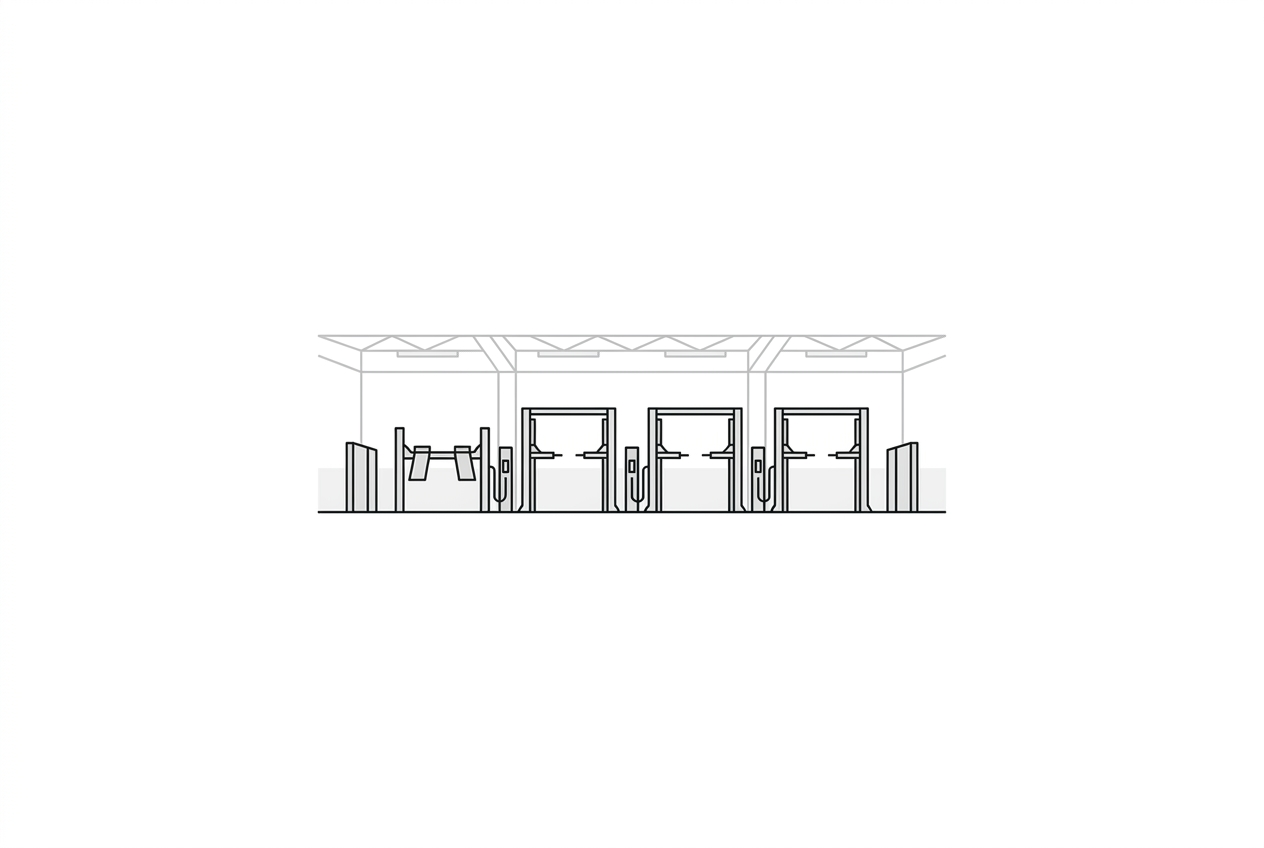
Six car lifts. Forty-eight posts. Those are the numbers that scale a fleet, and they scale it into the dozens and low hundreds, not the thousands. You can approve 5,000 permits with a unanimous voice vote in an afternoon. You cannot service 5,000 vehicles out of a building with six lifts. The retrofitted real estate is a truer forecast than the permit, because physical capacity can't be voted into existence.
This is the recurring lesson when machine learning enters the physical world. The regulatory number and the software demo are cheap. The lifts, the chargers, the square footage, the meter that actually charges a fare—those are expensive, slow, and honest.
There's a safety layer under all of this that the ceilings also ignore. Tesla's permit requires human supervision even in driverless operation, and mandates reporting of any crash, security incident, system failure, or data interruption within five working days. Nevada's real regulatory teeth are in that reporting mandate, not the ceiling.
And the reporting matters because the meter that's running has a record. Zoox robotaxis have reportedly been involved in at least 52 reportable crashes in Nevada, per a post attributing the figure to federal filings—the same company whose CEO reportedly backed tougher rules after a Zoox vehicle drove into a Las Vegas fire scene and triggered a recall. The only fleet actually charging fares is also the only one generating a real incident history. That is what deployment looks like when it stops being a permit number.
So here is the reframe. The 8,000-robotaxi Nevada headline is a financial fiction—an unstable sum of four ceilings, at least one of which the applicant disavowed under oath, and one of which covers cars the applicant doesn't build.
The number that predicts real deployment is the one nobody puts in a press release: Tesla's authorized 10, geofenced and speed-capped, serviced out of a building with six lifts.
The market bought the fantasy anyway, adding 5 percent to a $1.4 trillion company on a ceiling its chief engineer had already halved.
Which leaves one benchmark the paper ceilings can't fake. Zoox is the only operator with a meter running, and its early Las Vegas fares reportedly ran 57 percent above Lyft across six destinations. The open question that actually matters is whether Zoox ever publishes a real cost-per-mile—because the moment it does, there's a number on the table that a 5,000-vehicle permit can't compete with, and can't imitate.
Until then, count the lifts, not the permits.