Article — "Humanoids Chase Real Jobs: BMW Runs Figure 03, Persona Picks Welding, Sanctuary Shows Failure Recovery": Here is the contradiction most people miss: the humanoid deployment that pencils out is not the one with the biggest number attached to it.
BMW has the biggest number. Its Figure 02 robot supported production of more than 30,000 BMW X3 vehicles over ten months at Plant Spartanburg, inserting sheet-metal parts into the body shop for welding—a task the company itself calls high-speed, high-accuracy, and physically demanding.
That is a real milestone. Thirty thousand cars is not a YouTube demo.
And yet, after a run that concrete, BMW's own press release cannot name a single reliability figure. No uptime. No intervention rate. No throughput. No cost-per-task.
That silence is the story.
Last week I wrote about the pilot-versus-partnership gap and left one thread open: would any humanoid maker publish a falling intervention rate or a rising fleet-per-operator ratio? This week we have two fresh named deployments—BMW moving to Figure 03, Persona betting on welding—and a recovery-rate claim from Sanctuary. None of them closes that thread. One of them, though, doesn't need to.
Start with BMW's next step. Figure 03 is now starting a sequencing use case in logistics at Spartanburg: components arrive in larger containers, unsorted, and the robot picks them and sorts them into a sequencing trolley, which then moves to a collection point for onward transport.
BMW is honest about what this is—a use case that "occurs frequently" and "offers potential for further development and scalability." Potential. Not yet demonstrated at scale.
Brett Adcock frames the eleven-month Figure 02 run as proof that "humanoids are no longer lab experiments." Fine. But the leap from "no longer a lab experiment" to "a valuable asset in establishing a flexible, reliable manufacturing workforce" is exactly the leap the data would have to make, and the data isn't there.
Here is the thing about picking unsorted parts from a bin. It is a task where a human is cheap, fast, and utterly reliable. To justify a humanoid, you have to beat that human on cost—or at least approach it—and nobody at BMW or Figure has published a number that lets you check.
That's why the press release reads the way it does. It lists features—soft components for safety, wireless charging for availability, tactile sensors and palm cameras for dexterity—because features are what you talk about when you don't yet have a fleet-reliability curve to show.
Now turn to Persona, which reasoned in the opposite direction and arrived somewhere far more defensible.
Persona was founded by Nic Radford, who led NASA JSC's Valkyrie program, and Jerry Pratt, who ran IHMC's DARPA Robotics Challenge team and spent a couple of years as Figure's CTO. When IEEE Spectrum first talked to them in 2024, they admitted they were "all over the place"—warehousing, automotive, even the home.
Then they made a decision that reads as heresy in this industry: they rejected unskilled-labor economics entirely.
"We started forming this thesis around skilled trades and tool usage," Radford says. Radford calls it "last-mover advantage"—they watched everyone chase the same warehouse picking demo and chose a different door.
The door is welding. Specifically, long linear welds in shipbuilding.
And welding is skilled in a way that happens to be extraordinarily robot-friendly. Because you can only weld as fast as metal melts, the top speed for the task is reportedly about one centimeter per second. A high-quality weld is millimeter-scale repeated motion sustained over long periods—precisely where humans get tired and bored and robots do not.
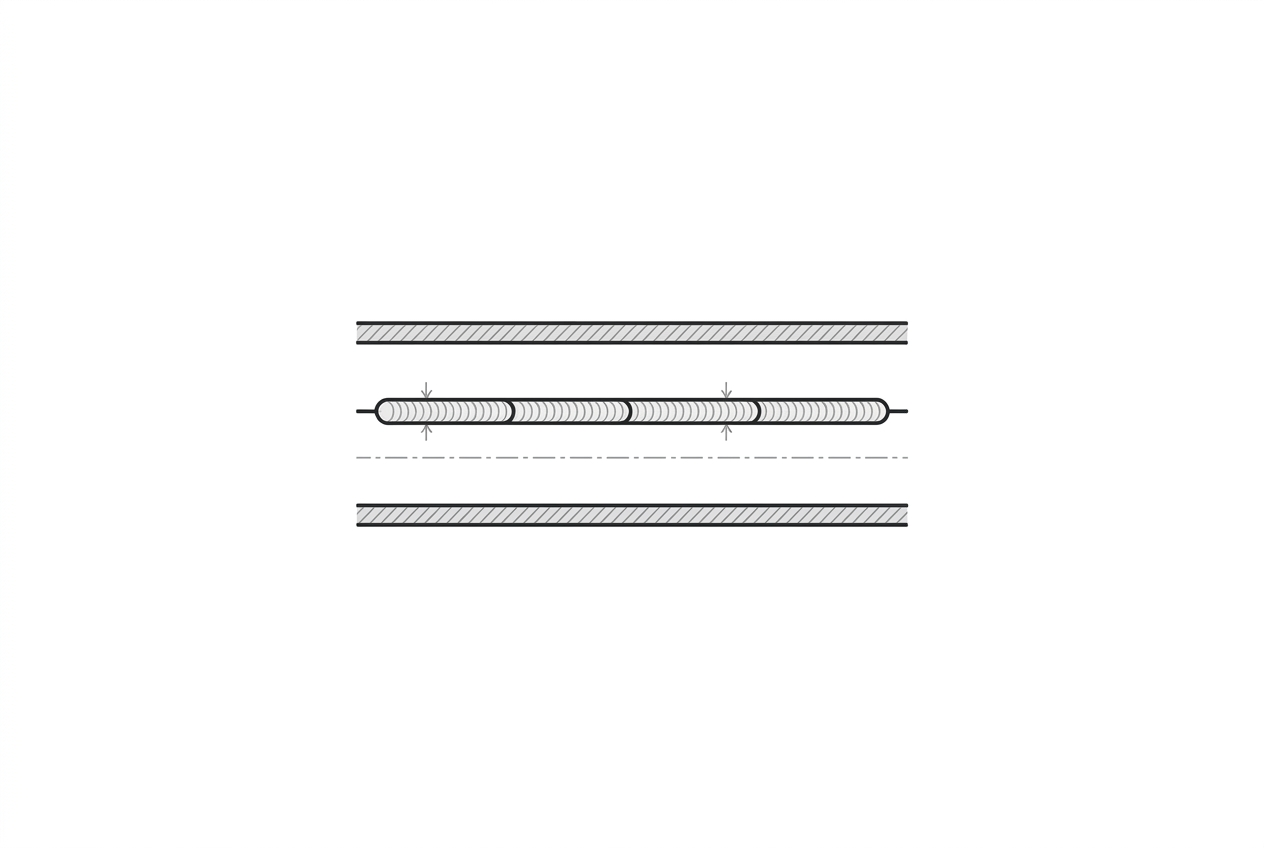
Then the volume. Shipbuilding needs "hundreds of kilometers of linear welds per ship," as Radford puts it. Persona's partners—HD Hyundai, the world's largest shipbuilder, and POSCO, the third-largest steel producer—are the kind of customers who can absorb hundreds of robots per location.
Here is the move that separates Persona from everyone else. The partners are running a significant backlog and are labor-constrained. The bottleneck is not cost; it's the existence of certified welders.
So Persona is not selling cost reduction. It's selling top-line growth—more ships built, not cheaper ones.
Radford says the quiet part out loud: "Even if our robot was more expensive than a human, that would still be valuable to these companies, because it could unlock additional revenue."
Everyone else has to prove their robot is cheaper than a person. Persona only has to prove its robot exists and works.
Read that again, because it inverts the entire humanoid pitch. Everyone else has to prove their robot is cheaper than a person. Persona only has to prove its robot exists and works, because the person it would replace cannot be hired at any price.
That is the rare job where the economics survive contact with reality. Labor-constrained, high-value, hazardous, physically taxing, and mechanically slow enough that a robot's weaknesses stop mattering. Pratt expects on-par-with-human performance on these uncomplicated welds "soon."
The legs even earn their keep. Open-air shipyards run a couple hundred meters long with spars you step over constantly, work overhead, on the ground, and through portholes—Persona considered four legs but chose two as least disruptive to existing shipyard rhythms.
And the usual bipedal safety objection is softened because a shipyard is already staffed by people trained to work around dangerous industrial equipment. The task selection isn't just clever; it's coherent all the way down.
Which brings us to the measurement problem, and to Sanctuary.
Sanctuary's argument is genuinely smart. It reframes the real barrier not as repeatability but as recovery: real-world environments aren't perfectly repeatable, parts shift, conditions change cycle to cycle, and the winning system is the one that recovers without a human stepping in.
Back in June, Sanctuary reportedly showed a plug-insertion task at 99.5%-plus success with a 2.54-second cycle time. This week's follow-up is titled "Robots Doing Stuff #63 | Failure Recovery Montage," with the tagline "our policies are as tenacious as we are."
Notice what that is. A montage.
A failure-recovery montage is, by definition, a curated selection of moments where the robot recovered. It is the single most flattering possible slice of the data, edited for effect. It tells you the robot can recover; it tells you nothing about how often it needs to.
99.5% on one task at one cycle time is a benchmark, not a fleet. It's the number you'd want to see plotted over months across many units in many bays, next to how many humans it takes to keep them running.
This is the same trap the DYNA-2 coverage falls into elsewhere—90% task success, resilience to disturbances, recovery without intervention—all real-sounding, all packaged as capability claims rather than sustained fleet data. Capability is table stakes now. Everyone can make a robot do the thing once, or in a highlight reel.
So here is the scorecard for the humanoid job hunt as it actually stands.
Job selection is now the whole ballgame. Persona won the job-selection round before writing much production code, because it chose a task where the robot doesn't have to beat a human—it only has to exist, in a place where the human doesn't.
BMW's sequencing pilot picks a job where the robot must beat a cheap, reliable human, and publishes no number that shows it can. Sanctuary picks the right problem—recovery—and then answers it with a montage instead of a curve.
The only companies worth believing from here are the ones that will publish the two metrics nobody wants to show: a falling intervention rate over time, or a rising fleet-per-operator ratio.
Until then, thirty thousand cars is a headline, not evidence. And a montage is marketing.
The thread from last week stays open.